Engineering clarity. Advancing safety.
A Boston deep-tech company teaching cars to see in a slice of the spectrum nobody else could tame - the terahertz band, somewhere between microwave and infrared, where rain, fog and snow stop mattering.
On a foggy stretch of test track outside Boston, a car is looking at a world its cameras cannot make out. The lidar is hedging. The radar sees blobs. And a small, fan-less box bolted near the bumper is calmly drawing the scene in high resolution - the pedestrian, the curb, the stalled truck three hundred meters out - as if the weather had been told to mind its own business.
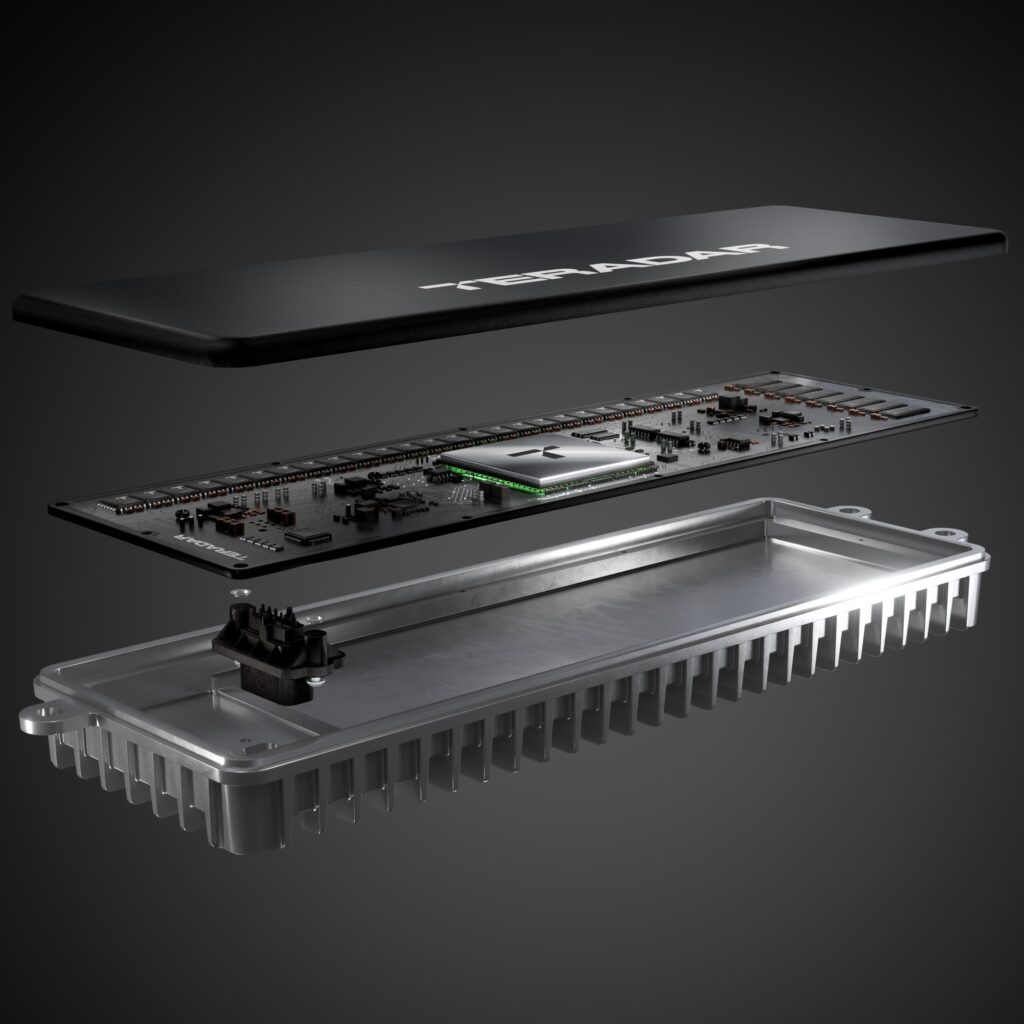
That box is Teradar's. It does not spin, it does not need a clear sky, and it sees using a band of the electromagnetic spectrum that, until recently, was treated as a no-go zone for cheap electronics. Today the company is roughly seventy people, $150 million better funded than it was a year ago, and quietly running its hardware past eight of the world's automakers and suppliers.
The pitch sounds like the kind of thing every sensor startup says. The difference is the frequency. Teradar is not building a better radar or a cheaper lidar. It is building in a place on the dial almost nobody had a working product in.
For two decades the autonomy industry has been stuck choosing between sensors that each fail in their own polite way. Cameras are cheap and detailed and go blind in a downpour. Radar punches through weather but renders the world in coarse smudges. Lidar paints gorgeous point clouds, then loses its nerve in fog and costs a small fortune while it does.
Everyone's answer was to bolt all three onto a car and let software argue the disagreements. It works, mostly. It is also expensive, power-hungry, and built on the quiet hope that at least one sensor is telling the truth at any given moment.
The gap was obvious enough that plenty of people had named it. What was missing was a part of the spectrum that could deliver radar's all-weather nerve and lidar's detail at once. That part exists. It just happened to be the hardest neighborhood in physics to build a business in.
The terahertz band sits between microwaves and infrared - longer waves than light, shorter than radio. Engineers sometimes call it the "terahertz gap," partly out of respect and partly out of frustration, because for years the electronics to use it were either too slow, too hot, or too expensive to ship. Teradar's founders looked at the gap and saw a Goldilocks zone instead: short enough wavelengths for fine resolution, long enough to shrug off airborne droplets.
Matt Carey, the CEO, came at the problem after a friend died in a car crash - the kind of origin story that would feel manufactured if it were not so plainly the reason the company is pointed at safety. Gregory Charvat, the CTO, had already built radar that could see through walls during a PhD at MIT, which is either a useful skill or a concerning one depending on whom you ask. Nicholas Saiz, Stanford-trained, took on the part everyone said was impossible: putting the entire sensor onto a silicon chip with no moving parts.
Co-founder & CEO. Robotics and electro-mechanical background; started Teradar after losing a friend to a crash.
Co-founder & CTO. MIT PhD who built through-wall radar; former CTO of sensing firm Humatics.
Co-founder & Chief Chip Architect. Stanford-trained; shrank the sensor onto silicon to crush cost.
Fig. 1 - Three founders, one frequency. Between them they have built radar that sees through drywall and chips that fit a sensor in your palm. The drywall part is no longer on the roadmap.
Founded in the Boston area to build an entirely new sensor category around terahertz.
Heads-down in stealth - turning a hard physics problem into a manufacturable silicon architecture.
Out of stealth with a $150M Series B and the world's first terahertz vision sensor for automotive safety.
Boston Globe reports major carmakers lined up for Teradar's sensors.
Summit revealed - the first terahertz-band vision sensor for cars, at 0.13° resolution.
The goal - winning a production vehicle program, which means being ready a year early.
Fig. 2 - The startup arc, compressed. Most of the interesting work happened in the years with nothing to announce.
Teradar's core is the Modular Terahertz Engine, or MTE - a set of proprietary chips that transmit, receive and process terahertz waves, arranged in an architecture you can tune. Need a short-range parking aid for an entry trim? Dial it down. Need a long-range sensor for a highway-pilot system on a flagship? Dial it up. Same engine, different settings, which is the sort of modularity that makes automakers stop fidgeting in meetings.
The first product built on it is called Summit. Teradar reports a native angular resolution as fine as 0.13 degrees - roughly twenty times finer than leading automotive imaging radar - while holding image quality through rain, fog and snow. No spinning mirror, no moving parts, no clear-sky clause in the contract.
Fig. 3 - The spec sheet, minus the marketing. Figures are Teradar's own; the weather, for once, is not invited to comment.
Relative angular detail · higher bar = sharper picture · source: Teradar (approx.)
Illustrative comparison based on Teradar's stated ~20x advantage over leading automotive imaging radar. Bars are directional, not laboratory-precise.
Conviction is cheap in deep tech; a term sheet is not. In November 2025 Teradar closed a $150 million Series B led by VXI Capital, with IBEX Investors, Capricorn Investment Group, MIT's The Engine Ventures, and Lockheed Martin Ventures alongside. The last name on that list is a tell - Lockheed does not write checks for things it expects to stay on a test bench.
Series B led by VXI Capital, with IBEX, Capricorn, The Engine (MIT) and Lockheed Martin Ventures.
Five leading U.S. and European automakers plus three Tier-1 suppliers, validating the sensor.
Target for a production vehicle program - which means the hardware has to be ready by 2027.
Fatal crashes a year Teradar estimates better terahertz perception could help prevent worldwide.
Teradar says it is in active collaboration with eight partners and expects to win a production program by 2028 - a date that, in automotive time, is roughly tomorrow afternoon. The skeptic's move here is to wait for a signed nameplate, and that is the right move. The believer's move is to notice that automakers do not run multi-year validation on sensors they consider toys.
Strip away the spectrum talk and Teradar's stated mission is blunt: harness terahertz technology to save lives, and set new benchmarks in automotive safety along the way. The vision is even shorter - unlock the power of terahertz for the benefit of humanity. Lofty, sure. But it traces straight back to the crash that started the company, which keeps it from reading as a poster in a break room.
There is an irony worth sitting with. The most advanced perception system on the road may end up being the one that simply refuses to be fooled by ordinary weather - the thing human drivers fail at every single rainy night. Progress, occasionally, looks like a machine doing the boring part reliably.
Return to that test track. The fog has not lifted; it rarely does on the days that matter. The cameras still cannot see, the lidar is still hedging, and the radar is still drawing blobs. The difference is the small box near the bumper, which has stopped being a science project and started being a part with a price, a spec sheet, and a delivery date.
If Teradar wins its production program, the foggy track stops being a demo and becomes a Tuesday commute - one where the car sees the stalled truck at three hundred meters whether or not the sky cooperates. That is the whole bet: not a flashier sensor, but a stubborn one. The kind that turns "the weather was bad" from an explanation into an excuse nobody accepts anymore.
The terahertz gap was supposed to stay a gap. Teradar is the company arguing, with silicon and a deadline, that it was just an opening nobody had walked through yet.
Sources: Teradar, TechCrunch, The Robot Report, FreightWaves, Boston Globe, PR Newswire, New Atlas. Figures are company-stated and approximate where noted.