A job offer is usually the point at which an unpaid intern says thank you. Teneshia Jackson Warner had another proposal. The communications firm could hire her company instead. She had left a secure technology career, moved from Minneapolis to New York, and worked without pay to learn a different business. When a salary finally appeared within reach, she asked for a client.
It is a revealing detail in a career often described through its awards. Long before EGAMI Group helped make an advertisement that reached the Cannes Lions stage, Warner was reconsidering the job description she had accepted for herself. Her employer had seen a potential employee. She was beginning to see a business owner. There is a considerable negotiation tucked into that change of nouns.
Today she runs EGAMI, writes books about purpose and ambition, and encourages other people to examine what they want their working lives to contain. Her own story gives that advice some friction. Starting again required learning, unpaid work, repeated requests, and the willingness to make a proposition before anyone had agreed she was ready.
A résumé, sent thirty times
Warner’s hometown is Dothan, Alabama. She attended Alabama Agricultural and Mechanical University. Before communications, she worked as a project manager at IBM Global Services while pursuing a master's degree. The respectable career was already there. The question was whether she wanted to keep it.
Her route toward another profession included a determined pursuit of Russell Simmons. After an encounter at a conference, she offered to volunteer in return for a chance to learn. He gave her a fax number. She sent her résumé every day for thirty days without a response, then pitched herself again at another conference where he was speaking. Eventually, the persistence earned her an opening.
The fax machine deserves a small supporting credit. It belonged to an era when following up required paper, a telephone connection, and the conviction that yesterday's silence might have been a technical problem. Warner's account contains no elegant shortcut. She kept asking, then accepted the opportunity to learn through work.
At RUSH Communications, early projects included voter participation and a reading initiative called Hip Hop Reader. These assignments brought corporate sponsors into contact with urban audiences while doing something useful for a community. Warner began developing a commercial argument around that overlap: a brand could pursue a business objective and make a meaningful contribution at the same time.
“Be courageous enough to lead with purpose and trust that the money will follow.”
Teneshia Jackson Warner, recalling career advice she received
The business behind the backward name
EGAMI is “image” spelled backward. The name makes a neat introduction to a founder who asks clients to reconsider the picture in front of them. Her early work developed from urban marketing into a broader multicultural practice, working with audiences whose experiences could disappear inside a general audience brief.
Her first book, Profit With Purpose, put that approach into print. Its subject was practical: how marketers could develop campaigns that connected business objectives with meaningful engagement among multicultural audiences. By her 2012 interview about the book, she was describing a strategic partnership with MSL Group and work for brands including Bounty, Verizon Wireless, Hennessy, and KFC.
That client work matters because purpose is a very comfortable word until someone asks what it means on Monday morning. Warner's answer involved campaigns, partnerships, and the particular people a company hoped to reach. Good intentions had to become an assignment a team could carry out. There were sponsors to bring together and audiences to understand.
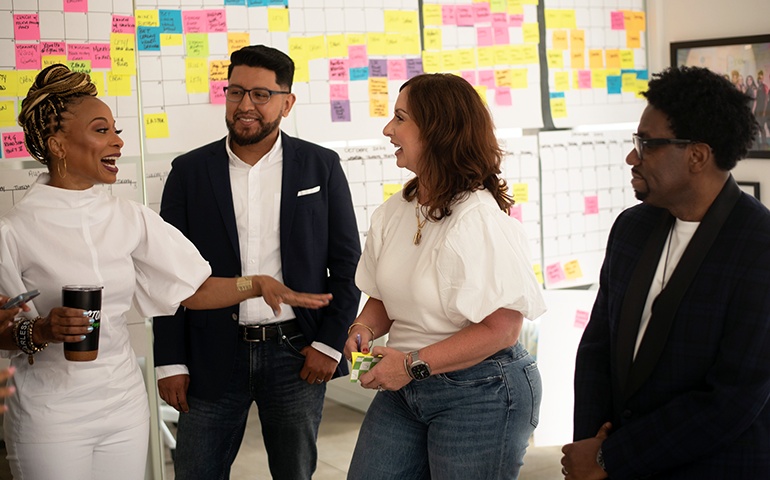
Her husband, Mike Warner, became her business partner as well. He is EGAMI's chief relationship officer, bringing experience across entertainment, marketing, fashion, and business development. Their roles place the founder's public story inside a shared enterprise. The agency's leadership now also spans finance, client experience, creative operations, and human resources. A decision made by one person eventually creates work that many people must deliver.
Two minutes, several generations
In 2016, P&G asked Warner and EGAMI to help make its My Black Is Beautiful platform relevant to African American women. The team encouraged a broader understanding of beauty, one that included the community and culture surrounding a woman's life. Listening to those realities led toward a subject far removed from a conventional beauty campaign.
The resulting film, “The Talk,” depicts Black parents preparing their children for racial bias. Across different decades and situations, parents explain what their children may encounter and how to respond. Released in July 2017, the two-minute film made a private family responsibility visible to a wider audience. Its repeated conversations carried the weight of experiences passed between generations.
The work was a collaboration involving P&G, EGAMI, and BBDO New York, with production by The Corner Shop. Keeping those names together is useful. A founder's biography can accidentally turn a collaborative piece of work into a solo performance. Here, the achievement depended on cultural insight, creative execution, and a client willing to put its name behind the result.
The film drew both support and criticism. P&G continued backing it, and its subject entered an episode of black-ish. In 2018, “The Talk” won a Cannes Lions Film Grand Prix and the Emmy for Outstanding Commercial. EGAMI became the first multicultural and Black woman-owned agency to win the Cannes Grand Prix film honor.
“The Talk” premieres in July.
Cannes Lions Film Grand Prix.
Emmy for Outstanding Commercial.
For Warner, the project also supported a larger argument about who gets invited to shape an assignment. Multicultural agencies could contribute at the beginning, when the question was still being framed. Their knowledge could inform work intended for a broad audience. The success of a culturally specific film gave that proposition a public demonstration.
“Multicultural agencies should be the new general market agencies.”
Teneshia Jackson Warner
A dream with work attached
Alongside the agency, Warner built a place for people still trying to decide what to build. She founded the Dream Project Symposium in 2013, bringing entrepreneurs, creatives, and people considering their next career move into a setting designed around ideas and execution. An ambition that feels solitary at a desk can look different in a room full of people working through their own.
The 2016 event in Atlanta advertised speakers including Magic Johnson, Rent the Runway cofounder Jennifer Fleiss, and stylist Ty Hunter. That range was part of its appeal. Participants could encounter people who had made careers in different fields, compare paths, and hear how an idea had survived contact with actual business decisions.
In 2019, Warner published The Big Stretch: 90 Days to Expand Your Dreams, Crush Your Goals, and Create Your Own Success. The title has the energy of someone moving the furniture to make room for a new plan. Inside, the structure is orderly: Dream, Design, Dare, Do. Readers assess their ambitions, resources, and willingness to take risks before working through weekly exercises.
The four parts of Warner's 2019 book. A sequence, not a race.
The book's approach leaves room for different kinds of dreamers rather than assuming every reader wants the same company or career. In an excerpt, Warner asks people to examine what brings them joy, what makes them curious, and which skills come naturally. She then brings the exercise toward a mission statement. The pleasant daydream eventually acquires homework.
Her commitment to opening the industry extends to students. As an HBCU graduate, she has supported the ANA Educational Foundation's efforts to connect historically Black colleges and universities with advertising and marketing careers. She wants more people of color to have opportunities to contribute their ideas and shape culture through the industry. It is a practical extension of the opening she once pursued herself.
Mother knows the presenter
At the Matrix Awards on May 20, 2025, Warner joined a class that included Kristen Welker, Dustee Jenkins, and Nkechi Okoro Carroll. The ceremony at Manhattan's Ziegfeld Ballroom recognized women across communications and the arts. Warner's presenter was her mother, Carolyn Hearns, a teacher with more than thirty years of experience in education.
Among the evening's introductions, that pairing offered a particularly personal way to recognize a professional life. The agency founder who spends time encouraging other people's ambitions received her award from someone whose own career centers on helping students learn. The relationship, and the choice of presenter, supply the connection.
Still looking past the label
Warner's latest agency work returns to a familiar concern: how much of a person disappears when a marketer settles for a category. On April 1, 2026, EGAMI announced its See Me More research and an AI platform called Multidimensional Mindset, or MDM. The platform is intended to help clients develop audience insights, test creative ideas, and refine campaigns.
In EGAMI's research, 89 percent of respondents said marketing that recognized multiple aspects of their identity could increase their trust in a brand. That is a reported survey finding, rather than a promised result for any campaign. The agency's broader proposition is that interests, faith, personality, and other dimensions deserve attention alongside demographic categories.
For Warner, the work continues an argument she has developed through client assignments, books, and speaking: pay closer attention to the person before deciding what that person might want. Her own career began with a similar reconsideration. An IBM project manager could learn communications. An intern could propose a company. A founder could keep changing the question.