Before Holly Whitaker built a recovery company, she encountered a peculiar access problem. She worked in healthcare, yet the help she wanted for her own drinking did not fit her budget, her working life or her sense of herself. Inpatient rehab was financially and practically out of reach. Calling herself an alcoholic did not help her heal. An industry could offer treatment and still leave someone standing outside its door.
Whitaker began getting sober in 2012. In 2014, she created the venture that became Tempest, initially called Hip Sobriety. Its proposition was disarmingly straightforward: you could want alcohol out of your life without first settling an argument about your identity. The decision to seek help could come before the confession.
- The invitation: recovery without a compulsory label.
- The product: online lessons, peer support and coaching.
- The turn: acquired by Monument in May 2022.
- The test: protecting the privacy of people seeking help.
The first obstacle was the invitation
Tempest occupied an awkward space between wellness and addiction treatment. Its customers included people considering sobriety, people already sober and people whose drinking was causing trouble. Women and historically underrepresented groups were central to its design; participation was open across genders.
That positioning mattered. A person might be ready to change a habit while unwilling to accept the social meaning attached to a diagnosis. Tempest made room for that hesitation. Its no-shame approach offered agency, education and company. Sobriety was allowed to be a choice someone made, rather than a verdict somebody delivered.

A school for the hours outside school
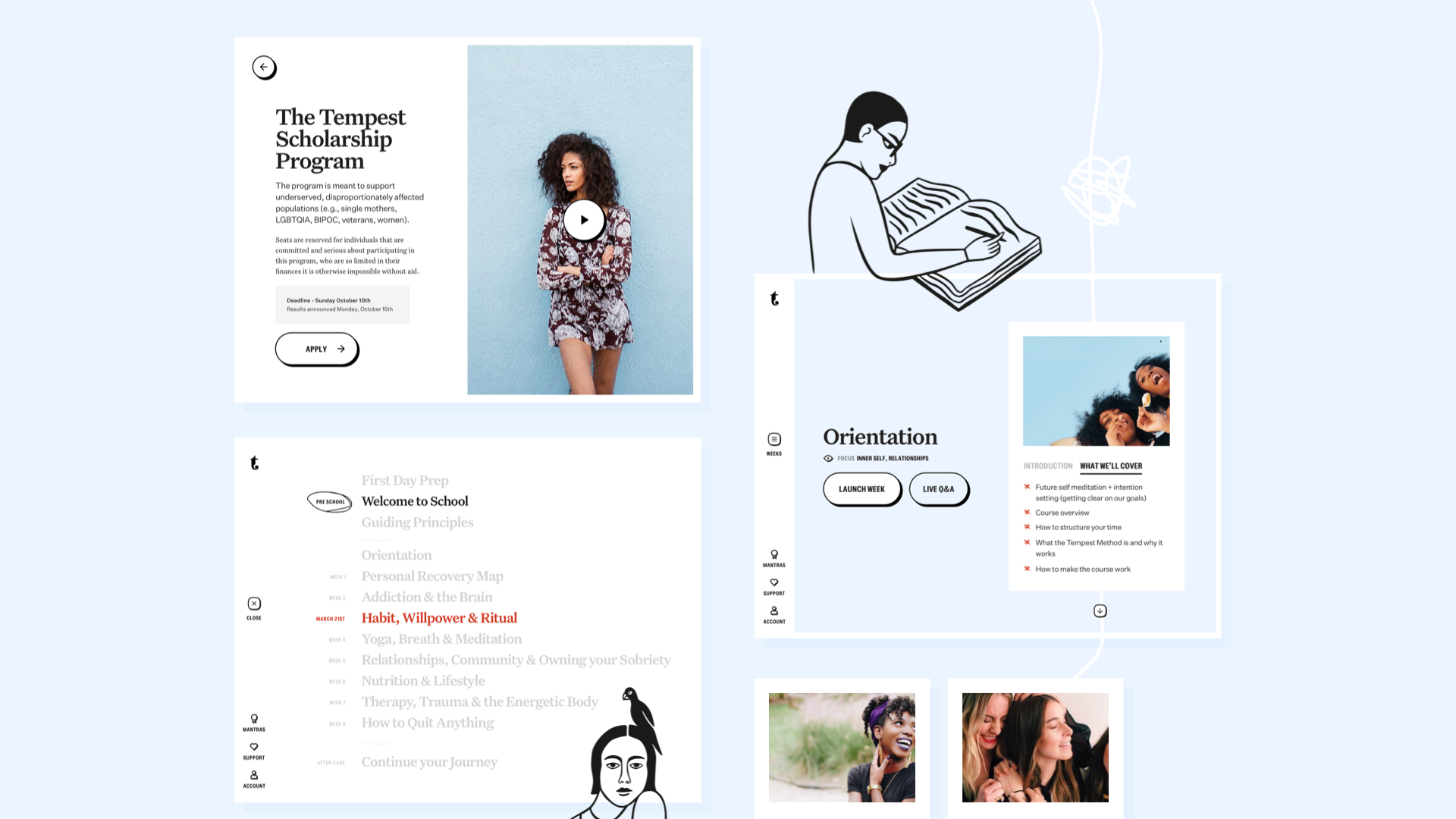
The flagship was an eight-week virtual school. Participants received recovery lessons, guided practices and opportunities for live support. Continued community access extended the relationship beyond the course. The school format made an intimidating subject into something a person could learn about, return to and practise.
The interface carried part of that burden. Design lead Ben Powell describes keeping tasks simple and content in small pieces to reduce overwhelm. This was a practical response to vulnerability: a complicated dashboard is an especially poor companion to a difficult evening. The product needed to make the next action easy to understand.
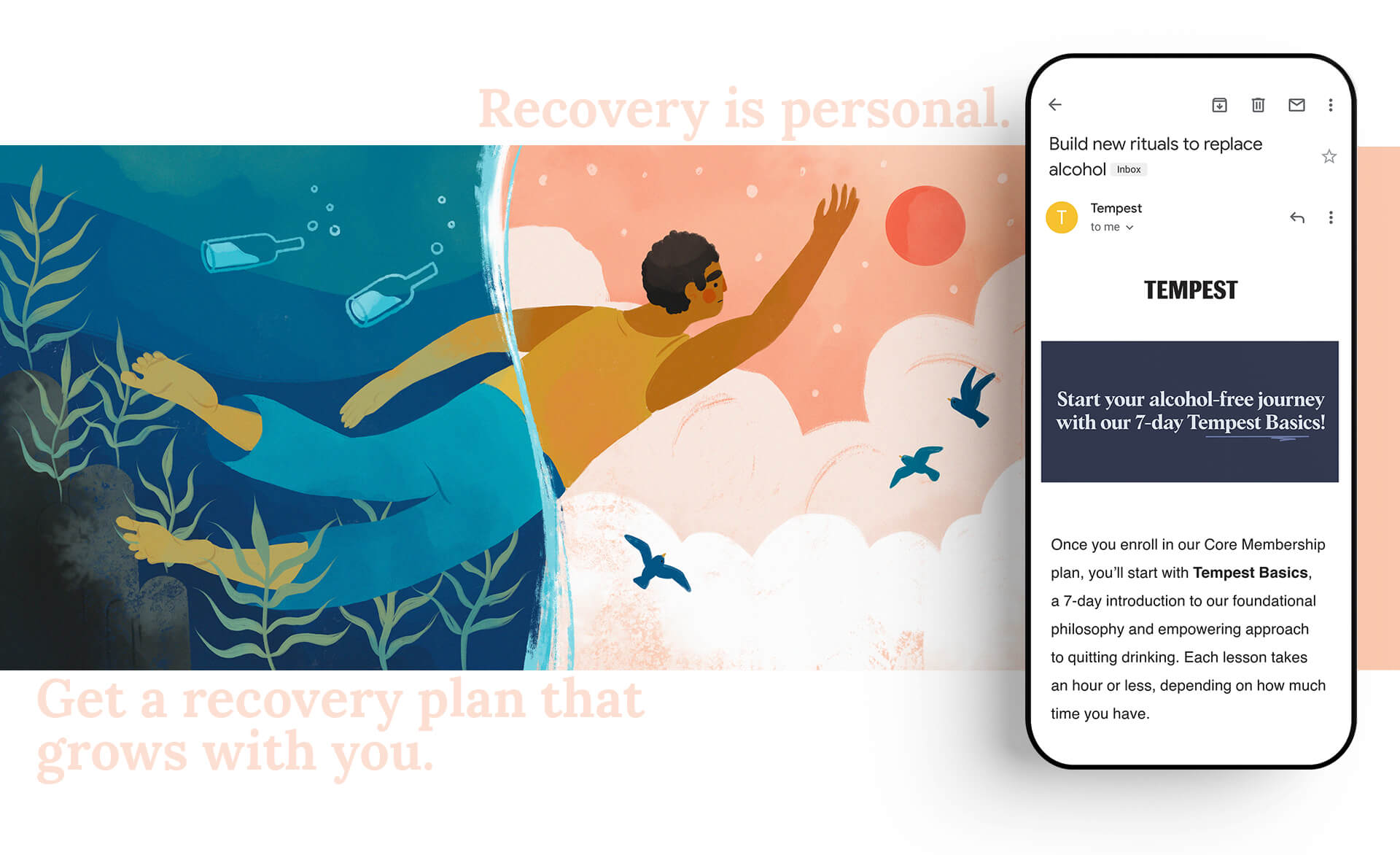
By 2020, Tempest had introduced Community, Daily and Complete membership plans. These added a social network, virtual calls and events, educational material and opportunities for individual coaching. The shift acknowledged that finishing a course and continuing recovery are different jobs.
The price of belonging
Tempest was a business, and access had a price. Its original eight-week school cost $647, according to historical reporting. By July 2021, the offering included a $300 four-week intensive and a $59 monthly core membership. These were different packages at different moments, not evidence of a tidy price cut.
Eight weeks · reported by 2020
Four weeks · July 2021
Per month · July 2021
Historical figures, not current enrollment prices.
The recurring model sold continuity: somewhere to return when the novelty of quitting wore off. Free mutual-support options such as Alcoholics Anonymous remained alternatives. Tempest’s paid education and coaching needed to offer a fit those options did not provide for a particular customer. A lower bill than residential treatment did not automatically mean an affordable bill.
Encouraging evidence, with an asterisk
A published evaluation followed 541 school participants. Respondents reported improvements in drinking, mental health and quality of life. But only 72 completed every assessment, and the study lacked a control group. Tempest personnel were among the authors. The findings were promising; they did not establish that the course caused the improvements.
13.3% completed every assessment. Attrition limits interpretation.
Product fit also has clinical limits. Educational support cannot provide medically supervised withdrawal care. NIAAA warns that abruptly stopping after prolonged heavy drinking can cause dangerous withdrawal. The right level of care depends on an assessment, not the attractiveness of a website.
The school meets the clinic
In 2019, Tempest raised a reported $10 million Series A led by Maveron. Venture backing gave the consumer recovery proposition institutional attention. In May 2022, Monument acquired it for an undisclosed sum.
The announcement described integrating Tempest’s library and community programming into Monument’s clinician-led plans. Monument already offered specialized therapy, medication-assisted treatment and therapist-moderated groups. Education and belonging could sit alongside medical care. That combination was the stated rationale, rather than proof that either company had solved recovery.
“I believe in Monument’s model”
Holly Whitaker · May 2022 acquisition announcement
The combined audience was described as exceeding 300,000 across channels. That was an audience figure, not a count of paying patients. The distinction is essential when a compelling consumer brand begins to sound like a large healthcare system.
A private struggle meets an advertising pixel
The uncomfortable sequel concerned privacy. In 2023, Monument disclosed data sharing involving users of both platforms. Its review traced Tempest’s sharing to November 2017. Monument said it fully disconnected its websites from advertising trackers by the end of February 2023.
The FTC subsequently alleged that Monument had disclosed sensitive health information to advertising platforms despite confidentiality promises. A court order entered in June 2024 restricted such disclosures and required privacy safeguards. It covered Tempest too. The $2.5 million civil penalty judgment was suspended based on financial representations; it should not be described as a fine paid.
Copy the invitation. Earn the trust.
Tempest offers a useful lesson for anyone building a service around a difficult personal admission. Examine what the customer must believe about themselves before they can begin. Then make the first useful action manageable and give people reasons to return. Those are design decisions other businesses can borrow.
The privacy chapter adds an equally concrete obligation: inspect what marketing tools transmit when someone asks for help. A welcoming community needs that discipline. Today, Monument’s homepage presents broader medical and mental healthcare. Tempest’s lasting contribution is the invitation it helped make familiar: wanting a different relationship with alcohol is reason enough to start a conversation.