Ted Fischer used to bring his grandmother presents selected for their sheer absurdity. A life-size inflatable Spider-Man. A stuffed animal whose chief distinction was its ugliness. The object was a delivery mechanism for a laugh. She often started laughing before he said anything, which must have made the job both easier and rather difficult to improve upon. Long before he helped build a company around play, Fischer had an audience of one who understood his act.
That relationship offers a useful entrance to the working life of Ageless Innovation’s co-founder and CEO. There are corporate transactions in his story, and product launches, and recognizable names on game boxes. Yet the question underneath them is wonderfully domestic: what can you bring into somebody’s day that they will enjoy?
Fischer has spent years asking it of an audience the toy business was still learning to address. His customers include grandparents. Sometimes the grandparents have excellent reasons to be unimpressed. They have, after all, had considerably longer to develop their taste.
A table with room for everybody
Fischer’s childhood memories gather around food. He grew up in a large, mostly Italian family, with different generations meeting for meals and telling stories. Some stories received repeat performances. A family table is an economical distribution system for anecdotes: no subscription, no archive, and absolutely no guarantee that you have not heard this one before.
He remembers those gatherings fondly. The shared history mattered, as did the simple fact that people wanted to be there. That combination helps explain the appeal of his later work. A game offers a reason to stay at a table after the plates are gone. It supplies rules for spending time together without requiring anyone to announce that spending time together is the purpose.
Seen through that family memory, Fischer’s interest in intergenerational play feels coherent. A product has to work for the people who are actually present. The youngest person should have something to contribute. So should the oldest. Everybody deserves a turn that amounts to more than polite attendance.
The customers beyond the toy aisle
Fischer joined Hasbro in 2015 as vice president of business development. He brought a career spent founding or working with early-stage companies into an organization with familiar brands and established routes to customers. His assignment involved finding new opportunities for what the company knew how to make.
One opportunity was already visible in an unexpected buying pattern. Older adults accounted for a portion of the audience for animatronic toys originally created for children. There were people beyond the usual customer picture who liked an animal that responded when touched. Fischer’s team began paying closer attention.
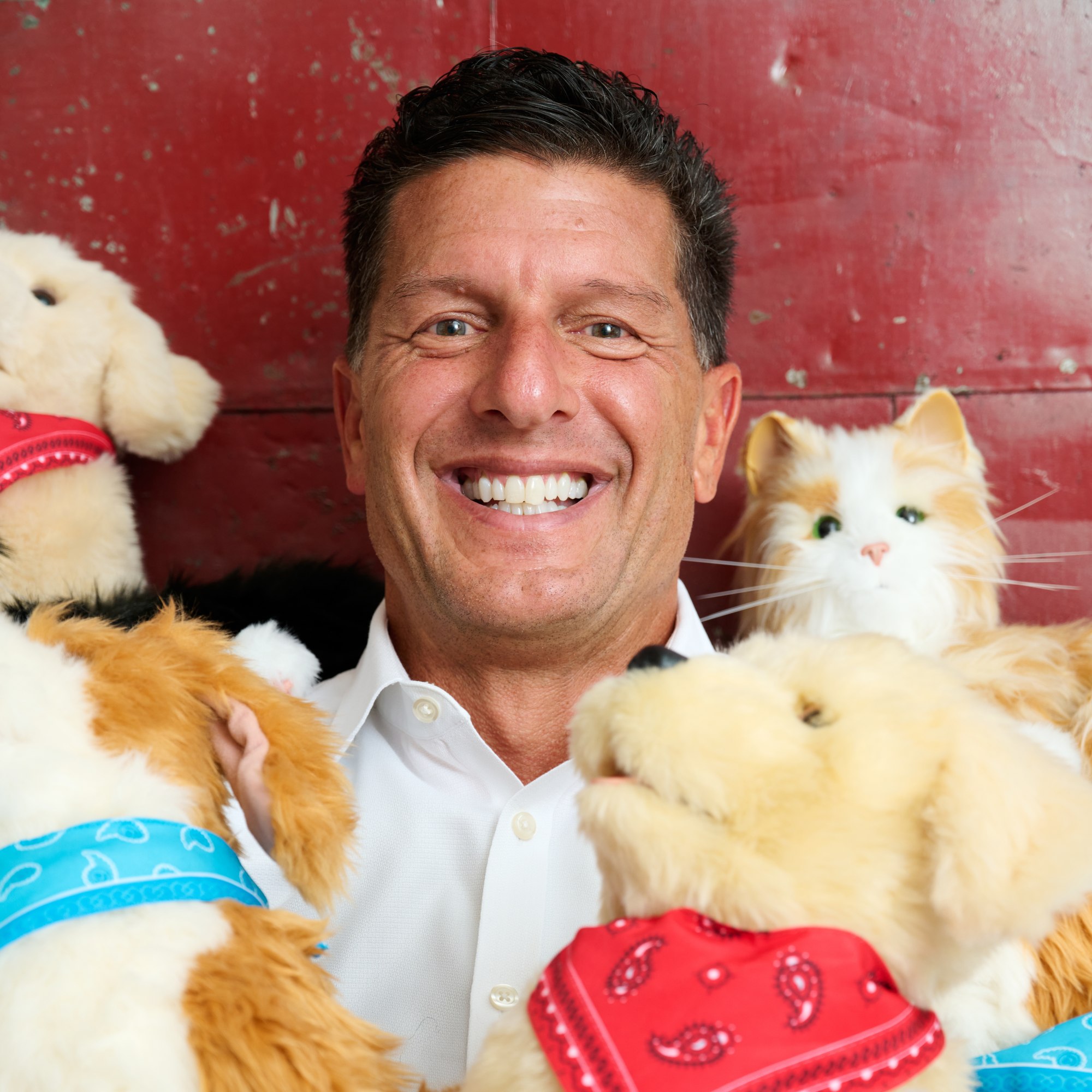
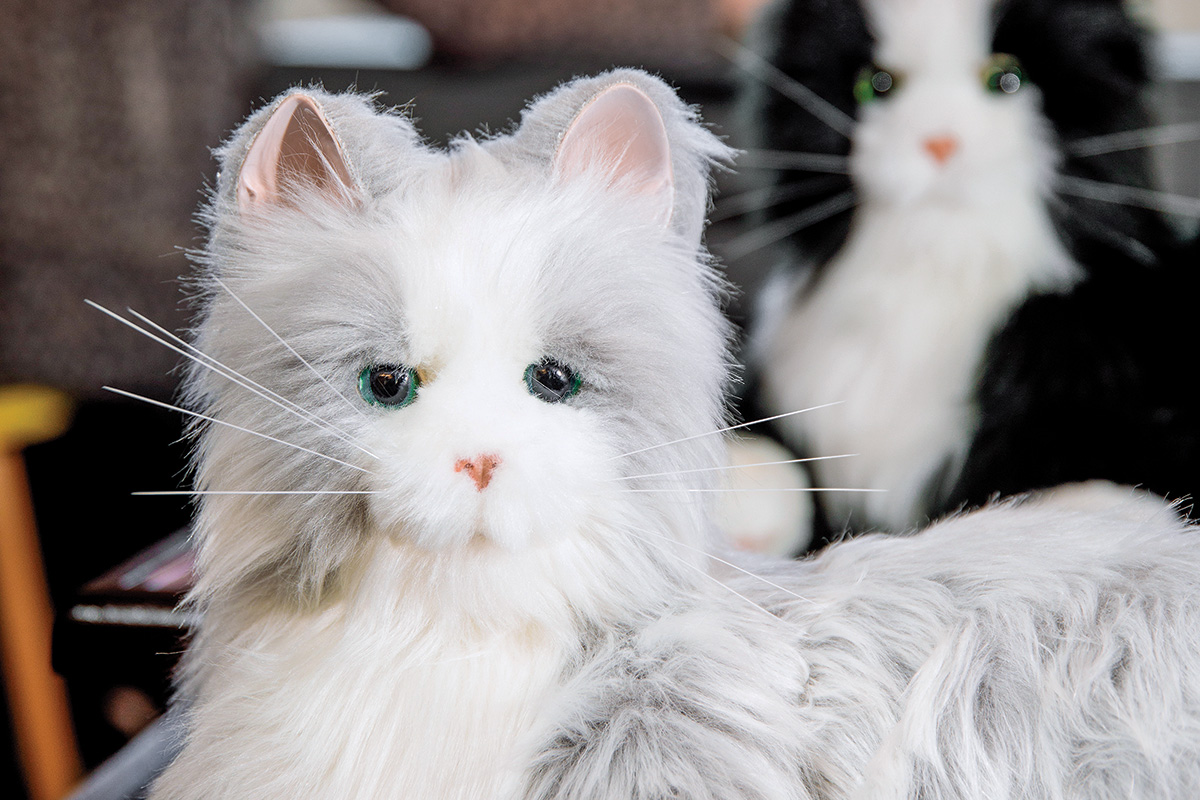
Joy for All launched in 2015, beginning with a companion cat; a pup followed in 2016. The animals offered an exchange people could understand without studying a new set of rules. Touch the cat and it responds. Talk to the pup and it can bark back. The familiarity was part of the design.
His grandmother became one of the early people to try the product and appeared on the original box. For Fischer, the intended customer had a face he already knew. The distance between a product meeting and a family visit had become unusually short.
Taking the cat out of the corporation
In April 2018, Fischer and the Joy for All leadership team left Hasbro and established Ageless Innovation. They acquired the brand through a friendly management spinout. The venture had moved from an initiative inside a large toy company to the central occupation of an independent business.
That change gave the team a concentrated audience. It also left Fischer with the ordinary, difficult work of introducing an unfamiliar product. A robotic companion animal for an older adult does not arrive with an obvious place in everybody’s shopping habits. Somebody has to explain it, stock it, buy it, and decide whom to give it to.
Fischer’s account of the early launch includes a distinctly founder-like worry. Shortly before the brand’s debut, he became anxious that people would never visit its own website to buy anything. He sought a meeting with Amazon. Even a small order, he reasoned, would let the team tell shoppers the products were available somewhere they recognized.
The anecdote is appealing because the ambition is so practical. Before a company can change a category, it needs a customer to feel comfortable clicking a button. A new idea may depend on an old habit.
Joy for All launches.
The team acquires the brand.
Classic games get new editions.
The small indignities of a small game piece
By 2023, Hasbro and Ageless Innovation were working together again. This time, Fischer’s company was a licensee, redesigning familiar games for older adults and their families. The first group included The Game of Life Generations, Trivial Pursuit Generations, and Scrabble Bingo.
These are revealing choices. Each arrives with years of associations attached. People know the names. They may remember playing them with children who now have children of their own. The task was to preserve that familiarity while reconsidering the details that determine whether everybody can comfortably join in.
Tiles became easier to grasp. Text became easier to read. Trivia could acknowledge different generations’ reference points. Those decisions give Fischer’s philosophy a physical form. An invitation printed in tiny type is an invitation with a condition attached.
Taboo Charades followed in November 2024. It added charades and improvisation to the word game, with oversized cards, references from the 1960s and 1970s, and a log for recording memories shared during play. A game box could contain a small excuse for a family story to escape.
“Older adults have the answers... you just need to ask them!”
Ted Fischer, on product design
Fischer has made that point directly in public. Older adults participate in shaping the products. It is a straightforward rule with consequences for who gets to be the expert in the room. The designer may understand how something is manufactured. The player knows what happens when it lands on the table.
A company needs people who get the joke
For someone selling play, Fischer seems willing to have some at his own expense. When colleagues promoted a series of videos featuring their CEO, his response on LinkedIn was: “Did I approve that intro??” The accompanying laughing emojis did their small but necessary work.
There is a recognizable continuity between that exchange and the grandson bearing a preposterous present. His public persona allows for the possibility that an executive can be useful without being solemn at every available moment. A title need not confiscate the sense of humor.
He is also attentive to people who understand an idea before everybody else does. In discussing his business, Fischer describes looking for champions: people inside organizations who grasp the product’s purpose and are willing to help it travel. That approach depends on relationships built one conversation at a time.
Among those relationships is his long association with Greg Olsen of the New York State Office for the Aging. In a 2021 interview, Fischer described receiving pictures, videos and notes from state partners about people receiving companion pets. He spoke about those messages with the pleasure of someone whose work had acquired an unusually engaging correspondence.
The distance he chooses to share
Ask Fischer about achievement and the subject can move away from the company. In an interview about his life in the toy industry, he chose marathons with his children as his claim to fame. His official biography now records that he has completed a marathon with each of his three children.
It is an apt detail for a person whose work keeps returning to shared activities. Running a marathon together gives companionship a demanding schedule. There is preparation to arrange and a distance to cover. The finish line comes with somebody else in the picture.
His personal motto, “Never Settle,” fits the competitive side of that picture. His commitments also include quieter, longer forms of participation. At Moses Brown School, where he was a student for thirteen years, he later spent ten years as a trustee and helped with fundraising and a school leadership transition.
The school recognized that service with its Karin Morse ’79 Service to Alma Mater Award. All three of his children attended, too. In his remarks, Fischer said, “I think we’re all called to serve.” The sentiment has a local address: the place that educated him, and then educated his family.
Reached in 2025 · announced May 2026
Back at the table
At CES in January 2026, Fischer hosted live sessions of Trivial Pursuit Generations and judged an AgeTech pitch competition. Among the demonstrations and conversations at a technology show, his contribution included the old-fashioned business of getting people to play a game together.
In May, Ageless Innovation announced that Joy for All companion-pet adoptions had passed 750,000, a threshold reached during 2025. Fischer joined partners in Rockland County, New York, for a celebration involving a local couple and a companion pup. His public reflection dwelt on meeting the people at the event.
The company can count its reach. Fischer keeps returning to the encounter. A grandmother laughing at a terrible stuffed animal. A child beside him over a marathon distance. People from different generations deciding who gets the next turn.
His business has changed since those early gifts. The underlying assignment remains pleasingly recognizable: bring something worth sharing, and give the other person a reason to join in.