The Toy Team That Sold 750,000 Robot Cats to Fight Loneliness
A former Hasbro team took a $60-to-$180 robotic cat, aimed it at grandparents instead of grandkids, and turned play into a public-health tool. State agencies now hand the pets out by the thousands.
The customer for a robotic pet, most toy companies assumed, was a child. Ageless Innovation built a business on the opposite hunch - that the person who really needs something warm, purring and undemanding is often 80 years old, living alone, and lonely. The bet has produced more than 750,000 robotic cats, pups and birds in the hands of older adults, and a growing line of state governments writing purchase orders.
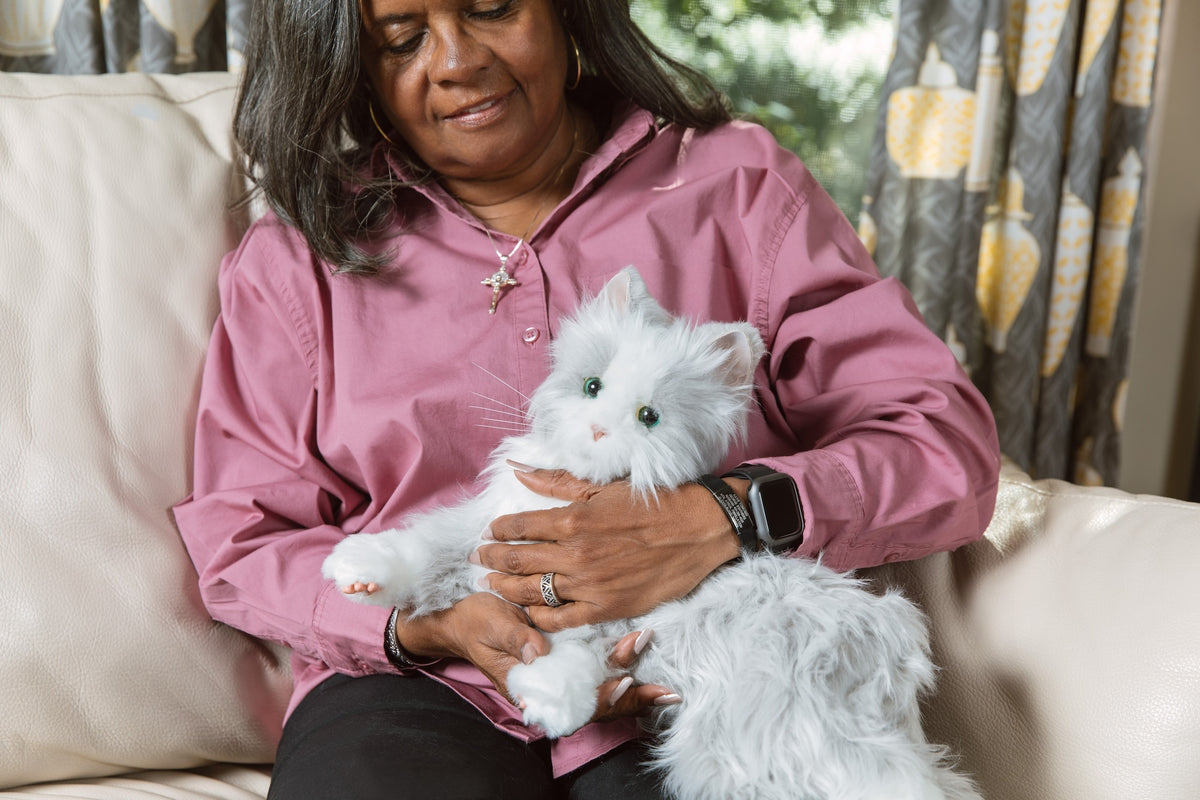
The company sits in Pawtucket, Rhode Island, a short drive from the Hasbro campus where its founders used to work. Its flagship brand, Joy for All, makes battery-powered companion animals that look, feel and sound close enough to the real thing to matter: a cat that purrs and rolls over for a belly rub, a pup that barks back, a bird that chirps when you speak to it. There is no app to configure and no subscription to renew. You pet it, and it responds.
What they actually do01A comfort object, engineered
The core product is the Joy for All Companion Pet Cat, first launched inside Hasbro in November 2015 and still the anchor of the line. It contains motion and touch sensors, a speaker, and a small motor that drives a simulated heartbeat you can feel through the fur. Pet its cheek and it nuzzles; hold it and it settles. The pup, which followed in 2016, adds "BarkBack" technology. In 2022 came the Walker Squawker, a robotic bird using "ChirpBack" that responds to speech, touch, light and movement - a product the company says was conceived by a 93-year-old inventor.
The pitch is deliberately modest. These are not medical devices and the company does not claim they cure anything. They are, in the words on the corporate site, products "that improve the lives of older adults through joy, human connection, and the proven power of play." That framing - play as a serious lever for wellbeing, at any age - is the thread that runs through everything the company makes, including a later line of adapted Hasbro games for older players.
02Two customers, one pet
The business runs on two very different buyers. The first is the consumer - an adult child buying a companion for a parent with dementia, or an older adult buying one for themselves. Those sales flow through the company's own store at joyforall.com, plus Amazon and retail, at list prices of roughly $159.99 for the cat and $179.99 for the pup.
The second buyer is the one that changed the company's trajectory: government. State and county aging agencies have started purchasing the pets in bulk and distributing them free to isolated older residents. The New York State Office for the Aging has handed out more than 31,500 animatronic pets since 2018, a program it has expanded repeatedly and one that has been copied in 30-plus states. New York City's Department for the Aging joined the state's robotic-pet trial. In Virginia, the Fairfax County Area Agency on Aging bought roughly 200 pets for local seniors and adult day programs.
Why would a state government buy toys? Because loneliness has become a budget line. Public-health officials increasingly treat social isolation as a health risk on par with smoking, and interventions that are cheap and side-effect-free are rare. New York State has reported that around 75% of older adults who received the pets felt less lonely - the kind of number that makes a $160 purchase easy to justify against the cost of a hospital visit.
Social isolation, loneliness and the agitation that comes with dementia and Alzheimer's. The pets are used at home, in senior living, in memory care and in hospice - not to replace human care, but to give a restless or withdrawn person something to hold, soothe and talk to.
03The case for cheap and simple
The companion-robot shelf is crowded at the top. PARO, a Japanese therapeutic seal, is certified as one of the world's most therapeutic robots and costs around $6,000. Sony's Aibo, an AI robot dog, runs about $3,000. Tombot makes a more lifelike puppy for roughly $500. Intuition Robotics' ElliQ is a subscription AI companion with medication reminders and fall detection.
Ageless Innovation went the other way. Its pets have no AI to speak of, no cloud account, no monthly fee - and a price a fraction of its fanciest rivals. That simplicity is the strategy. For an 85-year-old with cognitive decline, a device you cannot misconfigure and cannot lock yourself out of is a feature, not a compromise. It also makes bulk government purchases affordable in a way a $6,000 seal never could be.
04A friendly divorce from Hasbro
Joy for All was born inside Hasbro in 2015, the toy giant's first brand aimed at older adults rather than children. It worked - the launch generated more than two billion media impressions in two years - but a mass-market toy company is built to chase the next holiday hit, not to nurse a slow-building health brand. So in 2018 the leadership team executed a friendly management spin-out, buying the brand and building an independent company around it. Ageless Innovation later came full circle, becoming Hasbro's first licensee for the aging market and adapting classics like Trivial Pursuit and Scrabble into a "Generations" line for older players.
The founding team - CEO Ted Fischer, along with Andrew Jeas, Tom Canterino and Meghan Gamboa - all came out of Hasbro. The origin is personal for Fischer: his grandmother Claire, who lived with dementia, appeared on the original product packaging. It is the sort of detail that explains why a team of toy executives decided the more interesting problem was on the other end of the age curve.
05More than one animal
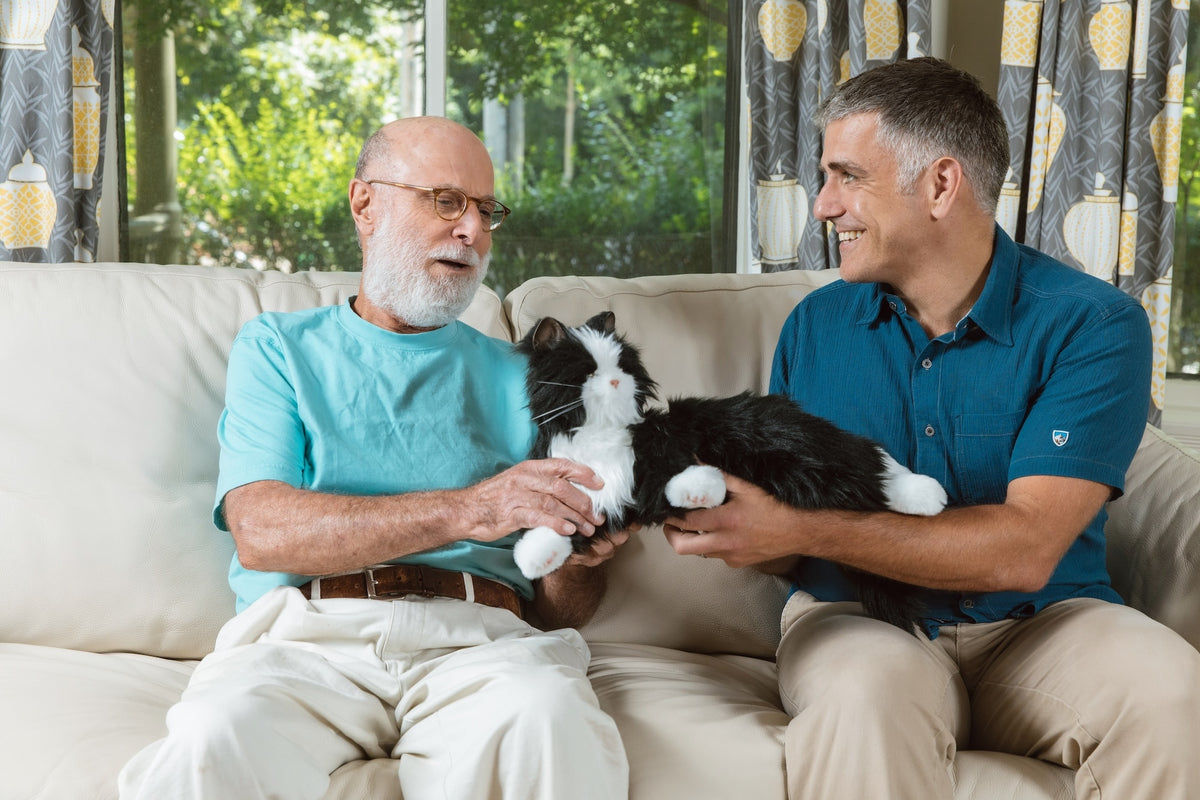
Joy for All is now a small menagerie. There are three cats in different coats - orange tabby, silver, and a black-and-white "tuxedo" - two pups including the Golden Pup and a Freckled Pup, and the Walker Squawker bird. Alongside them sits the Generations line of adapted games, built on the same idea that a familiar, low-stakes activity can pull a withdrawn person back into a shared moment with family or a care aide. It is a narrow catalog by design: every item points at the same customer and the same problem, which keeps the brand legible to the caregivers and agencies who buy it.
The evidence and the money06Proof, not hype
The company leans on outcomes rather than adjectives. It points to more than a dozen studies - cited through partners including AARP and UnitedHealthcare, and data from New York State - reporting reductions in loneliness, depression and isolation among people who received the pets. It is careful language, and the reserve is part of the credibility: a comfort robot that promised to cure dementia would be easy to dismiss.
On funding, Ageless Innovation has stayed lean. Aggregators put total outside capital around $3.4 million, including roughly $1.5 million in debt financing raised in July 2023. Separately, the National Science Foundation backed a research project - nicknamed ARIES - to explore adding affordable AI to the pets, a collaboration involving researchers at the University of Cincinnati, Brown University and Butler Hospital. Whether the pets should get smarter, or whether their charm lies precisely in staying simple, is the open question hanging over the next chapter.
At the low-cost, high-volume end of "agetech." Rivals compete on realism and intelligence; Ageless Innovation competes on price, ease and distribution - which is exactly what turned it into public-health infrastructure rather than a gadget.
What is worth stealing here is not the robotics. It is the reframe. The product barely changed when it left Hasbro; the customer did. By pointing a familiar object at an overlooked, underserved buyer - and pricing it so a county government could afford a pallet of them - a small team in Rhode Island built something rivals with far bigger budgets missed. The pets do not pretend to be alive. They just give someone a reason to reach out and touch something, which, for a lot of lonely people, turns out to be enough.