Some businesses begin with a patent, some with a whiteboard, and some with an adult carrying a carton of mismatched jerseys across a parking lot. Team apparel belongs to the third category. A volunteer gathers sizes, spells names correctly, collects checks, chases late orders, wonders whether youth medium means what it did last season, and eventually becomes a lightly compensated distribution center.
Frank Tillinghast knew this ritual from close range. He played baseball, football, and hockey as a boy, then club hockey at the University of Rhode Island. Later, he coached hockey and baseball with his son James. He served the Warwick Continental Little League as a coach, board member, and treasurer, and gave time to the Warwick Junior Hockey League. The person looking at the uniform problem was therefore both a finance executive and one of its repeat customers.
That double vision became useful at SquadLocker. The Warwick company invited a coach or league manager to create an online store, choose gear, upload a logo, and send families a link. Parents placed and paid for their own orders. SquadLocker handled the art, decoration, fulfillment, and direct shipping. A job once conducted through kitchen-table paperwork could begin online in less than five minutes.
The accountant already knew the fabric
Tillinghast did not arrive at apparel by way of an app pitch. He arrived through the ledger. He worked as a staff accountant at LGC&D, became a business planning manager at Duro Textiles, and held finance leadership roles at CTM and CleanBrands. By the time SquadLocker took shape, he had more than twenty years of finance experience in textiles and apparel. He was also a certified public accountant, licensed in Rhode Island in 1997.
His education added another layer. At URI he earned his undergraduate degree and played hockey. At Babson College, where he completed an MBA summa cum laude between 2001 and 2004, he focused on entrepreneurship. His coursework included managing growing businesses, mergers and acquisitions for entrepreneurs, and technology ventures. It reads now like a syllabus written in advance for SquadLocker.
The founders' working history was longer than the startup label suggested. Nelia Tillinghast, who later became a systems integration leader at SquadLocker, recalled joining Gary Goldberg at CTM in 2000. The office had four people: Goldberg, Frank Tillinghast, Nelia, and a receptionist. CTM operated a manufacturing facility in Mexico, so the tiny Warwick team still had to manage inventory, vendors, customers, and the daily physics of making things. Software could tidy an order. It could not sew a number straight.
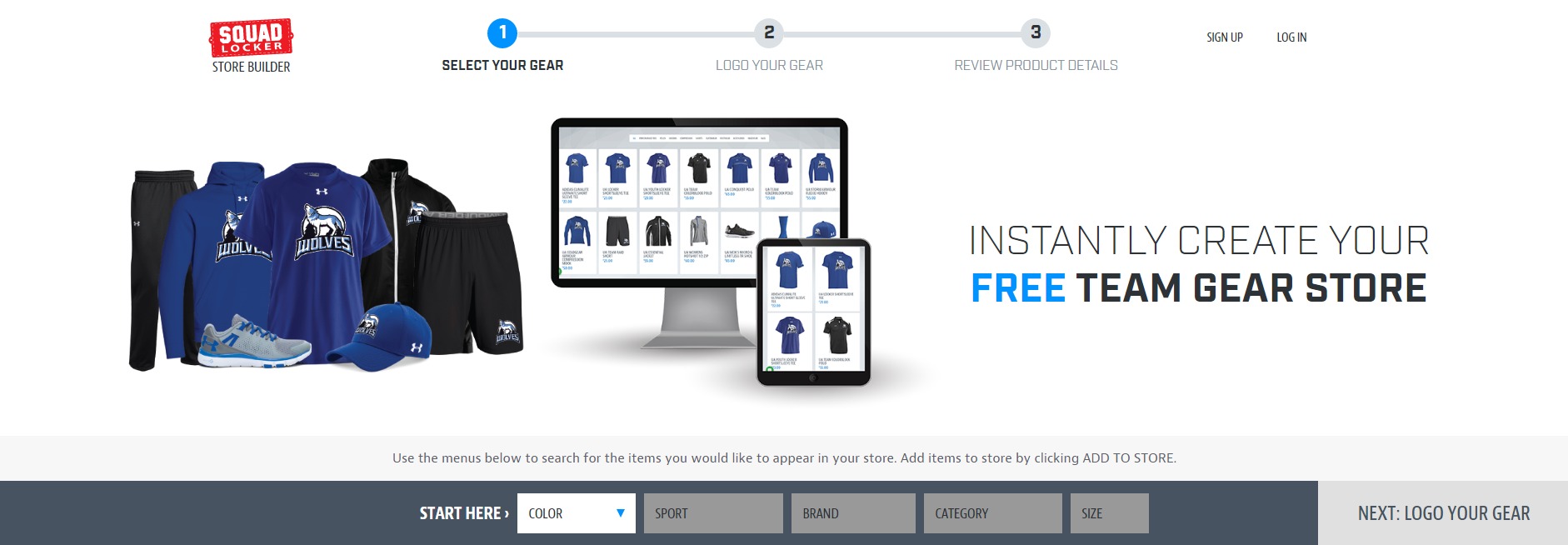
That distinction explains the business. SquadLocker joined a clean digital front end to stubbornly physical work behind it. Every order might be individual, but each still involved a garment, artwork, decoration, inspection, packing, and delivery. The company owned its Warwick fulfillment operation. Its proposition to volunteers was convenience; its obligation to customers was execution.
The route to customers also reflected the founders' knowledge of the game. Rather than wait for every coach in America to discover a new apparel site, SquadLocker formed partnerships with league-software and sports organizations including TeamSnap, Sports Illustrated Play, Sport Ngin, and USA Football. Apparel could sit beside the registration and scheduling tools that leagues already used. The arrangement gave those platforms another service for their communities and gave SquadLocker access to teams at the precise moment organizers were solving seasonal logistics.
The product's lack of minimum orders mattered just as much. Traditional group buying rewards a large batch, yet teams are untidy collections of changing sizes, late sign-ups, replacement needs, and parents shopping on different paydays. Processing each purchase separately made the system feel ordinary to the buyer, like any other online shop. Operationally, it asked the Warwick facility to behave like a custom workshop and a retailer at once. That tension, between personal treatment and repeatable scale, sat squarely in a CFO's territory.
“Revolutionize a mid-20th-century process with a unique 21st-century approach.”Frank Tillinghast on the mission he was proudest of
Then the easy store became a hard company
Removing complexity for customers has a mischievous consequence: the complexity does not vanish. It changes address. As SquadLocker attracted teams, the company had to absorb the work that coaches once scattered across evenings and weekends. Orders arrived one at a time. Logos varied. Seasons began on fixed dates. The jersey needed to be right before opening day, a deadline with little interest in corporate excuses.
In a 2018 conversation about managing growth, Tillinghast said the business had expanded from 20 employees to more than 120 and raised over $15 million. Recruitment and training had become, in his words, “our number one challenge.” It was a revealing CFO answer. The limiting resource was not a market-size slide. It was enough prepared people on the floor and in the office to keep a promise made on a screen.
Two years later, SquadLocker announced a $20 million Series C led by ABS Capital Partners, with Causeway Media Partners and investor Jim Lombardi participating. The money was intended for growth initiatives and wider channel partnerships. The round placed another obligation on the finance function: turn capital into durable capacity without losing the operating discipline that made the model work.
Rhode Island's corporate record gives the formal version of Tillinghast's part. It lists him as CFO, treasurer, secretary, and the company's registered agent. Those titles sound clerical beside the pitch language of technology ventures. They are also where a company becomes real. Someone signs. Someone reports. Someone notices when the ambitious plan and the bank account are having different conversations.
A preference for endurance
Tillinghast's public comments are sparing, though a few carry an enjoyable amount of personality. Asked to choose three athletes for company on a desert island, he selected Jackie Robinson for perseverance, Muhammad Ali for pride and will, and Cal Ripken Jr. for endurance. The qualities are revealing. None describes a lucky afternoon. All require repetition under pressure.
Frank's desert-island roster
- Jackie Robinson - perseverance to overcome
- Muhammad Ali - pride and the will to win
- Cal Ripken Jr. - endurance
His dream ticket was equally on brand: the United States' 4-3 victory over the Soviet Union in the medal round of the 1980 Winter Olympics. His ideal CEO dinner guest was Tony Hsieh of Zappos, from whom he wanted to learn about culture, empowerment, and engagement. One choice points to hockey history; the other to the difficult business of getting people to care about the work.
There is humor, too. Tillinghast continued playing hockey and golf, although his assessment of the latter was unsentimental. Having taken up the game around the end of his college baseball days, he said he was “forever doomed to bogey-hood.” A finance chief should be forgiven for recognizing a persistent variance from plan.
The sporting life was not merely biography added for color. It supplied the company's moral arithmetic. Every hour a volunteer spent sorting sweatshirts was an hour unavailable for instruction, encouragement, or simply getting children onto a field. SquadLocker's stated purpose was to return some of that time. Its customers bought apparel. Its deeper product was relief from administration.
The value of knowing both sides
Founders are often celebrated for seeing what others miss. Tillinghast's story suggests a quieter skill: seeing an ordinary nuisance from several seats at once. The accountant sees wasted labor and awkward cash handling. The textile executive sees decoration and fulfillment risk. The coach sees another evening disappearing into a spreadsheet. The parent sees a child who has outgrown last year's size.
SquadLocker gathered those views into a single workflow. The result did not eliminate the need for judgment, people, or machinery. It placed those resources where a dedicated company could manage them, rather than asking every league to improvise. The organizer chose the gear and identity. The family chose a size and paid. The company made and moved the product.
Tillinghast remains identified with SquadLocker as CFO and co-founder, based in Warwick. His LinkedIn profile carries a recommendation from Goldberg that praises his grasp of key business metrics and management reporting. It is the kind of compliment accountants might actually enjoy: specific, useful, and free of confetti.
The five-minute store is the attractive promise. The more durable story sits behind it, in decades of textile experience, years of coaching, a carefully managed funding round, and the unshowy knowledge that every digital convenience eventually meets a box that must leave on time. Tillinghast made a career at that meeting point. Somewhere, a coach closes a laptop and gets an evening back.