The cleanest way to understand TechnoVax is to picture a very expensive disguise. Its scientists build particles that dress like viruses - familiar shape, familiar surface proteins, convincing enough to get the immune system's attention - but leave out the genetic material that lets a virus reproduce. The result is a biological mannequin: alarming to antibodies, harmless in the specific sense that it cannot replicate. This is the virus-like particle, or VLP, and a small lab in Elmsford, New York, has spent more than 20 years trying to turn it into a vaccine business.
TechnoVax is not a vaccine manufacturer with cartons rolling off a line. It is a privately held, five-to-six-person research company whose public pipeline sits before human testing. Its products today are ideas with data behind them: a broadly protective influenza vaccine, an RSV candidate, adenovirus vaccines, a shelf-stable inhaled powder concept, and earlier work against Zika and COVID-19. Around that pipeline sits a practical bioservices operation selling custom VLP design, recombinant proteins, antibodies, ELISA work, reagents and modified cell lines to research and diagnostic organizations.
The trick is looking dangerous
Founder Jose M. Galarza learned the terrain inside big pharma. A veterinarian and microbiologist by training, he led an influenza subunit vaccine program at Wyeth, where his team worked on influenza VLP technology. He founded TechnoVax in 2003; George R. Martin, an NIH scientist emeritus, is listed as co-founder and chief technical officer. The company later licensed VLP technology from Wyeth and set out to reuse the same manufacturing logic across multiple pathogens.
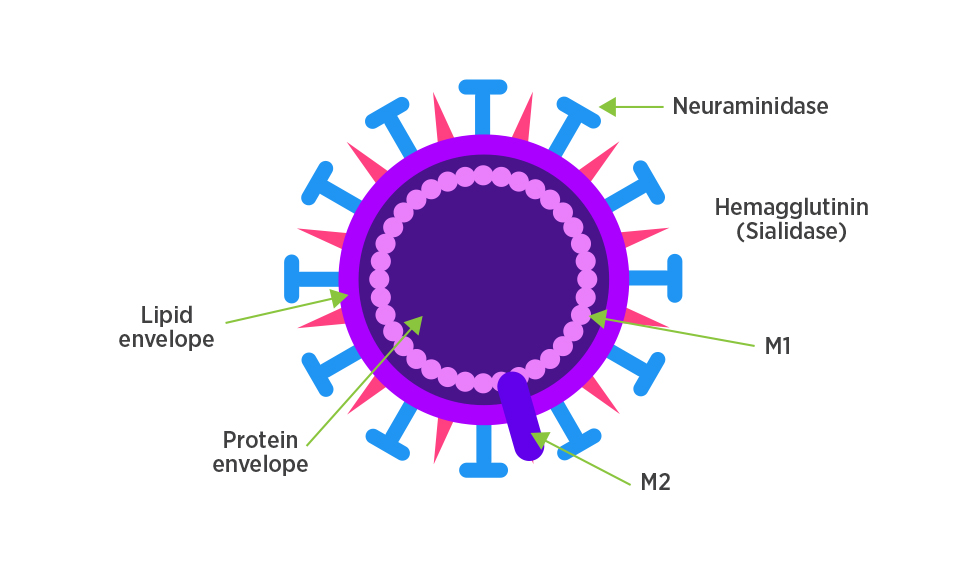
That reuse is the platform thesis. Influenza VLPs can display hemagglutinin and neuraminidase. An RSV version can present combinations of F, G and SH proteins. An adenovirus-like particle changes the structural cast again. The machinery and know-how are not identical for every target, but they rhyme. One technical foundation creates several shots on goal.
The influenza program shows what TechnoVax believes this architecture can buy. Seasonal flu vaccines chase moving strains. TechnoVax remodels hemagglutinin to reveal conserved, normally less-visible sites, hoping the immune system will make antibodies that recognize a broader collection of influenza viruses. In animal work funded by NIH, candidates produced neutralizing antibodies and protection against challenge. That is a sensible scientific answer to antigenic drift. It is not yet evidence of durable, broad protection in people.
“The first thing to fail was not a particle. It was the calendar.”What TechnoVax's public record quietly teaches
What did it cost?
Federal data gives an unusually crisp answer to part of that question: $10,022,344 across nine Small Business Innovation Research awards, five Phase I and four Phase II. The projects include influenza, RSV and adenovirus work. A 2009 influenza award alone was worth $2.9 million; later awards included $1.48 million for universal flu, $1.07 million for adenovirus and $300,000 for RSV. This is non-dilutive money - taxpayers bought experiments, not shares.
It also bought a striking 80 percent conversion rate from Phase I to Phase II awards. That number is genuinely useful and easy to misread. It says TechnoVax repeatedly generated enough evidence to win follow-on grants. It does not say 80 percent of its vaccines reached clinical trials. Grant conversion and drug conversion live on different planets.
The calendar meets the clinic
In a 2009 NIH commercialization showcase, TechnoVax mapped a seasonal influenza candidate into Phase I in late 2010, Phase II in 2011 and Phase III in 2012. None of those public milestones arrived. The company's current LinkedIn description still says it is seeking funding to start human testing, and its official pipeline says clinical progress depends on financing. In biotech, a clean Gantt chart is often the first preclinical casualty.
What failed first, then, was the assumption that promising animal data plus a platform would compress everything after it: process development, toxicology, GMP manufacturing, regulatory work, trial recruitment and cash. TechnoVax kept producing evidence. Its 2017 Zika work reached a peer-reviewed journal. In 2020, it and CUNY researchers reported SARS-CoV-2 VLPs with stabilized spike proteins. In 2023, collaborators at TechnoVax, CUNY and Walter Reed published an adenovirus-7 VLP study reporting a potent humoral response in animal work. The science moved. The clinical clock did not.

The pivot was really a widening
There is no dramatic founder conversion in the public record, no single experiment that made the company abandon one worldview for another. The visible change is more pragmatic: TechnoVax widened the surface area of the bet. Flu expanded to RSV, Zika, adenovirus and COVID-19. The company added contract services. For delivery, it combined its particles with MannKind's powder technology to imagine a shelf-stable vaccine inhaled directly into the lung.
That powder concept tackles three annoyances at once: needles, refrigeration and the mismatch between a respiratory infection and an injection into the arm. A self-administered powder could simplify distribution during an outbreak. But the cleverness adds dependencies. The formulation must remain stable, the device must deliver a consistent dose, mucosal immunity must be protective, manufacturing must scale, and regulators must evaluate a vaccine-device combination. Removing the needle does not remove the trial.
Where it fits in a crowded market
TechnoVax competes less like a branded vaccine company and more like a source of early-stage assets. In seasonal influenza, its alternatives include familiar egg-grown shots as well as cell-based and recombinant vaccines from large manufacturers. In RSV, GSK, Pfizer and Moderna already occupy adult indications. Pandemic programs can now choose among mRNA, protein subunits, viral vectors and other VLP systems. A buyer does not compare TechnoVax with “no vaccine.” It compares a preclinical package with platforms that have factories, safety databases and regulatory teams.
Its answer is a particular bundle: mammalian cell production, particles that carry no replicating genome, the ability to display several antigens, and a possible inhaled format. The bundle could matter where broad coverage, rapid redesign or cold-chain independence changes the economics. It matters less when an approved injected product already works well, refrigeration is dependable, or the extra complexity of pulmonary delivery outweighs convenience. TechnoVax therefore needs a sharply chosen use case, not merely a versatile platform.
Who pays, who uses, who waits
TechnoVax has three customer layers. Today, federal agencies pay for bounded research questions, while laboratories and diagnostic groups can buy bioservices. Tomorrow, a pharmaceutical or delivery partner would license a candidate or co-fund clinical proof of concept. Patients appear only at the end of the chain, and no approved TechnoVax product has reached them.
That makes the business model less like a miniature Pfizer and more like an option factory. Grants pay to make each option more credible. Publications and patents help defend it. Services create nearer-term commercial work. A partner with clinical, manufacturing and regulatory muscle is expected to exercise the most valuable option. TechnoVax says its own contribution is product expertise and initial R&D funding; the partner supplies the resources for clinical proof of concept. The division is honest because the expensive part is precisely what comes next.
What founders can copy
The stealable move is not “start a vaccine company.” It is to define a reusable technical primitive, then fund separate proofs that each answer one legible question. TechnoVax used a common VLP logic across several pathogens. It matched programs to NIH or Defense priorities. It published with universities and military researchers instead of staffing every specialty. And it sells adjacent technical capabilities rather than pretending future vaccine revenue can pay today's rent.
The second copyable move is to keep the commercial handoff explicit. A small biotech can be excellent at discovery and still be the wrong organization to run global Phase III trials. Designing for licensing or collaboration is not surrender. It is a boundary choice. The caution is to choose a lead program firmly enough that optionality does not become a permanent waiting room.
When the playbook breaks
This strategy fails under several conditions. Animal immune responses may not predict human protection. Broad antibodies may exist without lasting efficacy. Mammalian cell production may prove too costly or inconsistent at commercial scale. A pulmonary formulation can introduce device and dosing risks that an injection avoids. Capital can disappear between a successful grant and a trial-ready manufacturing run. Competitors can win approval first, as they have in adult RSV. And a platform can spread a tiny team across too many pathogens to push any one of them through the clinic.
TechnoVax remains interesting because its record refuses a tidy ending. It has patents, papers, experienced scientists and a double-digit-million federal vote of confidence. It also has an old clinical timetable that reality shredded. The next meaningful milestone is not another pathogen added to the menu. It is one candidate, one financed human study and a result that finally makes the platform answer to people rather than models.