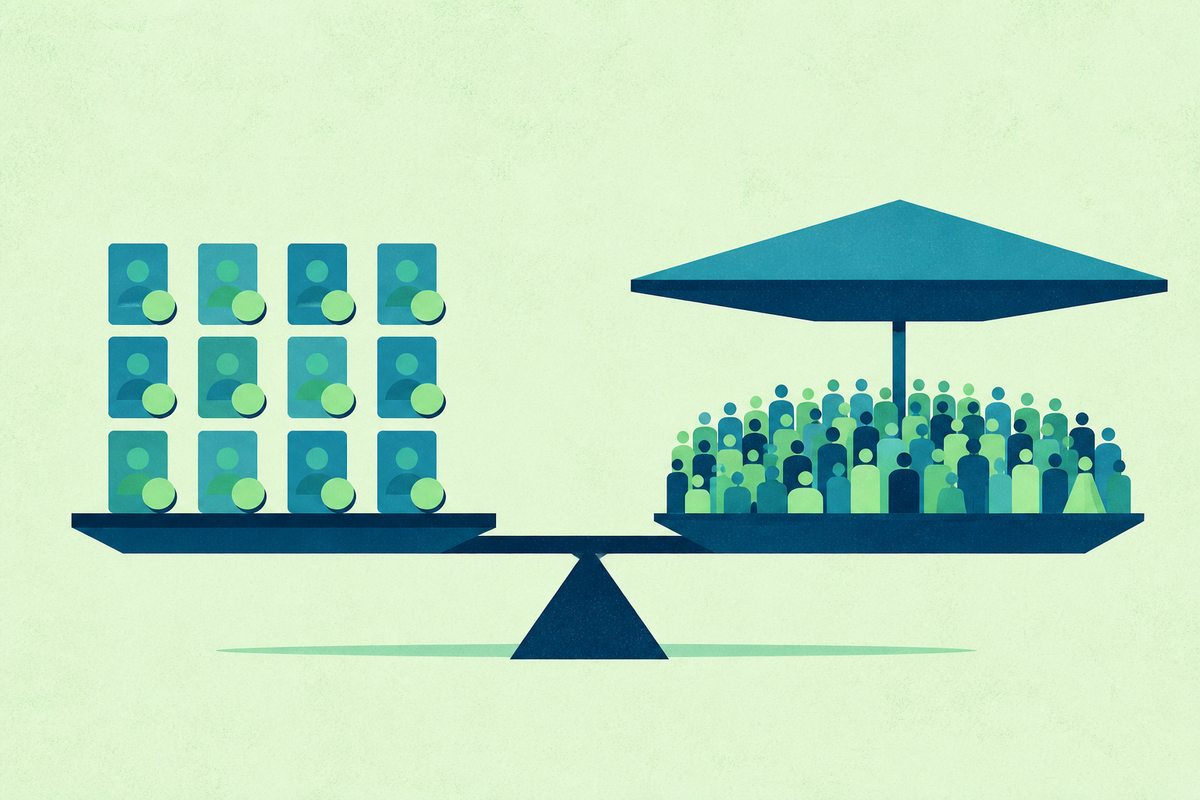
Add one person to a Trello workspace and, on a paid plan, the arithmetic may change. Add one person to Basecamp Pro Unlimited and nothing happens to the invoice. That small difference is the most revealing feature in this comparison. Trello and Basecamp are routinely placed beside each other because both promise a calmer way to organize work. One starts with boards, lists and cards. The other gathers to-dos, messages, chat, schedules, files and check-ins inside projects. Yet the products disagree about the basic unit of collaboration: is software something a company buys for each person, or a place the company buys once and fills?
At the prices published in August 2026, Trello Standard costs $5 per user each month when billed annually, while Premium costs $10 and Enterprise is listed at $17.50. Basecamp Pro Unlimited costs $299 a month when billed annually, with unlimited users and no per-user charge. These are not equivalent bundles, and sticker price cannot decide the product fit. It can, however, expose the incentives each product installs alongside its software.
Every seat is a tiny decision
Per-user pricing is easy to understand. A ten-person team on Trello Standard has a listed monthly cost of $50 with annual billing. The same ten people on Premium cost $100. A new colleague adds $5 or $10. Finance can connect the bill to headcount, and a small group pays for a small footprint. For a focused team that lives in cards, Trello can be the cleaner bargain.
The meter also changes behavior. When access has a marginal cost, inviting someone becomes a miniature procurement choice. Does the copy editor need a full seat? Should the outside adviser be on the board? Can operations share one summary instead? None of these questions is absurd. Together, though, they can make the map of work narrower than the work itself. A tool purchased to make progress visible may acquire invisible edges.
Listed monthly cost at thirty paid users, annual billing
Simple sticker-price illustration. Plans differ in features, limits and intended use. Basecamp price shown is Pro Unlimited.The crossover is easy to calculate. Basecamp Pro Unlimited becomes cheaper than Trello Premium at 30 paid users: $299 versus $300 a month on the listed annual-billing rates. Against Trello Standard, Basecamp's flat price does not become cheaper until 60 paid users, when Standard reaches $300. Real invoices can differ because of monthly billing, taxes, guests, discounts and enterprise terms. The point is not a universal break-even number. It is the shape of the curve. Trello rises in a straight line. Basecamp stops.
The pricing model decides whether the next collaborator feels like access or expense.
Basecamp sells the crowded room
Flat pricing looks wasteful before it looks generous. A twelve-person company buying Basecamp Pro Unlimited pays almost $25 per person each month, if everyone uses it. At 100 people, the effective rate falls below $3. The product has not grown cheaper in absolute dollars; growth has made each additional participant effectively free. That is useful for agencies, schools, nonprofits and companies whose projects regularly cross departmental lines.
There is a cultural effect, too. Once the bill is fixed, the default can shift from “who needs a license?” to “who should see the work?” A senior leader can follow a project without consuming a scarce seat. A new hire can enter the record on day one. A support specialist can be invited for one thread without a debate about utilization. Flat pricing does not guarantee open collaboration, but it removes one reason to ration it.
Trello's economic unit
The named userStart small, pay in proportion, and add cost as the paid team expands.
Basecamp's economic unit
The whole accountCommit to a higher floor, then spread that fixed cost across more people.
That fixed offer is not Basecamp's entire price list. It has a free one-project package and a Plus plan priced per employee or full user; clients and contractors are free on Plus. Pro Unlimited is the company's scale proposition. It also includes upgrades such as Timesheet and Admin Pro Pack, plus five terabytes of storage. Treating Basecamp as flat-price-only would miss the ladder it now provides to smaller teams.
A canvas versus a furnished house
Price follows product philosophy. Trello's core grammar is wonderfully small: put cards in lists on boards, then adapt the arrangement to the job. A sales pipeline, editorial calendar and hiring queue can share the same visual syntax. Standard adds unlimited boards, advanced checklists, custom fields and more automation. Premium adds multiple views, administrative controls, collections and AI features. More than 200 Power-Ups extend the system. This is a canvas that becomes specific through configuration.
Basecamp is closer to a furnished project room. The same core features appear across its packages: message boards for announcements, to-dos, Card Tables for Kanban-style process tracking, Campfire and Pings for chat, scheduling, files, reports and automatic check-ins. You can rearrange how the room is used, but its makers have already made strong decisions about what belongs inside.
Those decisions came from embarrassment, not a market map. In Basecamp's account of its origin, 37signals was a design firm losing information across email, chat, spreadsheets, calls and scattered documents. Three people built the first version, starting in 2003, to keep client work in one shared place. It launched in February 2004. The company says the product generated more revenue than its design work roughly a year later, prompting it to leave consulting behind.
The origin matters because Basecamp still sells organizational compression. Instead of assembling a board, chat channel, file store, calendar and status ritual from separate products, a team can give each project the same set of rooms. This consistency may be more valuable than a niche feature when clients rotate and new hires arrive. It may also feel restrictive to a team with a carefully engineered workflow. Basecamp's makers openly prefer fewer, more focused choices. The company says customers have managed more than 60 million projects, added more than 1.7 billion to-dos and shared more than 2.2 billion files. Those are company-reported figures, but they show the scale at which an opinionated structure has been tested. Basecamp also says the business has been profitable every year since its founding in 1999, remains privately held and carries no debt. The fixed price is therefore part of a broader posture: a vendor presenting predictability in both the interface and the relationship.
Trello arrived in 2011 and traveled another route. Its virtual sticky notes made enough kinds of work legible that Atlassian compared its versatility to a spreadsheet. When Atlassian announced the acquisition in 2017, Trello had more than 19 million registered users. The announced transaction was valued at about $425 million. Atlassian said more than half of Trello users worked outside technical functions, including finance, human resources, legal, marketing and sales. The blank board had become common language.
What to steal from both
Buyers should separate workflow density from collaboration breadth. Workflow density asks how much structure a small group needs: fields, views, automations, integrations and board-level control. Collaboration breadth asks how many people need to enter, observe or occasionally contribute. Trello often has the advantage when a compact team wants to shape a precise visual workflow. Basecamp Pro Unlimited becomes economically interesting when participation is broad and the organization values a common bundle over a highly configurable board.
Run the comparison with three headcounts, not one: today's active users, everyone who ought to have visibility, and the plausible team two years from now. Then classify outsiders. Trello's pricing page distinguishes plan capabilities and guest behavior; Basecamp says clients and contractors can be added free, including on Plus. A 20-person agency with 80 client collaborators is not economically the same as a 20-person internal product group, even if their payrolls match.
A buying test worth fifteen minutes
- Price the people who need to edit, not merely the people already licensed.
- Map the workflow you use weekly, including chat, files, scheduling and reporting.
- Calculate the bill at today's headcount and at the next two growth milestones.
- Test whether guests and occasional observers create cost or administrative friction.
- Ask which behavior the pricing encourages: tight access or broad participation.
Also count replacement costs. Basecamp argues that combining messages, tasks, files, schedules and check-ins reduces what it calls a “Hassle Tax” across multiple vendors. That claim should be tested against the tools a team can genuinely retire. Trello may coexist comfortably with chat, documents and a calendar because its job is narrower. A bundle is only cheaper if people use the bundled rooms; a flexible board is only simple if maintaining its integrations and conventions does not become another job.
The honest verdict is conditional. Choose Trello when the board is the product your team wants, the paid group is contained, and customization is worth a rising seat bill. Put Basecamp Pro Unlimited on the shortlist when many employees, clients or contractors need a shared home and the fixed ceiling matters. For very small teams, test the free and lower-cost tiers before comparing the flagships.
The larger lesson travels beyond project management. SaaS pricing is an interface. It teaches managers what to ration, what to spread and which growth will be welcomed without another approval. Trello makes the cost of each paid participant explicit. Basecamp makes the cost of unused capacity explicit. The better model is the one aligned with the company you are building, not simply the company signing in today.
Frequently asked questions
Is Basecamp always a flat monthly fee?
No. Basecamp offers Free and Plus packages as well as Pro Unlimited. Pro Unlimited is the fixed-price option with unlimited users and no per-user fee.
How does Trello charge paid teams?
Trello's Standard, Premium and Enterprise plans are priced per user. Listed rates vary by plan and billing cadence.
When does Basecamp Pro Unlimited cost less than Trello Premium?
At the listed annual-billing rates, Basecamp's $299 fixed monthly price becomes cheaper at 30 paid users, when Trello Premium reaches $300. This compares price, not feature equivalence.
Can Basecamp handle Kanban-style work?
Yes. Basecamp includes Card Tables, which it describes as its take on Kanban for process tracking.
Which product is better for a small team?
It depends on workflow and plan. Trello Free or Standard can cost less for a small board-centric team. Basecamp may fit a team that wants projects, chat, files, schedules and check-ins together.