Before there was an association database, there was a paper route. In eighth grade, Thomas Snide persuaded his father to get him a computer, then wrote software to run his deliveries. The job supplied the problem. The computer supplied a way to make the job easier. Years later, that same practical sequence would become the business of TCS Software.
- WebSuite2 connects membership records, websites, billing, events and email.
- TCS reports serving more than 200 associations, with direct live support.
- A $1,500 starting deposit is credited to the first monthly statement.
The paper route came first
A 1993 Ohio vocational-education profile traces Snide’s route through Fort Hayes Career Center, programming work and a Columbus association-management company called Accent on Management. There he learned the business he would eventually serve. He also met his wife, Lisa. The origin story contains both a market education and a marriage, which is an unusually productive return on a programming job.
Snide founded TCS in 1990. His earlier work helps explain its focus: membership organizations have administrative habits that a general website cannot absorb on its own. Members renew. Conferences need registrations. Education credits need records. Someone must keep those activities connected.
“The marketplace does not pay for a generalist.”
Thomas Snide · Ohio vocational-education profile, 1993
One member, fewer loose ends
WebSuite2 is TCS’s answer. It joins a website content-management system to a central contact database, commerce and communications. Staff can edit pages, issue dues invoices, collect registrations and send broadcast emails inside the same web-based product. The point is practical: information entered for one purpose can remain useful for the next.
Consider the published billing features. An association can invoice on an annual or anniversary cycle, offer payment plans and use recurring billing. Event staff can register multiple attendees and produce badges or sign-in sheets. A continuing-education administrator can record hours, approval numbers and expiration dates; members can print their own transcripts.
PublishDues
InvoiceEvents
RegisterEmail
Communicate
A conceptual map of published features, not a software screenshot.
The customer mix makes sense through that lens. TCS’s website portfolio includes the Ohio Association of Area Agencies on Aging, the Arizona Association of Chiropractic and the Carolina Asphalt Pavement Association. Their subject matter differs considerably. Their need to maintain a useful relationship with members does not.

The company also acts as a website design and development shop. It helps organize navigation and content, offers logo design, and builds custom reports or applications. Its published integrations include Authorize.net and PayPal for card payments, plus MapDynamics for interactive exhibit floor plans. The latter turns an exhibitor list into a navigable picture of the show floor. These are recognizable association chores, carried through to their small operational details.
The customer gets a trading card
The interesting part of TCS’s pitch begins where a feature checklist ends. Its website promises live assistance during published business hours, without an online support-ticket system or an extra charge for priority support. The customer-service page explicitly connects its scale to that offer: serving hundreds of clients lets the team learn who they are.
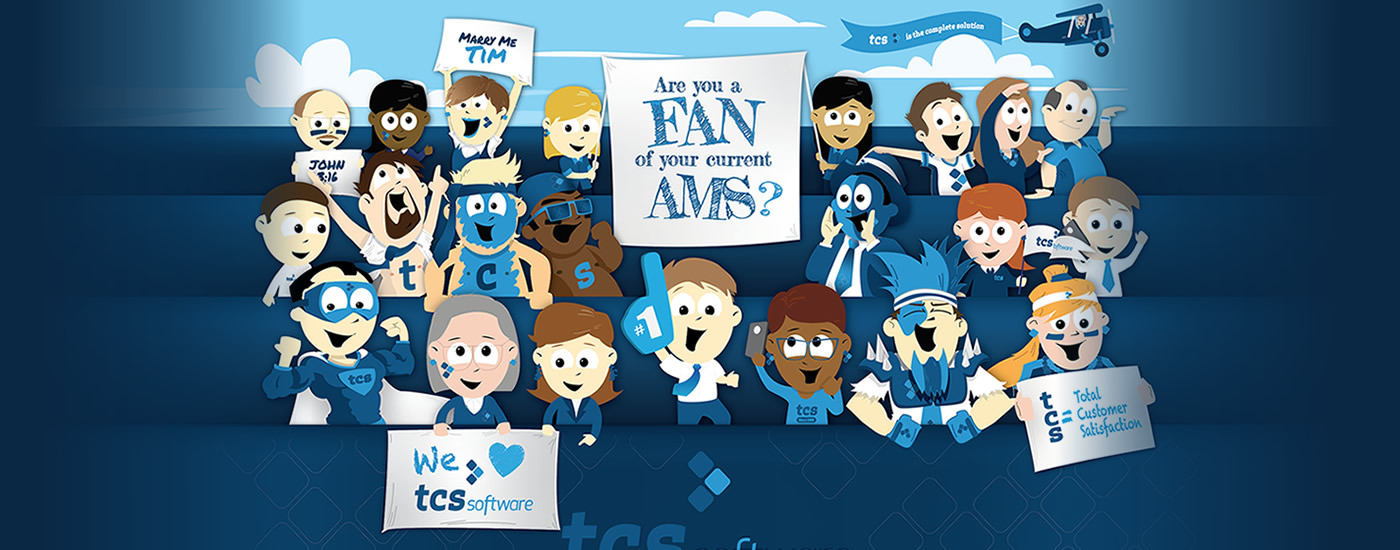
In 2019, the company gave that philosophy a wonderfully literal form. Visitors to the ASAE meeting in Columbus could collect packs of “Raving Fans” cards featuring customers. Association executives became the subjects of collectibles. It is a small, funny piece of marketing, and a useful explanation of the company’s referral strategy: existing customers are supposed to do the talking.
The testimonial page says about half its clients have stayed more than ten years. Treat that as a company-reported snapshot, rather than a measured annual retention rate. Still, it explains what TCS wants a buyer to value: continuity with people who already understand the organization.
A deposit is not a price tag
The service promise has boundaries worth understanding. Direct access is advertised for normal office hours. The relationship asks the client to learn the system, participate in implementation and keep its content useful. Buying software does not remove those responsibilities.
TCS publishes a concrete starting figure: a $1,500 deposit, applied to the first monthly statement. That number is a starting payment, not a complete implementation price. The company first assesses requirements and prepares an estimate. Monthly license fees support ongoing enhancements; website design and custom work belong in the proposal conversation.
Starting deposit → credited to the first monthly statement.
Project scope and recurring fees require a proposal.
Its implementation sequence is equally revealing. TCS prefers one design prototype, followed by construction, weekly remote check-ins and training. The customer participates throughout. The process page identifies the first one to three months after launch as critical for staff and members adapting to the site. Launch day is an early milestone in adoption.
Behind those conversations sits infrastructure. TCS’s security document describes AWS hosting, restricted private resources, multifactor authentication for administrative access and encrypted daily database backups. It also describes testing backup integrity at least twice monthly. Those are specific vendor disclosures a buyer can investigate, rather than a substitute for their own security review.
Bring the awkward invoice
TCS operates in the association-management software market alongside products such as MemberClicks and WildApricot. Both also combine familiar membership functions. Integration alone therefore does not settle the choice. TCS’s proposition puts particular weight on custom development, website work and a direct relationship with the people maintaining the system.
The useful buying lesson is to bring actual work to the demonstration. Ask for the dues invoice with the awkward rules. Bring the board report someone rebuilds every quarter. Follow a member from application through payment and event registration. TCS offers custom applications and reports, so the demo should establish what is standard and what needs a separate estimate.
That approach also exposes fit. An organization requiring assistance outside the advertised business hours should establish coverage before signing. Complex integrations deserve a specific demonstration. A team committed to separate specialist tools should weigh the work of consolidation. The attraction here depends on wanting one system and a continuing service relationship. Snide’s paper-route instinct still offers a useful test: begin with the job people must finish, then see whether the software makes it easier.