There is a moment in the life of a difficult invention when everyone gets nervous. The laboratory evidence works. The prototype behaves. The patents are filed. Then the comforting world of controlled tests ends, and a much messier question arrives: can anybody manufacture it, approve it, sell it and make the economics hold? Tau Capital has built its firm around that moment.
The Abu Dhabi-headquartered venture investor calls the territory “post-validation, pre-scaling.” In plain English, it wants the science to have survived its biggest technical doubts, but the company to still need help becoming a durable business. Tau says it generally invests about $15 million per company. It also brings commercial planning, financial discipline and introductions to regulators, industry leaders, customers and co-investors across North America, Europe and the Middle East.
That is a narrower identity than the fashionable version of DeepTech, a label now stretched over everything from clever software to nuclear reactors. Tau's test is practical. Is there serious science or engineering underneath the company? Is the intellectual property defensible? Has technical uncertainty fallen enough to see a route to market? And is scale still hard enough that an active investor can matter?
The gap with no comfortable owner
Early venture funds can tolerate raw experiments, but many lack the scientific bench or capital to underwrite a company entering manufacturing, clinical development or regulated procurement. Traditional growth investors prefer repeatable revenue and familiar unit economics. Tau argues that validated DeepTech falls between them: too technical for one group, too early for the other.
The firm borrows a little from each camp. From venture capital comes willingness to own unresolved market risk. From private equity comes attention to entry price, operating structure, financial resilience and milestones. Tau has described a typical investment timeline of 18 to 36 months, an unusually explicit clock for a sector famous for long waits. The point is not that every hard-science company matures on schedule. It is that capital should attach to a defined commercial passage, not float around a promising experiment.
The product Tau Capital sells is not simply money. It is a handoff - from scientific proof to commercial consequence.
The phrase the firm uses internally is admirably blunt: “Method beats momentum.” Its published ethos rejects the “venture lotto,” favors fundamental value and promises founders transparent treatment. Those are still claims made by the investor about itself. The useful evidence sits in the portfolio, where the promised method has to contend with factories, clinics, ministries and purchasing departments.
Air, milk, chips and other difficult nouns
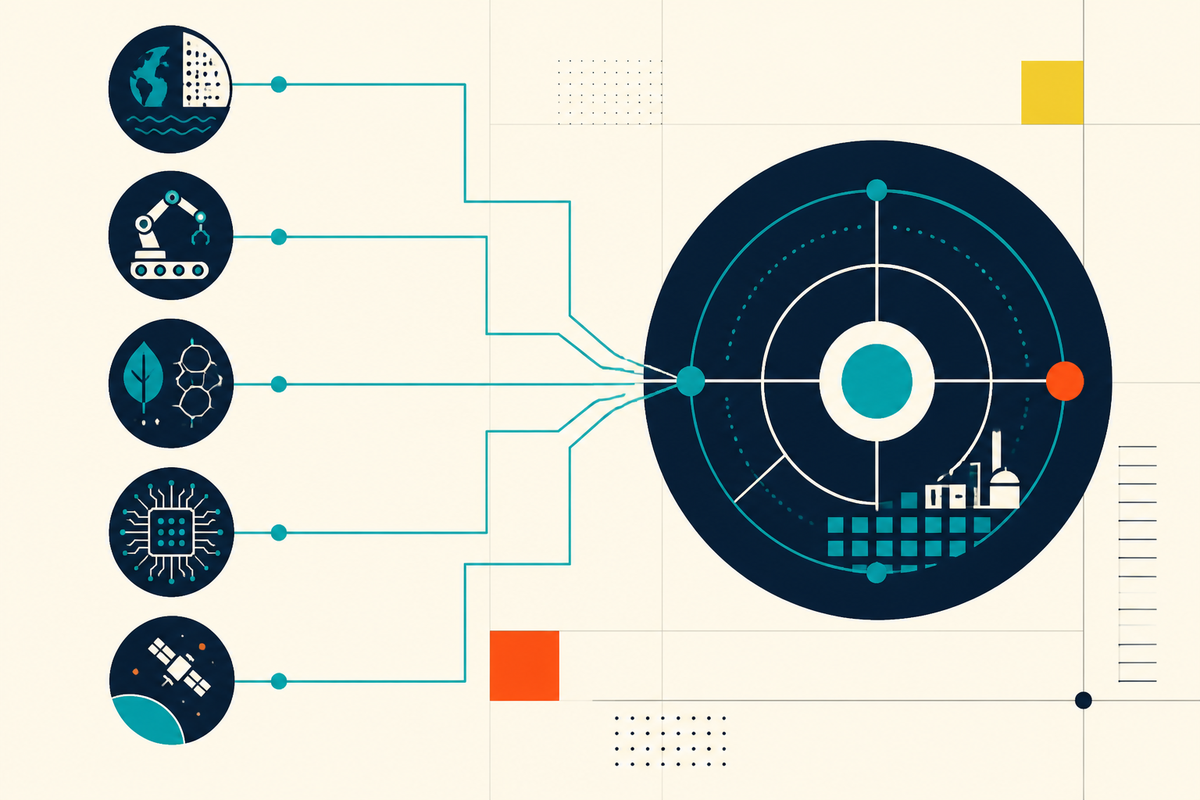
Tau organizes its interests into five themes: climate resilience, automation, TechBio, next-generation computing and the space economy. Its public portfolio currently lists 11 companies, with the visible concentration in climate, health and computing. The range is wide, but the businesses share a physical or regulated edge that makes “just ship it” an inadequate operating plan.
A portfolio built around systems
Conceptual emphasis, not dollars invested. Tau publishes company names and themes, not a full allocation table.
A1R WATER turns humidity into drinking water using atmospheric-water generation systems. Tau announced its investment in 2024 to support manufacturing, infrastructure, distribution and research. By 2025, A1R WATER had begun production at a Fort Lauderdale water farm and announced a proposed Nasdaq transaction at a stated pro forma enterprise value of $419 million. Its customers have included hotels, property developers, events and sports organizations. This is climate technology measured in filtration, logistics and bottles, not carbon-accounting slides.
Remilk makes milk proteins through precision fermentation rather than cows. The science matters, but distribution is what makes it a food business. In November 2025, Remilk and Gad Dairies launched “The New Milk” into Israeli cafés and restaurants, with retail expansion planned for early 2026. Gad contributed manufacturing experience, shelf access and consumer trust. Tau's thesis appears in miniature: validation got the product approved; partnership got it poured.
Health investments attack different bottlenecks. Quris AI combines machine learning with organ-on-chip models to predict which drug candidates may work safely in humans. Centrexion develops non-opioid treatments for chronic pain. Antidote Health uses AI-supported telehealth to lower the cost of care. Tavo Biotherapeutics is developing therapies for glaucoma and retinal disease; in June 2026 it closed a $17 million Series A with continued support from Tau. Each company faces a different regulatory and clinical maze, which makes domain judgment more valuable than generic growth advice.
Cybersecurity provides the cleanest scoreboard
Dream Security is the portfolio's most legible financial marker. The company builds AI-driven cyber defenses for governments and critical infrastructure. In February 2025, it raised a $100 million Series B led by Bain Capital Ventures, with Tau and other existing investors participating. The round valued Dream at $1.1 billion. For a young investment firm, a portfolio company crossing the unicorn line is useful validation, even if valuation is not the same as an exit.
Other computing bets widen the frame. FlowSec aims to stop distributed denial-of-service attacks at the internet-service-provider level, before junk traffic reaches a customer's network. Sepio identifies rogue and unmanaged hardware at Layer 1 without asking clients to install more agents on every device. These are enterprise products for buyers whose cost of failure includes downtime, compromised infrastructure and national-security exposure. Tau is not selling the tools to those customers; it is backing the companies that do.
Abu Dhabi is part of the product
Tau was founded in 2023 and lists offices or a presence in Abu Dhabi, London, New York and Los Angeles. Its headquarters sits in Abu Dhabi Global Market on Al Maryah Island. In March 2025, Tau Capital Limited received authorization for regulated investment activities in ADGM. The location offers more than a handsome address: it places the firm near patient pools of capital, ambitious government programs and a market willing to test infrastructure for arid climates, advanced industry and health.
The leadership team is built to use that geography. General partner Bill Murray brings diplomatic and government experience. General partner Andrea Mollica spent years in private equity and alternative investments, including at Royal Group. Managing partner Stefano Gurciullo has a doctorate in machine learning and previously managed DeepTech funds. Sergio Marques, partner for investor relations, has spent decades in institutional fundraising and distribution. It is a combination of policy access, technical screening and capital formation rather than a bench of consumer-app operators.
The business model is the familiar venture equation with an unfamiliar diligence burden. Tau manages private capital, buys minority stakes and expects returns when portfolio companies appreciate, raise later rounds or exit. But evaluating a cyber platform is not the same job as evaluating a cancer therapy or a water farm. The firm's breadth creates opportunity and a real organizational test: it must know when to rely on internal technical judgment, when to bring in specialists and when a scientific claim is simply outside its circle of competence. A small team can move quickly across sectors; it can also be stretched by them. Tau's published answer is a mix of analytical frameworks, external networks and selective entry after core validation. The quality of that filter will matter more than the number of themes printed on its website.
This cross-border posture is Tau's clearest difference from specialist US funds such as Lux Capital, DCVC, Playground Global and Eclipse Ventures. Those firms may offer deeper histories, larger platforms or stronger Silicon Valley density. Tau's pitch is that a validated company often needs several ecosystems at once: American customers, European science, Middle Eastern capital, Israeli engineering, and regulators everywhere. An Abu Dhabi anchor can turn those connections into a route rather than a collection of pins.
Who should call - and who should not
Tau is designed for a founder who can show data, not just a demonstration; defensible intellectual property, not just speed; and a commercialization plan complicated enough to benefit from regulatory and industry access. A robotics team still searching for basic technical feasibility is probably too early. A mature software company optimizing an established sales funnel is probably too conventional. The sweet spot is a science-led business that knows the machine works and now has to make the company work.
For limited partners, the proposition is concentrated exposure to technologies that may create new categories or reshape large ones. The tradeoff is familiar: DeepTech consumes capital, moves through regulation and often depends on hardware, clinical evidence or industrial partners. Tau's answer is not to pretend those frictions disappear. It waits until some have already been resolved, then prices its help around the ones that remain.
The firm is young, and its best-known achievements are portfolio financing and commercialization milestones rather than exits. That makes restraint important. Dream's valuation, Remilk's launch and A1R WATER's proposed transaction are signals, not a complete track record. The next few years will reveal whether Tau's precise entry point produces repeatable outcomes.
Still, the insight is useful even outside venture capital: breakthroughs rarely fail only because the original idea was wrong. They fail in the handoff between disciplines - science to manufacturing, invention to regulation, prototype to procurement. Tau Capital has chosen that handoff as its market. In a business fond of broad promises, knowing exactly where you want to stand is a meaningful start.