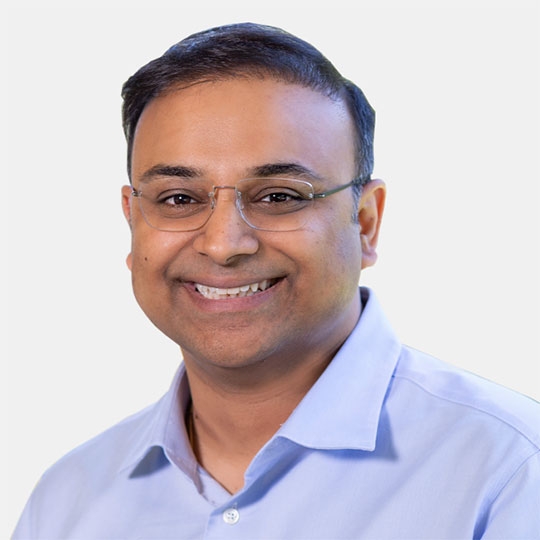
Varun Jain doesn't run the kind of fund that throws parties at Coachella. SE Ventures' portfolio - Augury, AiDash, Aquant, Enable, Oosto - reads like a list of companies that fix things before they break, optimize factories before they stall, and electrify fleets before regulators demand it. That is entirely the point. While half of Sand Hill Road was racing to back the next consumer app in 2019, Jain was co-founding a $565 million vehicle for Schneider Electric and making the quiet argument that boring is beautiful when you're early in the industrial revolution.
The fund has since grown to $1.1 billion AUM. Jain's argument appears to be winning.
The Six Years That Came First
Before SE Ventures, Jain spent six years at Qualcomm Ventures running its global early-stage practice - a portfolio that, at its peak, spanned over 80 companies and represented more than $100 million in deployed capital. The exits from that era would look strong on anyone's track record: Zoom went public on NASDAQ, Cruise Automation sold to GM, Matterport listed on NASDAQ, and 99 was acquired by Didi. Qualcomm Ventures was, by most accounts, one of the few corporate VC arms that could honestly call itself financially successful. Jain said as much when he left, thanking its leadership for building something with actual returns.
What Qualcomm gave him wasn't just deal flow - it was a specific kind of conviction about sectors that traditional VCs find unglamorous. Auto tech. Mobility. Aftermarket connectivity hardware. Autonomous vehicles in emerging markets where GPS reliability is a genuine engineering problem. Jain was writing checks and forming opinions in these spaces years before "climate tech" became a fund category.
SEV is a global corporate-backed venture fund, where our incentives are fully aligned with those of the founders we back. We are going to target companies that not only bear the promise of outsized financial returns, but are also in a position where they can leverage Schneider Electric's vast technical resources and distribution reach to radically grow their business.
- Varun Jain, on joining SE Ventures (2019)The Structural Bet
The pitch for SE Ventures isn't just capital. Schneider Electric operates across 100+ countries with deep relationships in utilities, industrial automation, data centers, and building management. For a startup selling predictive maintenance software or an AI-driven grid optimization platform, that distribution reach is the moat. Jain's core thesis has always been that the right corporate backer - one with aligned incentives and genuine sector reach - can compress a startup's go-to-market timeline in ways that no financial VC can replicate.
That's the word "aligned" doing a lot of work. Corporate VC funds have a reputation for strategic drift - investing for market intelligence rather than returns, slow decision-making, and disappearing when parent company priorities shift. Jain's response to this is structural: SE Ventures operates as a traditional venture fund with independent economics, not as a business development arm in VC clothing.
His portfolio reflects the thesis in action. Augury uses machine health data to prevent industrial equipment failures before they happen. Enable builds B2B rebate management software - unglamorous, essential, and deeply embedded in how distributors and manufacturers do business. AiDash applies satellite imagery and AI to vegetation management for utilities. Aquant deploys AI for field service operations. Every one of these companies benefits from proximity to Schneider Electric's industrial customers in ways that make the fund more than just a check.
From Delhi to Kellogg to Menlo Park
Jain's path to Silicon Valley is less "tech bro from Stanford" and more methodically global. He started with a B.Tech at Dhirubhai Ambani Institute in Gandhinagar, then took a sharp left into communications with a post-graduate diploma at MICA (Mudra Institute of Communications, Ahmedabad) - an unusual combination that suggests someone who understood early on that technology without narrative doesn't scale. After several years of work, he came back for an MBA at Kellogg School of Management at Northwestern University, where he was named a McCormick Scholar - a merit-based award that covered his full second-year tuition.
Kellogg placed him in Silicon Valley's orbit. Qualcomm Ventures followed in 2014. By 2019, he was building SE Ventures from the ground floor.
The Recognition That Followed
GCV (Global Corporate Venturing) named Jain to its Top 50 Emerging Leaders list in 2021 and again in 2022 - a two-time citation that reflects both his track record and his visible role shaping how corporate venture capital thinks about climate and industrial technology. The recognition isn't incidental; it mirrors a broader shift in which corporate VC is being taken more seriously as the category matures and firms like SE Ventures demonstrate that strategic capital and financial returns don't have to be in conflict.
His investment in UnitX in 2023 - a startup bringing AI to manufacturing defect detection, particularly for electric vehicle and lithium-ion battery production - signals where Jain's attention is currently focused. He noted at the time that UnitX had "cracked the right product and go-to-market approach" for large enterprise customers, and that the EV manufacturing sector is facing significant capacity expansion. That's not a bet on a trend - it's a bet on infrastructure that has to be built regardless of which EV brands survive the next decade.
We have looked at every major startup in this category in the past two years and it is clear to us that UnitX has cracked the right product and go-to-market approach to quickly deliver significant ROI to large enterprise customers.
- Varun Jain, on SE Ventures' investment in UnitX (2023)The Investment Philosophy, Distilled
Jain's approach to investing has a few recognizable threads. He gravitates toward B2B software with clear ROI for industrial customers - the kind of product that a plant manager or utility operations team will fight to keep in next year's budget even when capex is getting cut. He is skeptical of opportunistic founders chasing investor appetite (his words, from his Qualcomm era interviews on autonomous vehicles), and he values founders who understand that scaling in industrial markets requires more patience than in consumer software.
He also thinks seriously about emerging markets - during his Qualcomm years, he argued that the path to full autonomy in vehicles would be longer in markets with complex driving environments and regulatory uncertainty, which made aftermarket connectivity solutions a more immediately impactful near-term bet. That kind of market-specific pragmatism, rather than pure technology optimism, is a consistent trait.
At SE Ventures, those instincts translate into a fund that is sector-focused by design, stage-agnostic in practice, and disciplined about the intersection of financial returns and strategic value. The $1.1 billion under management is the output of that discipline compounding over five-plus years. The next chapter - Fund III, presumably, at some point - will be watched closely by anyone who thinks the industrial economy's software transformation is the most important undercovered story in venture capital right now.