There is a phrase executives adore because it can mean nearly anything: “Our door is always open.” Tatiane Freire Almeida has a less decorative test. Are people allowed to question the person standing in the doorway? If not, the architecture is beside the point.
Almeida arrived at that view during a career spent in the people machinery of technology companies. Her public record traces work through Telefônica Brasil, IDORT, TOTVS, Softline, SONDA and Oracle, followed by a long Red Hat chapter that expanded from Latin American people leadership into global HR business partnering. Her profile now lists IBM, a new corporate setting for an old preoccupation: how can a large organization stay responsive without treating leadership as a command performance?
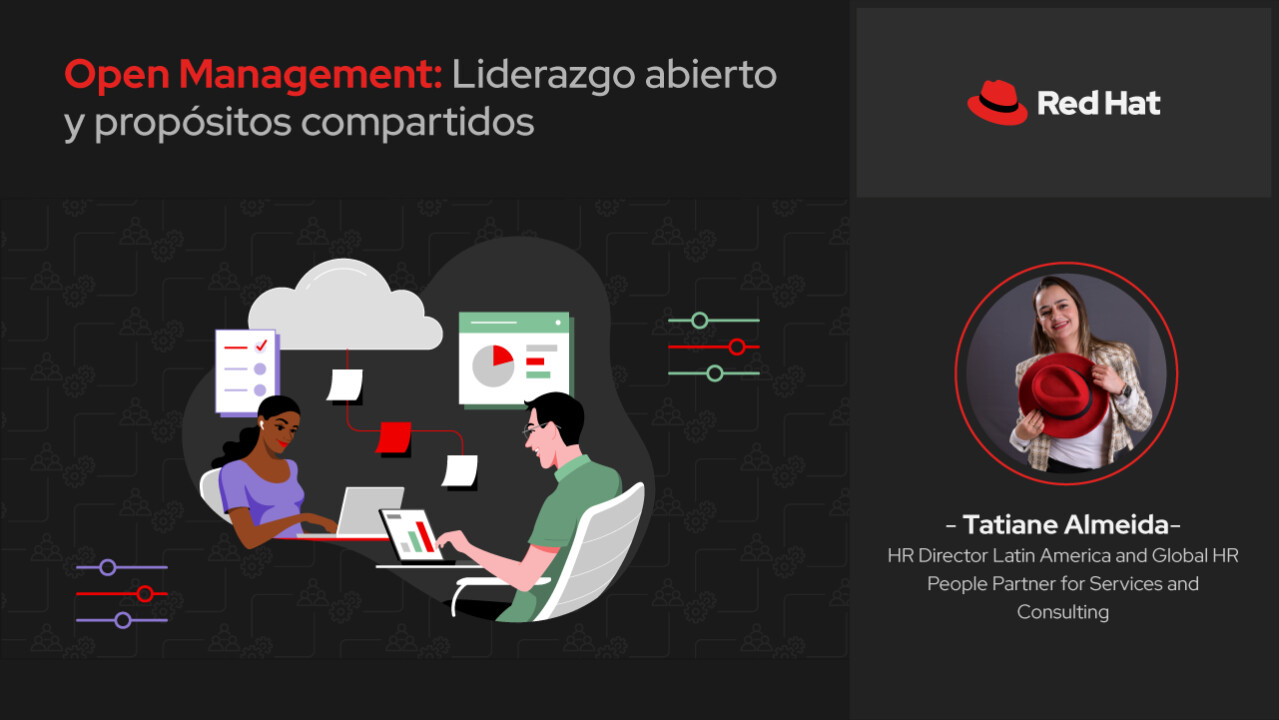
The answer she has developed borrows shamelessly from the industry around her. Open-source software improves when people can inspect, question and contribute. Almeida argues that management should tolerate the same sunlight. Participation is not a ceremonial invitation to a town hall. It is the ordinary permission to challenge an idea, understand the purpose behind it and improve the work without first flattering its owner.
“La gestión abierta es la antítesis del Ego.”Tatiane Almeida, writing on open management
When the company mission starts sounding like hold music
Her 2023 essay on open management opens with a sly observation about language: repeat a word often enough and it loses meaning. The same fate awaits corporate purpose. A mission can be memorized by 19,000 employees and still belong to nobody. For Almeida, purpose begins to work only when people recognize their own contribution inside it.
That distinction turns a soft corporate noun into a hard managerial obligation. If purpose is shared, leaders must explain decisions clearly enough to be examined. They must listen without converting every conversation into a loyalty test. They need direction, but not the sort that fills every available inch of the room. Almeida’s open leader knows when to speak, when to act and when another person should be visible.
The open-management loop
Trust gains substance when disagreement is safe enough to be useful.
Purpose travels when people can connect strategy to their contribution.
A leader makes room for expertise instead of hoarding the performance.
Experiments and failures become communal material for the next attempt.
This is warmer than bureaucracy and more demanding than informality. Someone still has to choose a direction. Deadlines remain unmoved by fine feelings. Almeida’s point is that authority becomes more durable when the reasoning can survive contact with other minds. Openness without direction wanders; direction without openness becomes theatre with an org chart.
A regional career becomes a global one
Almeida’s route to the global executive table ran through Brazil’s technology sector. Earlier jobs gave her a view of the business from several altitudes: consulting, HR operations, business partnership and regional leadership. At SONDA, a former colleague described her as strategic, demanding about quality and able to build trust with a team. At Oracle, she partnered with sales, digital and applications businesses. The sequence matters because her philosophy was tested in operating environments, not invented as a keynote theme.
She also learned to carry the argument across languages. Almeida works professionally in Portuguese, English and Spanish. Her open-management essay first appeared in Portuguese in May 2023, then in Spanish in July. This was more than syndication. Leadership language is unusually vulnerable to becoming wallpaper, particularly after translation. Words such as purpose, culture and trust travel easily while their obligations are left behind. Almeida kept the obligations intact: people need to understand why, feel able to contribute and see leaders behave consistently with the declared culture. The vocabulary changed; the test did not.
By 2022, she was speaking publicly as Red Hat’s People Director for Latin America. On a Brazilian news podcast, she joined customer-success executive Alexandre Duarte to discuss why voluntary departures were forcing employers to reconsider attraction, retention and culture. The period made every tidy theory of office life look rather antique.
When Red Hat opened a Future of Work office in Brazil that year, Almeida chose one word to explain the concept: flexibility. Remote work was not novel inside the company; more than 30 percent of its global workforce had worked remotely before the pandemic. The change was one of scale and trust. Flexibility returned time and allowed the working day to bend around responsibilities instead of pretending they had disappeared.
Her version of flexibility is not a beanbag with better publicity. It changes how managers decide whether work is happening. Physical presence stops serving as a lazy proxy for contribution. The leader must articulate outcomes, maintain connection across distance and resist the small narcotic thrill of watching chairs fill up.
One eye on the machine, one on the room
A career in technology eventually brings every people leader to artificial intelligence. Almeida has approached it with curiosity and a useful refusal to swoon. After the 2025 Red Hat Summit, she wrote about AI’s potential to inform more inclusive HR decisions with data. She paired that opportunity with a cultural condition: tools should help people and teams develop, not turn management into a remote-controlled procedure.
Her studies followed the question. In November 2025, she completed an MIT Sloan Executive Education credential in organizational design for digital transformation. In 2026, she completed an applied agentic-AI intensive through the Harvard Data Science Initiative and Harvard Data Science Review. What stayed with her was not the spectacle of autonomous systems. It was the exercise of deciding what should be automated, what should not and where human judgment still matters most.
There is a revealing continuity here. A 2024 Red Hat President’s Club award recognized her within the company; the following year, she returned to formal study. The combination is more interesting than either line on its own. Recognition did not close the syllabus. Her public posts moved from flexible work and organizational culture toward data, leadership development and AI. The subject changed quickly, while her central concern remained stable: technology earns its place when it improves the conditions under which people can contribute and leaders can decide responsibly.
THE ALMEIDA TEST FOR AI
Use technology to improve insight and consistency. Keep accountability, fairness and the human consequences attached to the people making the decision.
This makes open management newly relevant. An algorithm can make an opaque decision at impressive speed. A leader who values questions must ask who can inspect the reasoning, who can contest the result and who answers when the system is wrong. The fashionable word is agentic. The unfashionable word is responsible. Almeida’s work keeps the two in conversation.
The tension suits her larger career. She has worked close to software businesses without confusing people with software. Data can clarify patterns; it cannot absorb the moral weight of a decision. Automation can remove repetitive work; it cannot be praised, challenged or asked to step aside so a colleague can shine. Every efficient system eventually arrives at a human table.
The machine can organize the evidence. A leader still has to own the judgment.The principle running through Almeida’s recent AI work
The dinner-table theory of leadership
At the 2026 SHRM Conference and Expo, Almeida did not manage to attend every session. She did make it to two dinners with HR leaders from around the country. Those conversations became her principal takeaway. Around the tables, people compared challenges, traded experiences and formed relationships likely to last longer than the lanyards.
It is an almost suspiciously neat illustration of her worldview. The useful idea did not descend from a stage. It emerged among people with different perspectives, talking openly. Her career has stretched from São Paulo and Latin America into global roles and the United States, but the unit of progress remains pleasingly small: a conversation in which nobody pretends one point of view is sufficient.
Almeida wrote afterwards that the best ideas usually come from different perspectives sitting around the same table. The sentence works as conference reflection, management advice and an understated rebuke to the executive who thinks listening is what happens while waiting to speak.
The open-source comparison has limits, as all good comparisons do. Companies are not repositories. People cannot be forked without unpleasant paperwork. Yet Almeida has found something portable in the culture: contribution grows when information travels, questions are legitimate and credit is not rationed. The leader remains necessary, just less theatrical.
Her next chapter at IBM arrives as human resources is being rewritten by the same technology it is expected to govern. The old instincts will be tempting: purchase the system, announce the transformation, issue a vocabulary. Almeida’s body of work suggests a better sequence. Invite the question. Explain the purpose. Decide where judgment belongs. Then, if somebody else has the better answer, have the grace to move one chair over.