Tata Digital's founding problem can be pictured without opening an app. Imagine an Indian household moving through a week: vegetables from BigBasket, a phone from Croma, a prescription from Tata 1mg, a flight on Air India, a night at Taj, a shirt from Westside. The Tata Group may already appear at every stop. Yet, for years, each stop largely behaved like a separate address. Tata Digital was created in 2019 to build the hallway.
Its consumer entrance is Tata Neu, launched nationally in April 2022. The app brings commerce, travel, healthcare, payments and personal finance into one place, while NeuPass supplies the connective tissue. Eligible activity earns NeuCoins; within participating experiences, one NeuCoin is presented as one rupee. The arithmetic is refreshingly unambitious. No mental exchange rate, no prize-catalog archaeology. Shop, earn, return.
That simplicity sits on top of a complicated corporate machine. Tata Digital controls businesses including BigBasket, Croma, Tata 1mg and Tata CLiQ, plus payments and fintech subsidiaries. Tata Neu also reaches across other group brands, including airlines, hotels, jewellery and fashion. Tata Sons calls the resulting portfolio an omnichannel retailer. That description is more useful than "super-app": this is software joined to stores, warehouses, diagnostic labs, farms, hotel rooms and delivery riders.
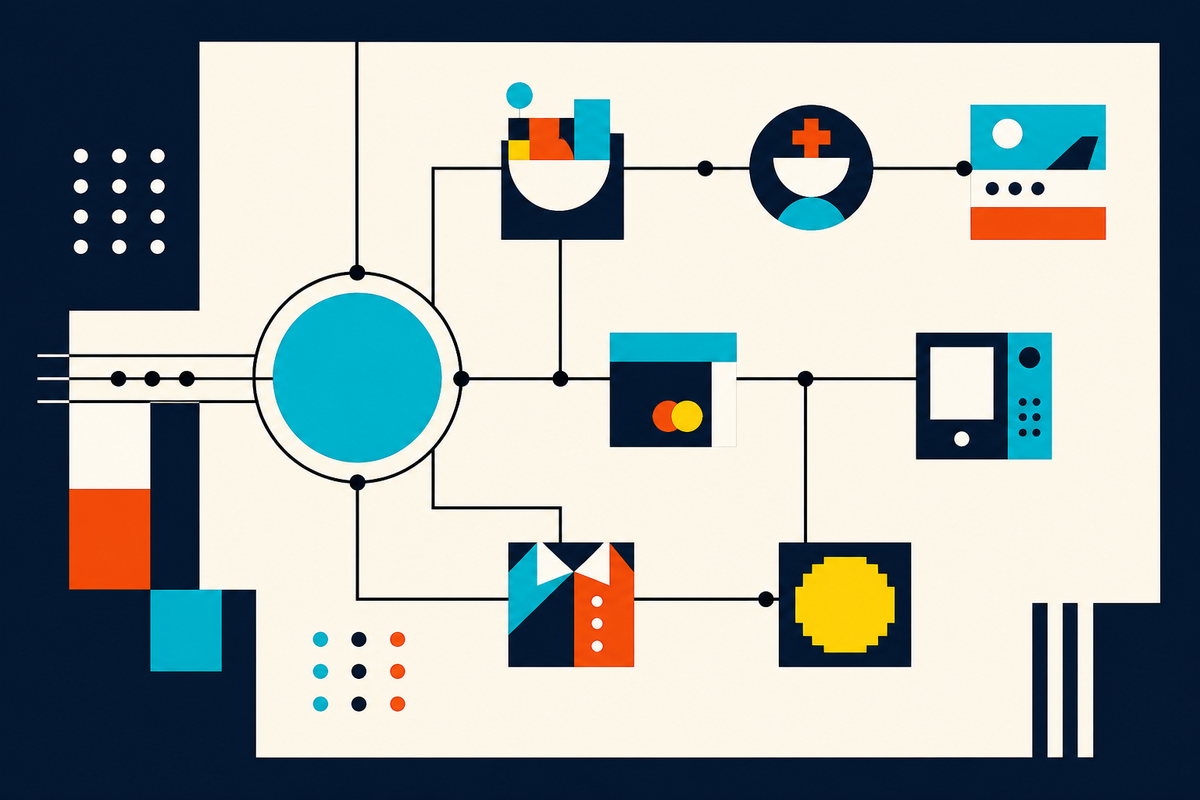
A portfolio disguised as an icon
Most celebrated Asian super-apps grew outward from a frequent behavior. WeChat had communication. Grab had rides. Alipay had payments. Tata Neu began from the opposite direction: a wide inventory of strong brands looking for a common interface. It started with supply before proving a single daily habit.
That inversion is both its difference and its difficulty. An independent rival could copy a rewards mechanic, but not quickly reproduce Tata's mix of consumer trust, physical distribution and category ownership. BigBasket brought grocery frequency and an integrated fresh-food supply chain. Croma brought electronics and hundreds of stores. Tata 1mg brought medicine delivery, diagnostics and teleconsultation. Hotels and airlines brought higher-value but less-frequent purchases. Put together, they cover the mundane and the aspirational.
The numbers are substantial. Tata Sons reported more than 140 million NeuPass members, FY2025 revenue of ₹8,969 crore and 2,370 employees across the Tata Digital business. At launch, Tata Neu said its connected assets already touched 120 million consumers, 2,500 stores and 80 million app users. This was never a cold start. It was a warm start in a building with many thermostats.
“The product is not the catalog. It is the permission to return for a different reason.”The operating idea behind cross-category loyalty
The coin is the plot
NeuPass is designed to make one purchase improve the odds of another. A grocery order can create value for a later electronics purchase; a hotel stay can feed the same identity used for medicine or fashion. That changes rewards from a discount attached to one shop into a portable balance. In theory, every new category makes the existing categories more useful.
For customers, the proposition is practical when they already shop inside the group. Tata Neu can be a single place to order food, book a laboratory test, recharge a phone, pay a bill, buy a flight or compare a financial product. The strongest benefit is not that these actions are technologically novel. It is that identity, payment and reward can travel with the customer. A household can use the app as an errand board, a wallet and a rewards ledger, then decide whether convenience beats opening the specialist app for each task.
But breadth creates tax. Every additional mini-store adds navigation, data and service complexity. A delayed grocery order and an insurance policy do not belong to the same customer-support script. A luxury hotel should not feel like a supermarket checkout. The product team must preserve each brand's reason for being while making the seams disappear. If the seams remain visible, a super-app becomes a folder with marketing.
Finance finds the frequency
The more focused version of Tata Neu is emerging around loyalty, payments and financial services. That is a logical correction. Shopping categories may be broad, but payments can touch all of them. Credit cards can reward transactions inside and outside the app. Insurance, loans, fixed deposits and investments create higher-value relationships and additional reasons to reopen the platform.
The company has been building that layer in pieces. Its co-branded HDFC Bank card crossed 1.5 million users by October 2024. SBI Card joined in April 2025 with Plus and Infinity variants. Tata AIA life policies appeared inside Tata Neu with a shortened digital purchase journey. A fixed-deposit marketplace launched with investments starting at ₹1,000. Zomato and Spotify partnerships pushed card benefits beyond Tata-owned storefronts.
ONDC, India's open digital-commerce network, offers another route. Tata Digital said that, as a buyer platform for financial services, it drew more than one million personal-loan applications in under three months in 2025, connecting customers with 14 lenders. Here Tata Neu is not manufacturing the loan. It is using reach, identity and distribution to help consumers compare and apply while partners supply the balance sheet.
This is the business model in miniature. Tata Digital earns through a mix of underlying retail operations, marketplace and service economics, payments, financial-product distribution and partnerships. Loyalty can reduce the cost of reacquiring the same customer for a second category. Data can improve personalization and underwriting journeys, subject to consent and regulation. The platform becomes more valuable when it recognizes intent early and hands the customer to the right operator cleanly.
A moat with maintenance costs
There is no single Tata Neu competitor. In broad commerce it meets Amazon, Flipkart and Reliance. In quick grocery it faces Blinkit, Zepto and Swiggy Instamart. In payments and finance it competes with PhonePe, Google Pay and Paytm. In healthcare, Tata 1mg meets PharmEasy and Apollo 24|7. More broadly, it competes with every familiar icon that already owns a consumer habit.
Tata's edge is a portfolio competitors would have to negotiate brand by brand. Its burden is that ownership does not guarantee integration. Different technology stacks, incentives, fulfillment systems and executive priorities have to cooperate. The group has supplied patient capital: in June 2026, Tata Sons reportedly invested just under ₹3,000 crore at an implied valuation near $10.3 billion. Yet reported FY2026 losses widened to ₹4,974 crore. Scale has not removed the demand for discipline.
Leadership has also changed. Sajith Sivanandan, previously president of Jio Mobile Digital Services and earlier chief executive of Disney+ Hotstar, became CEO and managing director in September 2025. His stated focus on loyalty and financial services suggests a move away from measuring success chiefly by the number of categories or gross merchandise value. The sharper question is whether each transaction strengthens the next one.
“One NeuCoin equals ₹1.”A tiny sentence doing conglomerate-sized work
The useful lesson in the hallway
For product builders, Tata Neu offers a portable lesson: aggregation is not integration. A dozen services can share a login and still feel unrelated. The connective layer needs a job customers notice. NeuCoins are one such job. Payments are another. A consistent service recovery system may matter as much as either, because trust earned by one Tata brand can be spent by another.
The company also illustrates why distribution is not the same as engagement. More than 140 million loyalty members create a formidable address book, but membership can be passive. Daily or weekly usefulness comes from speed, relevance and predictable value. Grocery can supply rhythm. Payments can supply reach. Finance can supply margin. Travel and luxury can supply memorable redemptions. The craft is arranging those roles without asking the customer to admire the corporate diagram.
Tata Digital describes a culture of customer-first decisions, trust, equal voice and comfort with the ambiguity of building. Its own phrase, "product is marketing," is unusually apt here. No campaign can permanently explain away a crowded journey. If Tata Neu becomes faster and clearer each time the portfolio grows, the product will make the case. If not, users can still visit the brands directly.
The original super-app ambition was easy to draw: every need inside one rounded square. The more interesting ambition is now narrower and harder. Make a rupee earned in one corner feel useful in another. Make a payment reveal the next helpful service without becoming intrusive. Make a century-old collection of companies recognize one customer, while letting each company retain its character. Tata already built the rooms. The future of Tata Digital depends on whether the hallway becomes a destination.