The customer had a rather inconvenient objection. Tasso Roumeliotis and his colleagues were describing how their software could let a business exchange messages with its customers. They had imagined something like WeChat: a place where commercial life could happen through conversation. The prospective buyer, however, received no texts and hundreds of telephone calls. Could they do something about those?
It was a small correction with a large consequence. A ringing telephone does not care how elegant a product demonstration looks. The people building the software had arrived with a view of the future; the person running the business had arrived with work to finish. Roumeliotis later recalled the encounter as a lesson in timing. Useful technology still has to meet a customer where the customer actually is.
That encounter makes a good entry into his career. Roumeliotis has an MBA, a company sale, and a second venture with colleagues from the first. Yet the revealing moments involve people interrupting the neat version of events. A customer changes the question. An acquisition gives the founder a boss. Dealerships find uses for software its creators had not anticipated. He keeps having to listen.
Eight years behind the counter
He grew up in Montreal, the son of Greek immigrants, in an extended family of small-business owners. His parents ran a convenience store. He has described them working for eight years without taking a day off, weekends and holidays included. That is an education in the cost of keeping the door open. The store also offered lessons in how to make somebody want to come back.
In a later conversation about his upbringing, his mother’s approach to customers stood out: remember their names, greet them warmly, make them feel valued. Those gestures required attention rather than a budget. Years later, he would build software concerned with the same commercial question: what happens between a business and the person who needs something from it?
His formal education took him to McGill University for a Bachelor of Commerce and Harvard Business School for an MBA. His career included Bain & Company, merchant banking at Donaldson, Lufkin & Jenrette, and a vice presidency at Claridge Investments, the Bronfman family office. Consulting and finance gave him one view of business. The family store had already supplied another, at counter height.
The exit that came with a new boss
Location Labs built mobile and location-based technology, distributing services through wireless carriers. By 2014, Roumeliotis was running a business whose products reached people through the companies selling them phone service. Its acquisition by AVG was announced that September in a deal worth up to $220 million. A founder could reasonably have treated that as an ending. Roumeliotis soon found plenty of unfinished work.
In February 2015, he wrote about the aftermath. He was meeting employees in small groups, making room for questions about the new arrangement. He described himself as emotional and intense, and the work of listening as demanding. The sale had changed the ownership of the company. Helping the people inside it adjust was a more personal assignment.
There was also a novelty his team enjoyed: he now reported to somebody. After more than a dozen years, the founder had a boss, AVG chief strategy officer Todd Simpson. Roumeliotis admired Simpson’s steadiness. He also credited Joel Grossman with handling the many practical details of bringing the two companies together. The celebration may have belonged to everybody; the calendar invitations still needed an owner.
His reflections wandered beyond the transaction. He spoke Greek, English, and French, and welcomed the prospect of working across more countries. He was more interested in supporting other entrepreneurs than buying a Lamborghini. For someone whose next company would work with car dealers, that last preference makes a pleasing footnote. The work, and the people doing it, continued to hold his attention.
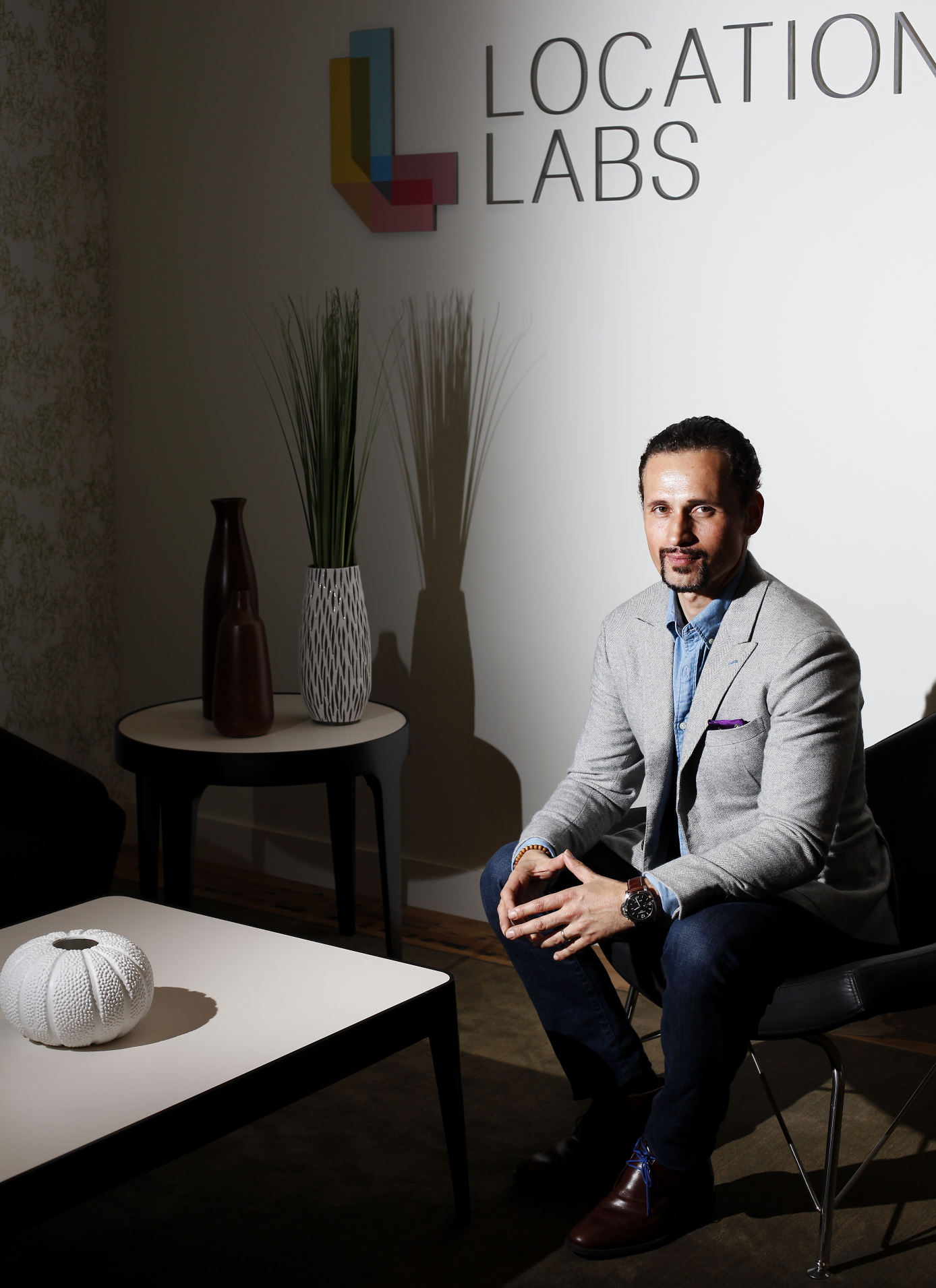
The colleagues who stayed for the sequel
Grossman’s connection to Roumeliotis began with an introduction through a business-school friend and a summer internship. He eventually became Location Labs’ chief operating officer. In 2015, the company reported a 95% employee retention rate. Roumeliotis was still interviewing nearly every new hire. Hiring had remained part of the chief executive’s job even as the organization grew.
Location Labs gave an award called the Spartan Shield to employees who helped colleagues beyond their own responsibilities. The image was of a shield protecting the person beside its bearer. It was a theatrical name for a practical workplace habit: if another team is struggling, its problem may become yours soon enough. Helping early is cheaper than admiring the wreckage later.
That history matters to Numa. Roumeliotis returned to company building with Grossman, Andy Ruff, and Steven Ginn, all veterans of Location Labs. Today they hold the roles of CEO, president, chief product officer, and chief technology officer respectively. Their new venture carried an existing working relationship into a different market. They had already learned who could handle which part of a difficult day.
Location Labs’ reported employee retention rate in its 2015 culture interview.
A telephone number with a second life
Before its dealership focus, the business was known as NumberAI. In 2019, when Roumeliotis joined the Endeavor network, its proposition was to make small-business landlines usable for messaging. A number customers already knew could become a route into two-way conversations, with software helping businesses manage questions, orders, and appointments. The familiar number was an asset worth keeping.
The company also looked to telecom partners as a distribution channel. That echoed experience gained at Location Labs: the technology was only one part of the job; reaching customers was another. A small-business owner has little reason to learn a new tool merely because somebody has built it. A tool arriving through an existing relationship has a different introduction.
The original ambition covered many kinds of businesses. A salon’s appointment book and a restaurant’s changing menu both offered reasons for customers to ask questions. But serving that variety meant finding a common product among different working days. Roumeliotis’s story of the customer with hundreds of calls captures the difficulty. Demand is wonderfully specific, particularly when it is standing across the table.
The car dealers arrived without an invitation
The automotive turn had an unexpected beginning. Roumeliotis has said dealerships became some of Numa’s biggest users even though the company had spent no marketing money reaching them. They were also using it in ways the team had not expected. He responded by committing the business to dealerships. Customers had supplied both a market and an education in how it worked.
He described the coordination problem in concrete terms: about 19 different people might interact with a customer across a dealership visit. An advisor needs an answer from the parts department. A customer needs an update from the advisor. Somebody else wants an appointment. Numa brought communications into a shared system, making requests and responses visible. Even an ordinary question about a delayed part could become something a manager could track.
The attraction is easy to understand. A customer does not experience the dealership as a collection of software systems and departments. They experience a promise about their car. When the answer gets lost between people, that promise becomes harder to believe. Roumeliotis’s chosen problem gives a familiar frustration an organizational explanation: the answer may exist, but the person who needs it cannot yet see it.
Money for the next version of the working day
In October 2024, Numa announced a $32 million Series B led by Touring Capital and Mitsui, bringing its stated total funding to $48 million at that time. The announcement described more than 600 dealership customers across the United States and Canada. It also recorded a No. 168 position on the 2024 Inc. 5000 list, with 2,248% revenue growth over three years.
Roumeliotis wanted to build what he called the AI-native dealership. The company said the funding would expand its AI engineering team and speed product development. Mitsui described tools for inquiries, appointment scheduling, customer relationships, and workflow design. The ambition was widening from catching a missed conversation to coordinating more of the work that conversation set in motion.
His public discussions also kept returning to the employees using the tools. In his outlook for service departments in 2025, he argued for automating repetitive administration while keeping staff involved in the customer relationship. In June 2026, a conversation with Jen Suzuki examined resistance to AI and how leaders communicate change. Winning agreement inside a dealership remained part of the assignment. A purchased tool still has to earn a place in somebody’s day.
- AVG announces the Location Labs acquisition, worth up to $220M.
- Roumeliotis joins Endeavor as NumberAI’s founder.
- Numa announces its $32M Series B.
- FordDirect selection and the SocketTime acquisition.
When the dashboard became a scoreboard
An August 2026 discussion with Sean V. Bradley supplied another customer-led surprise. Roumeliotis explained that some dealerships had put Numa’s LiveCSI rankings on television screens in their service departments. The company had built a way to see customer sentiment and advisor performance; operators turned it into a visible scoreboard. They had found a use the founder said he had not imagined.
His short instruction was “Create the visibility.” The appeal of the screen is that people can see the work and their place in it. He also argued that dealerships were fundamentally in the retention business, and that feedback needed to arrive while somebody could still act on it. An angry customer helped today presents a different opportunity from an angry customer discovered weeks later.
The principle has a personal echo. At Location Labs, he had made time for employees to voice concerns during an acquisition. At Numa, he wants teams to notice customer concerns sooner. The situations differ, but both depend on a person being heard in time for another person to respond. Software can make the signal easier to find. Somebody still has to decide what to do with it.
“Create the visibility.”
Tasso Roumeliotis, in conversation with Sean V. Bradley, August 2026
Connecting the conversation to the workshop
The next move reached further into the shop. In August 2026, Numa acquired SocketTime, whose software handles service scheduling, dispatch, technician utilization, inspections, and other operational work. The announced plan was to integrate AI into that platform by the end of the year. Roumeliotis wanted customer communication to draw on information about the actual work, including progress and delays.
That same month, FordDirect selected Numa as a strategic AI vendor for Ford dealers and Lincoln retailers. The announcement said more than 170 stores in those networks were already using it and put Numa’s wider customer base above 1,300 dealerships. Those are company-reported milestones. They show the scale of the current undertaking, while the SocketTime integration remained a stated plan.
The distance from a Montreal convenience store to dealership software is considerable. The recurring question is surprisingly ordinary: does the person asking for help get an answer? Roumeliotis has built, sold, listened, and started again. The prospective customer who interrupted his messaging pitch had handed him a useful test. Hundreds of calls were coming in. There was work to do. Could his team help pick up?
Read, watch, follow
- Numa - the current work
- LinkedIn - Tasso Roumeliotis
- X - @TassoR
- Medium - essays by Tasso
- Post-acquisition Life: What’s on the Other Side?
- The Location Labs culture interview
- The customer correction: a 2020 interview
- How dealerships discovered Numa
- The $32 million Series B announcement
- Watch: Immigrant Nation, episode 116
- Watch: Sean V. Bradley and Tasso Roumeliotis
- Listen: Dealer Talk with Jen Suzuki
- Numa acquires SocketTime
- FordDirect’s Numa selection
- Endeavor welcomes NumberAI
- Location Labs in 2014