The first bargain was modest: give it three months. Dr. Tariana V. Little and Jonas Meyer were students trying Craigslist gigs, testing whether their creative work could support a business. A three-month experiment has certain advantages over a grand declaration. It fits on a calendar. It permits doubt. And if the idea fails, at least it has the courtesy to do so before becoming a five-year plan.
The idea survived. They founded EmVision Productions in 2013. Ten years later, they bought a building in Lynn, Massachusetts, and opened a studio where the agency could make films and other people could make things happen. The question had grown from whether two students could find paying work to what a creative business could make available to its neighbors.
Little’s route to that building runs through a suburban school bus, an organic grocery store in Germany, a community-college registration desk, and several rounds of learning how to be a CEO. She brings those experiences into a company concerned with who gets heard. The finished video is one expression of that concern. The studio and scholarship fund are others.
Ten dollars at the door
Little grew up in Dorchester, in a Spanish-speaking, multigenerational family with Dominican and German roots. Through METCO, she traveled from Boston to schools in Framingham. Her daily route crossed communities with different resources and expectations. She has described experiencing inequity before she had the words to describe it.
After school, she worked alongside her mother cleaning offices and homes. College was geographically close and financially distant. In 2007, after high school, she moved to Germany with help from her family and German teacher. She learned the language, worked in her host mother’s organic grocery store, and met Meyer, who would become her partner in life and business.
Returning to Boston brought a reckoning with tuition. Her plans for American University gave way to what she could afford. She arrived at Roxbury Community College with a copy of her high school diploma and $10 for registration. At 19, she became the first person in her family to attend college.
RCC gave her a place to participate. She completed the Honors Program, joined student government, led clubs, worked on campus, and wrote for the Gateway Gazette. She graduated with an associate degree in social science in 2009, after three semesters. The registration fee had purchased entry; she supplied the considerable activity that followed.
At UMass Boston, where she earned her undergraduate degree in 2012 and a graduate degree in 2017, her interests continued to cross disciplines. Research, writing, photography, and activism could inform one another. She created TVLENSES as a creative identity and described her approach as “intentional creativity for social change.” It was a useful name for a working life that refused to stay in one department.
Three months to see what happened
EmVision’s early experiment allowed Little and Meyer to try that combination in public. People needed creative work. The two students could attempt to provide it. Each gig offered a more useful answer than another evening spent discussing whether the idea might work.
Little also had a different career plan underway. She intended to become a research scientist. A failed doctoral qualifying exam interrupted that plan. She later described giving herself two years to experiment, grow, and decide what she wanted to do. She committed more fully to the agency they had started while students.
Her education continued; she earned a Harvard doctorate in 2020. So did the company. The interesting part of this turn is its lack of tidiness. Academic training and creative work overlapped. A setback required a decision, and she made space to test a different direction without waiting for a complete map.
Today, EmVision calls its approach Social Impact Storytelling™. The agency helps organizations explain their work through people’s experiences. Its clients span grassroots groups, public institutions, and corporations. Little’s background gives her a reason to ask both what an organization wants to communicate and whose account will make that communication meaningful.
The creative range extends beyond institutional campaigns. Little’s photography is credited on musician Al Copeland’s Love Story album; a later release credits her with photography and styling. The photographer and the executive have been sharing a working life for some time.
The CEO went back to class
A creative business eventually presents questions that cannot be settled with a better camera angle. What should it charge? Who keeps the books? What structure lets the team keep doing the work next year? Little and Meyer sought instruction.
In 2018, EmVision participated in Interise’s StreetWise MBA program. Mentor José Perez of Roads Consulting Group encouraged them to think more strategically. They worked on business targets, finances, taxes, bookkeeping, and operating systems. It was the education behind the production: less likely to appear in a showreel, rather useful when a bill arrived.
Little also completed Goldman Sachs’ 10,000 Small Businesses and ICIC’s Inner City Capital Connections programs. At ICIC, hearing fellow entrepreneur Andreina Viera Silva describe her experience expanded Little’s sense of possibility. Her recollection was direct: “I can be like her, too!” A peer had made the next step easier to imagine.
Perez later introduced EmVision to Eastern Bank. Through that relationship and the SBA 504 loan program, the founders financed a property in Lynn. The path from classroom to building involved several kinds of expertise. Little’s willingness to learn made those connections part of the company’s growth.
A building with more than one purpose
They purchased the building in January 2023. Owning it gave EmVision control over a place to conduct interviews and produce work. It also introduced the founders to the practical requirements of a space that other people would use: equipment, furnishings, paint, heating, and cooling.
The founders used the state’s Biz-M-Power crowdfunding program to help fund improvements. The program offered a two-to-one match on qualifying contributions, up to a $40,000 match. EmVision raised $22,157 from 72 patrons in 30 days. The campaign exceeded its donor goal when a client supplied the final $1,000.
Campaign goal: $20,000 from donors + up to $40,000 in program matching funds. The donor campaign exceeded its goal.
The studio opened in September 2023. Local artists had a hand in giving it character. Anna Dugan created an exterior mural; Michael Aghahowa’s paintings appeared inside. The founders deliberately hired local companies, contractors, and artists, keeping part of the investment close to the place it was meant to serve.
The space became available to artists, organizations, and community members. Subsequent programming has included networking, business workshops, screenings, and vendor markets. A production studio has demanding technical uses, but it can also be a room where people meet someone they will later work with. Little’s business made room for both.
The scholarship remembers
In 2022, Little and Meyer established the EmVision Social Impact Scholarship Fund at UMass Boston. Their commitment has since grown to more than $50,000. The fund supports graduate students in Critical Ethnic and Community Studies, the program Little completed herself.
It offers flexible funding, mentorship, and applied opportunities. The scholars’ projects show how widely community work can range: colorism in entertainment media, religious identity among African Muslim immigrant students, and cultural approaches to learning. Supporting the program gives students time and resources to finish work rooted in questions that matter to them.
Little has said scholarships made her own education possible, and she had promised to repay those gifts. Her choice of institution and program makes that promise specific. She remembers the route because she traveled it. She has also expressed a hope of establishing a scholarship at RCC.
The agency extends support through other channels. EmVisionary Grants provides pro bono services to small nonprofits led by people of color. Community Portraits offers discounted collaborations for grassroots organizations. Each addresses a different practical obstacle: paying for school, commissioning professional media, or finding support for a small organization’s message.
The next person in the frame
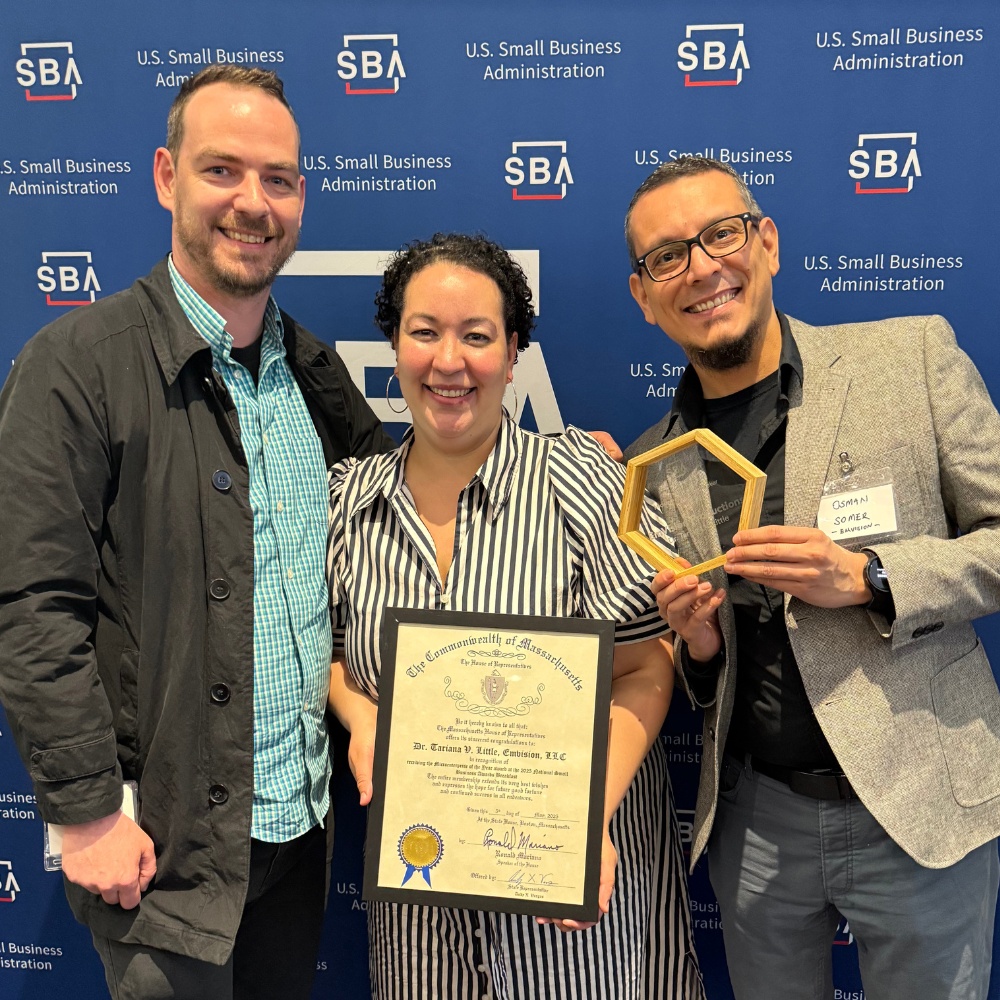
Recognition has followed. EmVision was the SBA’s 2025 Massachusetts Microenterprise of the Year and received the Greater Boston Chamber of Commerce’s Cultural Excellence honor. In 2026, it became the Massachusetts LGBT Chamber of Commerce’s LGBTQ+ Business of the Year. Little joined the Boston Business Journal’s 40 Under 40 class.
Her habit of imagining what comes next has a physical form: vision boards. She describes them as a practice of mindfulness, a way to clarify intentions. In a conversation with Mikki Wilson, she put the purpose plainly: “Nothing becomes real until you put it in front of you or speak it out loud.”
A business test becomes a studio. An education becomes support for another student.
The shape of a continuing commitment
There is a satisfying counterpart to those boards in the company’s return to RCC. EmVision has produced student-centered videos for the college and partnered on its Legacy Video Series. Little arrived there carrying a diploma and a registration fee. Her company returned with the means to help other people describe their beginnings.
That is where her story keeps opening outward. A business test becomes a studio. An education becomes support for another student. The person behind the camera knows what it took to enter the room. Now she has some say in how wide the door stays open.
Watch, read, follow
Explore the films, conversations, and community projects.
- EmVision Productions: work and studio
- RCC Legacy Video Series: watch the YouTube films
- Watch a film from RCC’s Legacy Series on YouTube
- Creativity Connects: Little in conversation with Mikki Wilson
- Meet the EmVision Scholars
- The studio’s crowdfunding story
- Tariana Little on LinkedIn · Instagram · Twitter / X · TVLENSES photo blog
- EmVision on Instagram · Facebook