The clock started with a Canon camera and a bargain between two poor college students: three months. If the experiment produced paid work, Tariana Little and Jonas Meyer had a business. If it produced zero dollars, Meyer’s new love of filmmaking would remain a hobby. They put free creative services on Craigslist, found people willing to take the bet, and earned money before the deadline. The idea survived. More importantly, the deadline did its job.
That was 2013. EmVision Productions now occupies a useful corner of the media market: the place where an organization has something complicated, consequential and slightly impossible to explain. A public-health department needs clinicians to understand holistic HIV care. A foundation wants data about uninsured residents to sound like lived experience rather than a spreadsheet. A biotech company needs families living with rare disease to be heard without becoming props. EmVision makes the videos, photographs and campaigns that carry those stories.
01 / The actual product
Video is the container. Trust is the merchandise.
Little, the CEO and co-founder, did not arrive from advertising. She was studying how stories could change health behavior. Meyer, now creative director, was a musician who picked up a camera to film his band. Their overlap became a question: if narrative can help change what a patient does, can it help an organization explain what it changes?
EmVision’s answer is a branded framework called Social Impact Storytelling. Strip away the trademark and the method is sensible. Start with the people most affected. Decide which audience needs to move and toward what action. Recruit speakers who can carry the truth of the issue. Build interview guides around dignity rather than extraction. Then combine interviews, supporting visuals, pacing, music, captions and distribution into an asset with a job beyond looking polished.
The company’s Cristo Rey Boston case study makes the machinery visible. The audience was not “everyone.” It was current and potential donors, funders and corporate partners. Speakers included a student, an alum, the school president, an early sponsor and a founding trustee. The film premiered at an academic signing-day event where the school raised more than $1.1 million for scholarships. The video did not single-handedly raise that money, but it had a defined seat in the room.
“Humanize complexity. Build trust. Inspire action.”EmVision’s six-word operating brief
02 / The founders in the frame
An accidental agency learns to run a company

The founding story is charming because it is scrappy. The middle is more useful because it was not. By 2018, the first thing failing was not demand or craft; it was the idea that two first-time entrepreneurs could improvise every part of a growing company. EmVision entered Interise’s StreetWise MBA program, its first formal business training. Mentor José Perez pushed the founders to think larger and more strategically. They set targets, structured finances, arranged tax and bookkeeping support, and built operating systems.
That intervention changed their minds about scale. The lesson was not to become a large agency. It was to stop treating administration as the boring bit attached to the art. For a tiny service company, reliable books and a repeatable process are production equipment. Perez later introduced EmVision to Eastern Bank. That relationship eventually helped the company navigate an SBA 504 loan and buy a building in downtown Lynn.
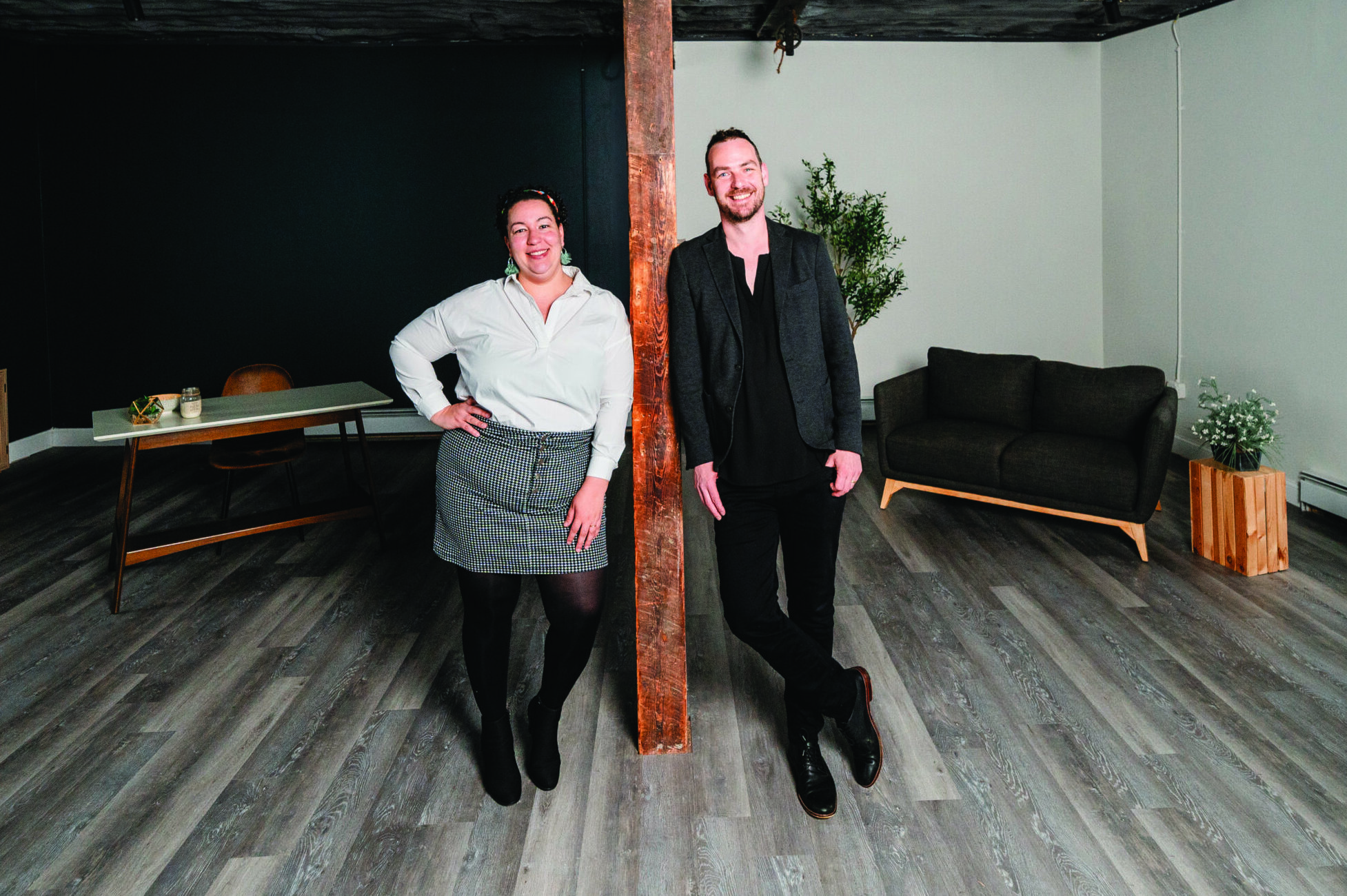
The building changed the product again. EmVision Studios is roughly 3,400 square feet across two floors, with natural light, movable furniture, photography backdrops, a conference room and event capacity. For the agency, owning the interview environment matters when a speaker is discussing medical neglect, immigration, housing or identity. For the business, the same asset can be rented to creators, meetings and events. For Lynn, it can host workshops, exhibits, queer-business clinics and screenings. One property does three jobs: set, revenue line and commons.
03 / The money
A rate card in fragments - and one unusually revealing budget
EmVision sells custom projects, so the public numbers cover several very different offers. Studio membership begins at $300 a month. Creative or meeting rental begins at $85 an hour; event rental begins at $150. The yearly EmVisionary Grant provides an eligible nonprofit with a 2.5-minute mission film valued at $30,000, delivered across six to nine months. Organizations with up to $250,000 in revenue contribute nothing; the sliding contribution rises to $2,500 and then $5,000 in the next two revenue bands.
Four public prices, four different products
A municipal grant application supplies a rarer view. EmVision estimated $200,000 for four English-language films of roughly two and a half minutes each, plus four 30-second clips, about gambling-harm reduction. The largest buckets were $80,000 for production, $61,600 for post-production and $54,400 for analysis, strategy, planning and coordination. Inside those buckets sat pre-interviews, speaker recruitment, a full crew, photography, stipends, transport, meals, licensing, captions, three feedback rounds, hard drives, archiving and contingency.
That is the hidden product. A viewer sees ten minutes of finished film. The client buys the research, relationships, consent, logistics, redundancy and judgment required to make those minutes responsible. Cheap video competes on camera days. EmVision’s offer makes a case for pricing the invisible work.
04 / The give-forward loop
The portfolio is also a redistribution system
EmVision describes itself as a social enterprise, and the claim has a mechanism behind it. A portion of paid engagements supports pro bono work for BIPOC-led nonprofits, grassroots collaborations and a UMass Boston scholarship. Since launching EmVisionary Grants in fall 2020, the company says it has donated more than $225,000 in services. It also committed $50,000 to endow a scholarship for graduate students in Critical Ethnic and Community Studies.
The EmVision flywheel
The grants are designed, not improvised. One or two Greater Boston nonprofits are selected each year. Applicants need nonprofit status or a fiscal sponsor, at least five years of operating history, paid staff and leadership reflecting disadvantaged backgrounds. Past and current EmVision clients cannot apply. That last rule is a small masterstroke: it keeps the benefit from becoming a rebate for insiders.
Community Portraits widen the model through partially subsidized collaborations. Subjects have included medical distrust, Afro-Latinx identity, housing justice, climate organizing and queer business. In 2020, an EmVision film for the One Chelsea Fund accompanied a campaign that raised more than $1 million at its May debut for families hit by COVID-19. Again, correlation is not sole credit. But distribution, moment and audience lined up.
05 / What to steal
Copy the architecture, not the aesthetic
The easy imitation would be a teal website and the phrase “impact storytelling.” The valuable imitation is structural. First, test demand with a deadline and a deliberately cheap experiment. Second, combine two forms of expertise that rarely share a proposal; EmVision fused production with public health and community studies. Third, name the process so customers can understand why it is different. Fourth, invest in unglamorous operating systems before the founders become the bottleneck. Fifth, make the give-back legible with eligibility, cadence, scope and dollar value.
There is also a product lesson in the studio: buy infrastructure only when it can perform several jobs. EmVision’s property improves sensitive production, generates rental income and creates a public venue. The company did not jump there from Craigslist. Training, mentorship, a banking relationship and SBA-backed financing formed the bridge.
Works when...
- The issue is complex and trust-sensitive.
- People affected can shape their representation.
- The client can name an audience and an action.
- Time exists for research, recruitment and consent.
Breaks when...
- The brief is image control dressed as listening.
- Speed erases community review and care.
- Success means views with no next action.
- The client wants authenticity but not honest voices.
This model will not suit every production job. A quick product spot, a price-led social clip or a tightly controlled executive message may be better served by a generalist crew. EmVision fits where the human stakes are part of the technical brief. Its competitors are not only other agencies; they are in-house communications teams, freelancers and the institutional reflex to say nothing difficult at all.
The company remains small. That can constrain simultaneous productions and make the method dependent on client patience. It can also be the point. A five-person, multicultural core can stay close to speakers, decisions and consequences in ways a layered agency may struggle to reproduce. Its hybrid four-day week, profit-sharing and impact-based performance suggest that the internal culture is another piece of the offer: do not promise dignity on camera while building the work on exhaustion behind it.
06 / Where it lands
Between the documentary set and the boardroom
EmVision sits between production company, strategy shop and community institution. Customers include Boston Public Health Commission, MassDevelopment, The Boston Foundation, UMass Boston, Roxbury Community College, Beam Therapeutics, Union Capital and Studio Luz Architects. The work stretches from bilingual substance-use campaigns to rare-disease stories, student voices, housing research and economic development.
Recognition followed the operating model. EmVision was named Massachusetts Microenterprise of the Year by the U.S. Small Business Administration and won the Greater Boston Chamber’s 2025 Cultural Excellence award. In 2026, the Massachusetts LGBT Chamber named it LGBTQ+ Business of the Year, and Little joined the Boston Business Journal’s 40 Under 40 class.
Awards are tidy endings; the more interesting ending is a roll of backdrop paper in a former Lynn building. In the photograph above, Little and Meyer are arranging it together. The researcher and the musician are still solving the original problem: create a setting in which somebody can tell the truth, then make sure the right people hear it.