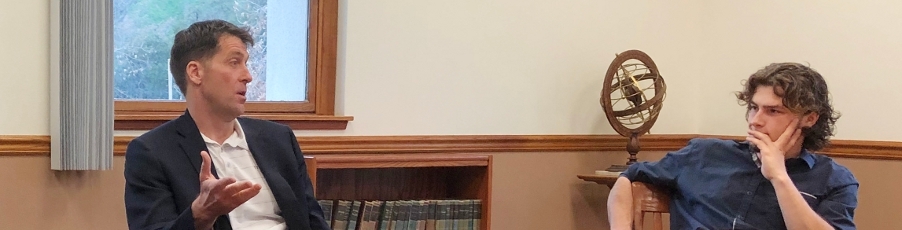
Michael Ortner arrived at Thomas Aquinas College with a business degree, a software company behind him, and a rather inconvenient piece of career advice. He congratulated the students for not majoring in business. Having done so himself, he felt qualified to recommend another course. There are gentler ways to introduce yourself to a business club. There are also less memorable ones.
It was 2019. Capterra, the business software marketplace he had co-founded two decades earlier, had been sold to Gartner. Ortner could talk about customers, hiring, and building a company through difficult years. Instead of treating those experiences as a reason to turn every undergraduate into a finance major, he made a case for the education already in front of his audience.
Clear writing mattered. So did speaking well and thinking carefully. These abilities could travel into sales, client service, product development, and project management. “The business world needs liberal arts graduates,” he told them. For students wondering how a seminar might lead to a salary, this was encouraging news from someone who had signed paychecks.
The directory that took its time
Ortner grew up in Malvern, Pennsylvania, and graduated from Georgetown University in 1995. His early working life included Price Waterhouse and J.P. Morgan. He later earned a philosophy degree from the University of London. The combination would become a recurring feature of his career: commercial experience accompanied by a suspicion that commercial preparation alone left something out.
At Digex, a web hosting company, he encountered a more immediate puzzle. Research into business software exposed a crowded market, with vendors spending heavily to reach customers and buyers facing an awkward abundance of choices. A directory connecting the two seemed useful. In 1999, he left to help build Capterra.
A useful idea does not arrive with a working cash register. Capterra’s first paying customer took about eighteen months to secure. Another year passed before the second. Friends-and-family money ran out, and Ortner accumulated roughly $250,000 in credit card debt. The early business had an ample supply of things to explain and a much smaller supply of people prepared to pay.
In 2002, a pay-per-click model and growing search traffic helped the company gain customers. Vendors paid when a visitor clicked through. The arrangement made the advertising proposition easier to test. A buyer could browse; a vendor could measure interest. The directory began to support the business that its founders had been trying to find inside it.
Capterra begins
Gartner acquires Capterra
b.school begins
The education work continues
By 2007, the company had made the Inc. 500. Its revenue had grown 633 percent from 2003 to 2006, and its database included software from nearly 10,000 vendors. A public relations campaign sought to turn that growing directory into a familiar destination. After years spent waiting for customers, Ortner now had another task: helping more people recognize the business that existed.
Let the unhappy review stay
Growth brought a question with rather more bite than a marketing slogan. Buyers wanted user reviews. Vendors paid Capterra’s bills. What would happen when those buyers had something unpleasant to say about those vendors?
In August 2007, Ortner and co-founder Rakesh Chilakapati discussed the proposal with colleagues around a blue ping-pong table. Chilakapati worried about the work required and the prospect of upsetting customers. He asked what would happen if a large company wanted to join only after a bad review disappeared. Ortner’s answer was brief: “So, let them walk.”
“So, let them walk.”
Michael Ortner, on vendors demanding the removal of a bad review
The disagreement was useful. A review system had to serve people making a purchase while operating inside a business funded by sellers. Every invitation to speak candidly carried consequences. The episode makes Ortner’s willingness to accept those consequences visible, alongside Chilakapati’s insistence that an appealing idea still needed examination. A co-founder who asks awkward questions can be an excellent companion to an enthusiastic salesman.
A job interview with room for an about-face
Ortner also wanted awkward questions in recruitment. In a 2015 essay, he described asking candidates about a time they had changed their minds. He wanted to hear how they discovered they were wrong, what that felt like, and how they arrived at a different view.
It is a revealing question because a candidate cannot answer it well merely by announcing a virtue. There must be a before, an interruption, and an after. The impressive part is the movement. Someone has to explain what happened to an opinion they once found perfectly satisfactory.
He drew on Carol Dweck’s work on growth mindsets and described using objectives and key results to stretch employees without punishing every shortfall. Learning from an unsuccessful attempt mattered to him. So did taking responsibility and accepting criticism. A company that keeps changing needs employees with more range than a part designed to perform one fixed task.
His workplace convictions were specific enough to invite disagreement. He defended open offices, arguing that physical proximity helped colleagues communicate and collaborate. Capterra had used an open layout since moving into an office in 2005. In his account, expectations about noise and behavior were essential to making that arrangement work.
He acknowledged distractions and differences in working styles, yet remained persuaded by the benefits. That is a more interesting position than an uncomplicated celebration of freedom. Ortner had preferences about how people should work together, and he was prepared to argue for them.
He was similarly cautious about full-time remote work. In January 2015, he described valuing the small encounters through which colleagues coach one another and form friendships. Four employees worked remotely for much of their time after family circumstances took them elsewhere. Flexibility existed alongside his desire for an office where people actually met.
The office had games and a stocked kitchen. He also insisted that employees had lives beyond it. A workplace can offer pleasant reasons to stay while still requiring its leaders to remember that people eventually ought to go home. The distinction becomes especially interesting when the founder must make the same decision himself.
An exit with somewhere to go
Gartner acquired Capterra in 2015. Ortner’s explanation for exploring a sale included the prospect of more travel and work, his growing family, and a wish to pursue other interests. Success had expanded the available opportunities. It had also made choosing among them more urgent.
He later published his farewell to Capterra in September 2017. The company had occupied the years between his twenties and forties. Leaving involved more than completing a transaction: it meant stepping away from a mission and a working community he had helped shape.
He remained interested in businesses. In February 2018, GoodSeeker announced that he had led its seed round and joined its advisory board. The employer branding software company helped employees and other participants share stories about what happened at work. The announcement put its total funding at $1.3 million, without specifying Ortner’s individual contribution.
It was a fitting subject for someone who had spent years thinking about company culture. An organization’s account of itself can be polished indefinitely. Accounts from the people inside it introduce detail, personality, and the occasional surprise. His interest in workplace stories kept him close to a familiar question: how does an institution become understandable to someone outside it?
Plato gets a place on the syllabus
Education gave that question a different setting. Ortner’s reading interests were already public during his Capterra years. In a 2015 essay advocating Latin, he described encountering Plato’s dialogues seriously in his late twenties and reconsidering his own schooling. He wished he had read more classics and studied logic, poetry, music, and mathematics more deeply.
His argument connected education with judgment. Stories offered encounters with choices, virtues, and failures beyond a reader’s own experience. Studying difficult texts could sharpen the habits needed to make decisions. One need not accept every curricular preference to appreciate the autobiographical candor: a successful business graduate was still revising his idea of what he should have learned.
In 2021, he helped establish b.school. Its team lists him and Michael McGrath as co-founders and seminar leaders. The bootcamp is aimed at liberal arts and humanities graduates considering business careers. It gives institutional form to the advice he had offered students: a serious engagement with books and ideas can accompany practical commercial work.
The project begins with a recognizable anxiety. Someone has studied literature or philosophy and now needs to explain that education to an employer. b.school’s proposition is that critical thought and communication already have value; the next step is helping graduates bring them into a working business. For Ortner, the conversation between the seminar room and the office remains unfinished.
The next marketplace is a community
His later projects also make his Catholic commitments explicit. The Ortner Family Foundation supports education and fellowship, including organizations such as the Institute for Catholic Liberal Education, Cana Academy, and Thomas Aquinas College. Its work encompasses both support for institutions and projects of its own.
One is Run With Saints, designed to help Catholics find nearby people, groups, events, organizations, and schools. Capterra helped people navigate a crowded software market. Here, the connecting happens closer to home. The purpose is to make opportunities for community easier to discover.
Another is Catholic School Playbook, a website offering seven chapters on subjects including curriculum, teachers, families, community, finances, and oversight. The project shares practices from Catholic schools. Ortner has also coauthored a book of the same name. Its scope reflects an interest in how schools work day to day, as well as what they teach.
In August 2025, he described Catholic education through three connected concerns: spiritual, intellectual, and cultural formation. He spoke of his family’s routines, reading, and the influence of Augustine and Aquinas. The educational preferences had become part of a larger account of how he wanted to live.
On May 5, 2026, he joined Tod Worner on the Evangelization & Culture Podcast to discuss Catholic schools and the Playbook. The second chapter was still producing conversations, projects, and arguments. The founder who once helped buyers choose software was spending his attention on schools and communities, with books continuing to take up their share of the room.