A candidate sits down to take an exam. The webcam turns on. The identity document looks right. Somewhere outside the frame, though, there may be a second phone, an invisible assistant, or an entirely different person waiting to take over. The exam is easy to put online. The difficult part is deciding what its result means afterward.
Talview arrived at that problem by a rather roundabout route. Its founders first wanted to make interviews less laborious. The software that followed, Interview Master, helped employers meet candidates through video. Today the San Mateo company sells a broader set of tools for online exams, certifications and hiring. The organizing idea is that a high-stakes decision needs a record sturdy enough to withstand an awkward question.
- Talview sells remote proctoring, identity checks, secure assessments and interviewing software.
- Its buyers include certification bodies, universities and employers with large applicant pools.
- Its recent pitch joins AI agents with human oversight and an auditable session record.
First, the calendar
The origin story begins at IIT Bombay in 2011, where Sanjoe Tom Jose and Mani Ka saw how much time mock interviews consumed. They joined with Tom Jose and Jobin Jose to build Interview Master in 2012. It was a sensible first problem. Recruiters and candidates had to find a common place and hour, then repeat much the same exchange many times. Video removed the journey; an asynchronous interview removed some of the scheduling.
Three founders carried the business into Talview Inc. in 2017. The company called its hiring proposition “Instahiring,” a name that reveals the prevailing anxiety of that era: time to hire. Scheduling, recorded interviews, live rooms and assessment workflows promised to move a candidate through the funnel before another employer did. A faster funnel was useful, but it also moved more judgment onto screens. That created a second question: how reliable was the signal coming through them?
Talview’s own milestones show where its attention went next. It raised $6.75 million in Series A funding in 2019 and launched an education and certification solution in 2020. In July 2021 it announced a $15 million Series B led by Eileses Capital, with Storm Ventures, Inventus Capital and Emergent Ventures participating. The stated plan was to develop its video AI platform. The lasting strategic consequence was a wider field of customers. A recruiter, a licensing board and a university all need to evaluate a person at a distance, though the cost of a wrong decision varies considerably.
Then, the person on the other side
A remote assessment has at least three separate problems. Is the test taker the registered person? Can the testing environment be trusted? And, if someone challenges the result, can the institution reconstruct what happened? Talview addresses these in layers: identity verification and liveness checks, browser restrictions, optional secondary camera views, automated alerts, live proctors and recorded review. Its present website describes the output as a timestamped record with human decisions logged.
That distinction matters. A suspicious glance is a poor verdict on its own. The candidate may have been looking at a clock, a child, or a connection warning. Software can collect events and point a reviewer toward them; a credible process still needs policy, context and a way to contest a mistake. Talview’s marketing speaks confidently about automated detection. The more durable part of its offer is the chain from check to event to review.
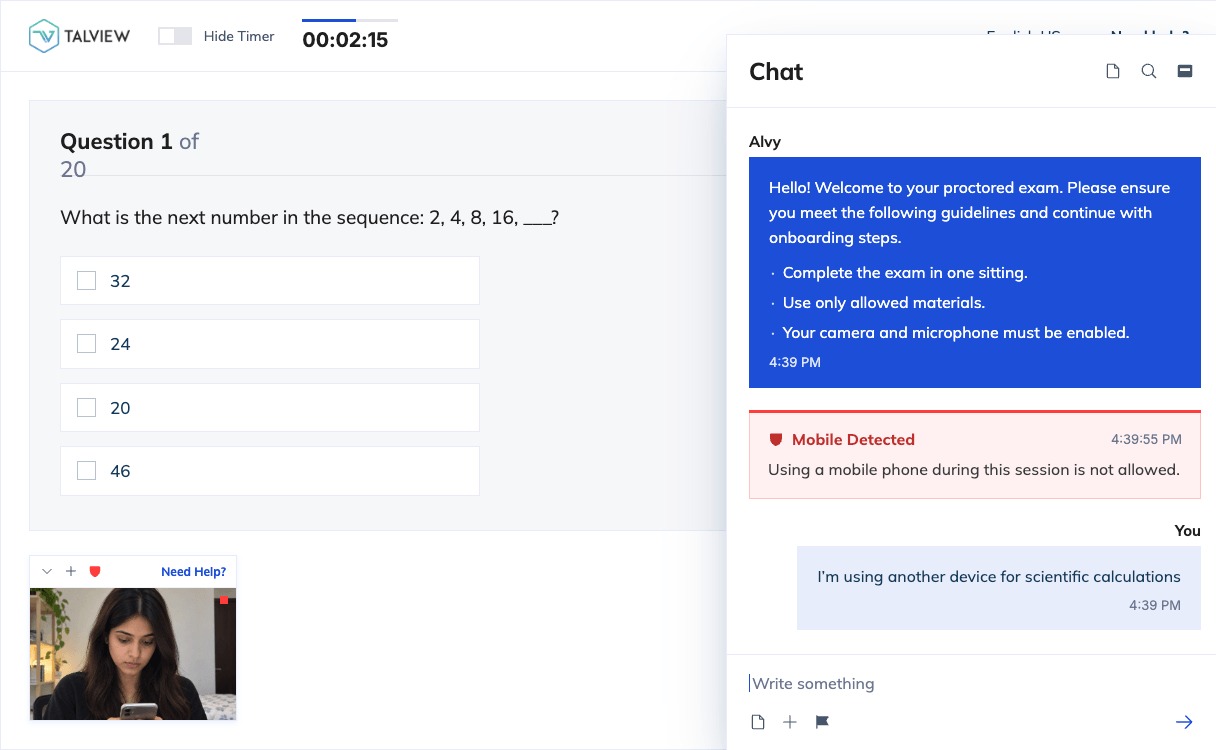
Alvy, introduced in 2024, is Talview’s named AI proctor. A product image shows an exam question beside a chat window: Alvy welcomes the candidate, then identifies a mobile phone; the candidate replies that it is needed for scientific calculations. That small exchange is more revealing than a grand claim about artificial intelligence. The software can notice a possible violation, but the rule depends on the exam. In July 2025, Talview received U.S. patent 12,361,115 B1 for technology related to contextual, real-time session detection. A patent establishes a protected method, not a guarantee that every alert is correct.
The useful question is not merely whether a camera saw something. It is whether the institution can explain what it did with the sighting.YesPress analysis
One engine, two very different rooms
Talview has also brought this integrity language back into hiring. Ivy, its AI interviewer, conducts structured conversations, asks follow-up questions and creates candidate reports. Interview Rooms supports live meetings and collaboration; the wider suite includes scheduling, on-demand interviews, candidate verification and workflow automation. An employer can use a portion of the system for first-round screening or connect the pieces to an existing applicant tracking system.
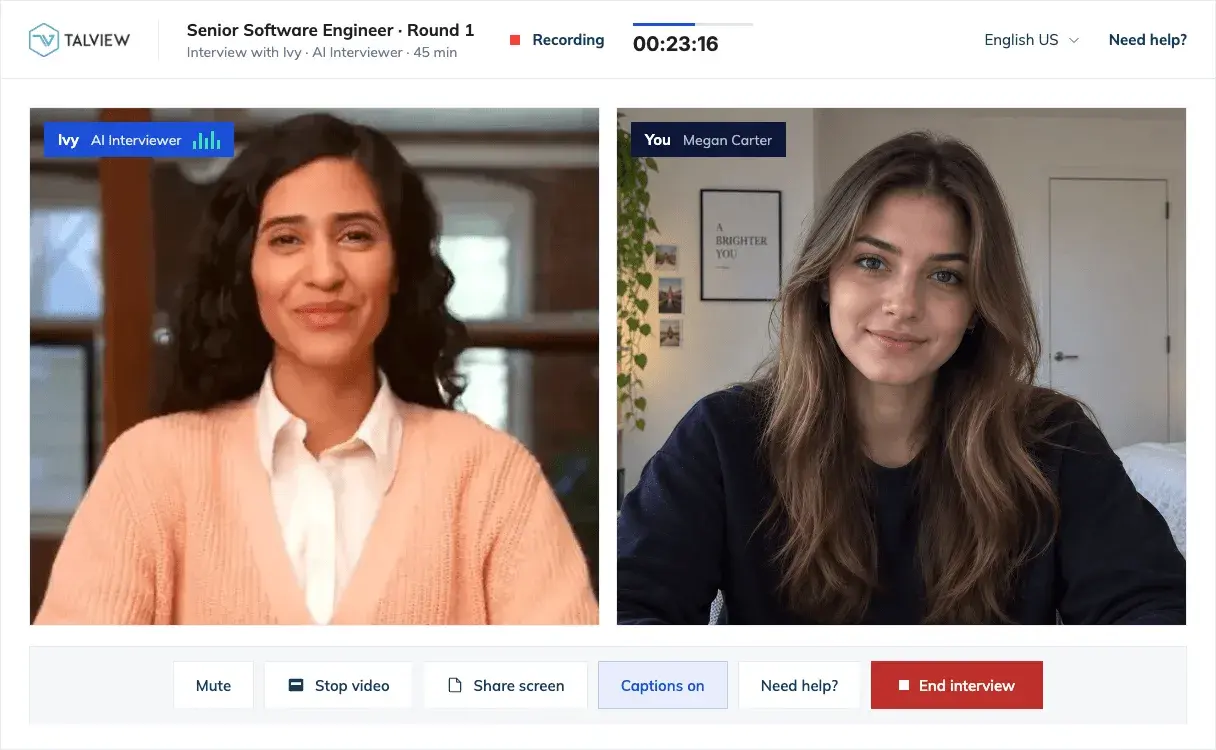
The difference between an exam and an interview is worth preserving. A final certification may justify strict browser controls and a second camera. An early job application may not. Talview says its controls can vary by session type, with consent captured before they run. That flexibility is commercially shrewd. The same institution might want speed for a preliminary screen and stronger evidence for a professional license. A one-size rule would make one of those experiences miserable.
Establish identity
Check the person and the permitted testing setup.
Observe context
Record relevant events and allow human escalation.
Defend the result
Preserve a timeline that a reviewer can actually inspect.
The customer examples reveal why these details sell. Talview says La Trobe University used live proctoring for 12,000 students at once, with a proctor-to-student ratio of one to eight. It says more than 200 Cambridge agents worldwide use the platform. Its HCLTech customer story reports ten proxy candidates identified. Gallagher Bassett Technical Services reported growth from 2,000 to 30,000 test takers and a 40% year-over-year revenue rise after integrating proctoring with its learning system. These are customer-reported outcomes, not controlled proof that Talview alone caused every gain. Still, they describe concrete purchases: capacity, reach and a way to protect a credential’s value.
The price of the invisible invigilator
Talview does not publish a simple price list. Its enterprise business sells to employers, test publishers, certification programs and educational institutions, either directly or through integrations, APIs and partner platforms. The actual spend will depend on exam volume, live proctor staffing, the level of identity checks and integration work. A buyer should ask for the full cost of support, review and candidate appeals, not just a per-session number. Monitoring that produces more flags can become expensive if people must clear every one.
There are alternatives on each side of Talview’s business. Proctorio, Honorlock and ProctorU/Meazure Learning compete for exam integrity; HireVue and other interview platforms compete for hiring workflows. Talview’s particular position is the overlap: the company wants identity, observation and an audit trail to follow a person from assessment into interview. That is useful for customers who own both processes. A university running only low-stakes quizzes, or a small employer hiring one person a month, may find the operating burden hard to justify.
The story is easy to misread as a tale of AI replacing invigilators and interviewers. Talview’s own product architecture leaves humans in the loop for escalation and final interpretation. The practical lesson for anyone building a remote decision process is less glamorous: decide which failures would truly matter, set the controls to that level, tell candidates what will be recorded, and preserve a reviewable account of each exception. The camera is the beginning of that work. The explanation is the product.