An online exam begins with a strange transfer of power. A college buys the software. An instructor chooses the settings. A student, often at a kitchen table or in a bedroom, supplies the camera, microphone, screen and nerves. Proctorio lives inside that transfer. The Scottsdale company sells institutions a way to verify identity, constrain a browser, record selected signals and point reviewers toward moments that may deserve attention. What it cannot sell quite so easily is the feeling that the arrangement is fair.
That gap is the whole story. Proctorio is useful because it turns remote supervision from a scheduled service into software. It integrates with Canvas, Blackboard, Moodle, Brightspace and other assessment systems, so an instructor can enable controls without sending a class to an unfamiliar booking portal. A test can open during its normal window, day or night. The company says its standard product can operate with less than 0.2 Mbps of upload bandwidth. At institutional scale, those are not decorative details. They are the product.
The product is a set of knobs
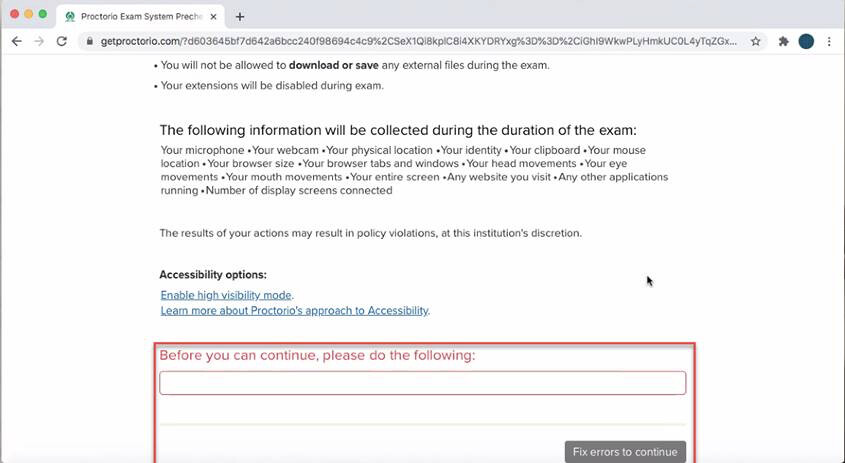
There is no single Proctorio exam. Administrators can choose recording options for video, audio, the screen or web traffic. They can restrict new tabs, printing, clipboard use, downloads, extensions, extra displays or re-entry. They can request identity checks and select the behaviors the system should flag. For higher-stakes work, a desktop application can extend controls beyond the browser. Live proctoring adds a person watching in real time; the Review Center organizes recordings, timelines and analytics afterward.
This configurability is both the moat and the mess. A nursing exam, a community-college quiz and a software certification do not require the same controls. Proctorio lets buyers make that distinction. But it also means two students can say they “used Proctorio” and describe completely different encounters. One saw a locked tab and an identity prompt. Another recorded a room, microphone, webcam and screen. The institution, not the software vendor, decides how much machinery enters the room.
A flag is a request for attention, not a verdict.The distinction every rollout should make explicit
That last step matters. Proctorio says it does not make automated misconduct decisions. It ranks or surfaces signals; authorized people at the institution interpret them. A student looking away may be consulting notes, watching a child or simply thinking. A face-detection problem may reflect lighting, a camera angle or the limitations of a model. Treating a flag as proof is not efficient automation. It is outsourced judgment wearing a dashboard.
What it costs, and who pays
Proctorio is enterprise education SaaS, not a $12-a-month consumer app. Schools, testing companies and certification organizations buy access through contracts. Public procurement records show several shapes: per exam, per student, bulk purchases and annual institution agreements. Historical documents have listed figures from a few dollars per attempt to broader campus rates, but there is no honest universal sticker price. Features, volume, term and who operates live proctoring all change the bill.
The business works because the alternative is expensive in a different currency. Physical test centers require seats, staff and travel. Traditional live-remote proctoring requires appointments and labor. Unsupervised exams risk weaker confidence in grades or credentials. Proctorio packages the trade as software: pay for scalable control, keep the assessment inside the existing platform, and reserve human time for the attempts the system highlights.
What failed first was the social contract
The pandemic did not invent remote proctoring, but it shoved the category from an online-program utility into bedrooms at emergency speed. Students objected to cameras, room scans, browser permissions, opaque flags and the practical indignity of proving innocence to a machine before proving knowledge to a professor. Researchers and advocates raised questions about privacy, bias, disability and security. Institutions sometimes deployed the software before they had written a convincing answer to the simplest question: why is each setting necessary for this exam?
Proctorio's own response made the conflict hotter. The company pursued legal action around public criticism and copyrighted support materials, including a dispute involving a University of British Columbia employee and a case involving student critic Erik Johnson. Whatever the legal theory, litigation was a poor user-interface for skepticism. It converted a technical argument into a story about power - exactly the terrain on which a monitoring company is least likely to receive the benefit of the doubt.
The company's public posture later put more weight on plain-language policies, administrator responsibility, accessibility, third-party audits and privacy architecture. Its central technical claim is zero-knowledge encryption: audio, video, screen recordings and images from automated sessions are encrypted so that institution-approved representatives hold the practical ability to decrypt them, while Proctorio says it cannot. The service also says it does not sell test-taker data.
A privacy-preserving recording is still a recording. Architecture lowers risk; policy decides whether the recording should exist.The uncomfortable but useful rule
This is the shift that matters. Early remote-proctoring rhetoric leaned on catching cheating. The sturdier case is narrower: minimize what is collected, show the test-taker what will happen, encrypt it, keep it briefly, let trained humans review context and provide a genuine route for accommodation or appeal. Proctorio's 2025 ISO/IEC 42001 certification gives buyers an independently audited AI-management signal. It does not settle whether a particular exam deserves a webcam.
From universities to credentials
Proctorio began in 2013, with founder and CEO Mike Olsen recalling a tiny office and desks made from pallets. The University of Colorado Denver became its first institutional partner in 2014. The company reported 425,000 exams in 2016, more than 400 partnerships by 2018 and 30 million exams during 2021 alone. Its LinkedIn page now claims more than 80 million exams since launch, 4 million active weekly users and more than 4,000 institutions.
The next market is larger than the college final. In 2024, Oracle began using a Proctorio-developed platform for certification exams worldwide. Oracle's own proctors monitor candidates, while Proctorio supplies live-session technology, flagging and post-exam review. It is a telling arrangement: the customer keeps the people and subject expertise; the vendor supplies the machinery for consistent oversight at scale. As AI makes it easier to generate answers or impersonate competence, credential issuers face the same authenticity problem universities met a decade ago.
The five things worth stealing
- Embed inside the system customers already use. Workflow beats another portal.
- Make control proportional. A weekly quiz should not inherit the settings of a licensing exam.
- Design the algorithm to route attention, then make the human own the decision.
- Treat low bandwidth and old hardware as product requirements, not support tickets.
- Explain data collection before consent, in ordinary language, with a usable alternative.
When the model breaks
Remote proctoring is a poor fit when an institution can measure the same learning through a project, oral defense, open-book analysis or frequent low-stakes work. It also strains when students lack a private room, compatible device, stable connection or the physical ability to satisfy standardized movement and camera expectations. A configurable system helps only if instructors understand the controls. “Turn everything on” is not a security strategy. The right baseline is the least intrusive setup that can still protect the specific claim an assessment is meant to prove.
No clear purpose, no practice run, no accommodation path, no human review, no appeal, or no restraint. Under those conditions, more detection produces more noise and less legitimacy.
Competitors including Honorlock, Respondus, Meazure Learning's ProctorU, Examity and Proctortrack contest the same budgets. Proctorio differentiates through deep LMS integration, on-demand automated sessions, low published bandwidth requirements, configurable controls and its encryption design. But the most dangerous competitor is not another surveillance vendor. It is a better assessment.
That is why Proctorio's future depends on disciplined use as much as clever code. The company has already proved that online exams can be supervised at enormous scale. The next proof is subtler: that institutions can use the tool without confusing observation for evidence, flags for guilt or security for excess. In the exam room inside the laptop, trust is not a soft feature. It is the thing being tested.