The first thing to fail in Criteria Corp's story was not a server or a product launch. It was the résumé. Josh Millet had trained as a medieval French historian, wandered into educational technology, sold a test-prep company and then helped hire people at the buyer. The more applications he read, the less he trusted the ritual. Credentials described where somebody had been. Interviews rewarded polish. Managers called the remaining intuition “fit.” None of it looked much like measurement.
So in 2006, Millet and fellow PhD David Sherman started Criteria in Los Angeles with an unglamorous idea: put validated aptitude, personality and skills tests online, sell them as software, and let smaller employers use tools once reserved for large corporations. The early product, HireSelect, offered remote tests and instant scores. Its commercial hook was equally practical - an annual flat fee and unlimited testing, instead of a toll each time a candidate clicked “begin.”
Two decades later, the company says it has delivered more than 80 million assessments for over 4,000 organizations in 60 countries. Its data set has passed 6 billion points. The library has become a platform spanning assessments, asynchronous and live video interviews, AI-generated summaries and scores, and post-hire coaching. The résumé, meanwhile, has encountered a machine that can improve it before breakfast.
The product is a second opinion on a human being
Criteria is used by recruiters and hiring managers who need to narrow an applicant pool without relying entirely on job titles, school names or a confident half-hour conversation. A call center can test basic skills, typing speed and work style. A manufacturer can add mechanical reasoning and integrity measures. A software company can combine cognitive and personality results with a structured interview. Scores flow back into applicant-tracking systems such as Greenhouse, Workable or iCIMS.
The current catalog falls into three lanes. Criteria Assess bundles cognitive, personality, emotional-intelligence, risk and skills tests. Criteria Interview handles recorded and real-time video, question guides, transcripts and evaluation. Criteria Hire combines both. Develop, a premium add-on launched in 2024, crosses the once-sacred start-date boundary with team check-ins, manager insights and an AI coach.
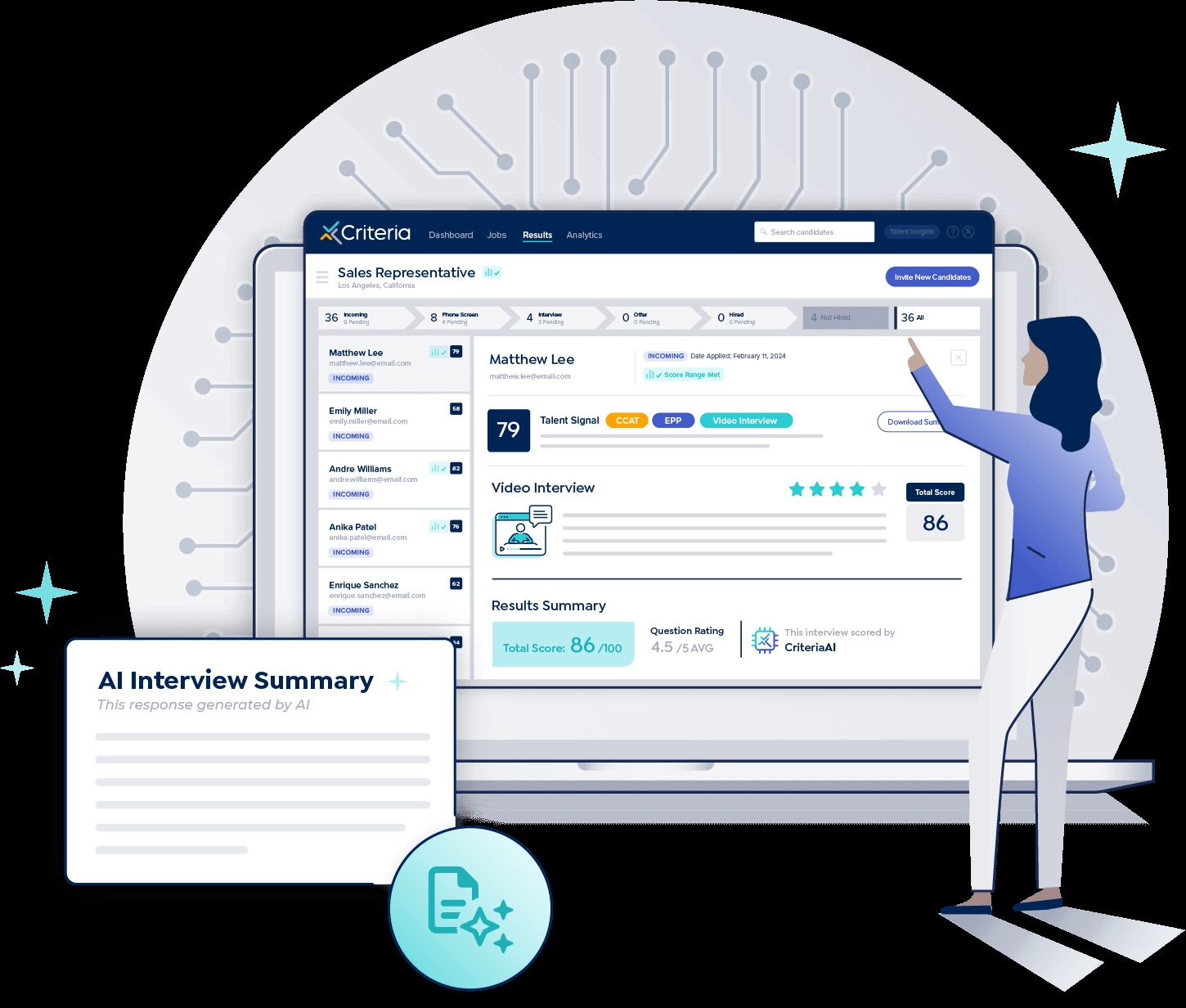
Interview Intelligence is the sharpest expression of Criteria's difference. Its automated scorer works from the words in a transcript, deliberately excluding appearance and vocal tone. Industrial-organizational psychologists shape the prompts and rubrics. Employers may use their own questions. The point is less “AI knows talent” than “software can make a panel ask the same relevant questions, record what was said and stop the debrief from becoming group folklore.”
“People are more than their resumes.”Criteria's founding argument, newly useful in the generative-AI era
One ugly number can change a buying committee
The most persuasive customer stories begin with operational embarrassment. ASK, an Alabama customer-care center, was hiring 10 to 20 people a week and losing new staff almost as quickly. In one 15-week period, it hired 172 people and lost 127 - 74 percent turnover. The company stopped leaning on temporary staffing, moved to direct hiring and used Criteria's basic-skills, personality and typing tests before interviews.
Interview time fell, too: the team reported interviewing about 17 people to make 15 hires, down from 40, saving roughly 23 recruiter-hours a week. Heartland ECSI tells a similar story, reporting call-center turnover falling from roughly 75 percent to 26 percent after adding a four-test screen. These are company case studies, not randomized trials. Their value is in the method: define the costly failure, introduce a job-linked signal and compare cohorts.
What it costs - and what the capital bought
Criteria does not publish dollar prices. Every current package ends in “request pricing,” with the quote shaped by headcount, modules, AI upgrades and premium integrations. That opacity is the weakest part of the buying experience. Historically, unlimited use made the arithmetic friendlier as applicant volume rose. For a business hiring three people a year, even a sensible annual contract can become expensive shelfware. For a call center screening thousands, the cost of one bad cohort can dwarf the subscription.
The company itself bootstrapped for about nine years. Level Equity invested $8 million in 2015. Sumeru Equity Partners followed with a reported $56 million majority growth investment in 2019. The money financed a wider answer to the same problem. Criteria bought Australian assessment company Revelian in 2020, adding emotional-intelligence and game-based tests. It bought Alcami Interactive in 2021, adding structured video interviews and a larger Asia-Pacific presence. Prices for those acquisitions were not disclosed.
That sequence also explains why Criteria looks different from a point solution. SHL and Wonderlic carry deep testing pedigrees. TestGorilla, Vervoe and iMocha push skills-first screening. HireVue and Harver automate more of the recruiting funnel. Criteria has assembled a middle path: enough assessment science for the industrial-organizational psychologist, enough workflow for the recruiter, and enough reporting for an executive who would prefer one dashboard. It has appeared on the Inc. 5000 eight years running, but the more relevant achievement is product continuity. The same company that sold a cognitive test in 2006 can now place that result beside a structured interview and a post-hire team signal.
Remote work changed their mind about the interview
Criteria did not build video interviewing from first principles. COVID changed the workflow before the product roadmap did. Its own benchmark work found a 159 percent increase in video interviewing after the pandemic began, while customers asked for a solution. Management reviewed the market and acquired Alcami. That is the useful bit: the company did not pretend its assessment platform was the whole hiring system once customers had moved the bottleneck downstream.
The next expansion followed the same pattern. Customers who had made a good hire wanted help keeping and developing that person. Develop turned Criteria's psychology and team-dynamics expertise inward. Criteria now uses the product on its own staff through weekly two-minute check-ins, quarterly TEAMscan surveys and manager summaries. The company says the system can surface disengagement before an employee announces an exit. Conveniently, it also makes the vendor its own live demonstration.
That self-experiment fits the culture Criteria publishes: lead with evidence, build with fairness, earn trust, see the whole person and innovate responsibly. Employees take the company's cognitive and personality assessments when they join. The practice could sound a little like a restaurant requiring every cook to eat the tasting menu. It is also an unusually direct way to make product debates personal. When a candidate experience is confusing or a score report feels bloodless, the people shipping it have sat on the other side.
The copyable playbook is structure, not a magic score
A small employer does not need to reproduce 6 billion data points to borrow the operating logic. It needs discipline. The useful sequence looks like this:
A score is not a verdict
Assessment software works badly when the employer cannot explain what success in the job looks like, uses a generic cutoff without validation, skips disability accommodations or treats the result as destiny. Criteria's own terms say test results should be only one element in a human decision. That sentence deserves more attention than any predictive percentage.
The economics also narrow the fit. Quote-based annual software favors organizations with steady hiring volume and enough outcome data to learn from. Tiny samples make local validation noisy. Rarely filled, highly idiosyncratic roles may demand deeper work samples and expert interviews. And standardization, while useful against improvisational bias, can fossilize a bad rubric with impressive consistency.
Where Criteria fits
Employers with repeatable roles, meaningful applicant volume, an ATS workflow and a willingness to track post-hire outcomes.
What buyers compare
SHL and Wonderlic for established testing, TestGorilla and Vervoe for skills-first screening, and HireVue or Harver for broader automation.
Criteria's advantage is breadth joined to a coherent point of view. It has old-school psychometric expertise, a modern interview layer, integrations, global reach and enough proprietary history to make useful benchmarks on day one. Its risk is the same breadth: a platform that measures, interviews, summarizes and coaches can feel like a complete answer before the employer has asked a precise question.
The company has survived several HR-tech fashions because its original observation keeps aging well. A résumé is a designed artifact. An interview is a social performance. Both contain information, and both can mislead. Criteria's business is selling the second opinion - structured enough to inspect, human enough to challenge, and now urgent because the first opinion has never been easier to manufacture.
Keep reading, keep watching
See the platform, candidate materials and the company's own explanation of its methods through the links below.