The form was supposed to be the dull part. Marie Martens and Filip Minev were building Hotspot, a platform connecting hotels with travel influencers. To test demand, they collected information from hotels through a Google form. The business idea was travel. The irritation was paperwork. Only one of those would survive the spring of 2020 intact.
- Build forms by typing, with no coding required.
- Keep core features free; charge for branding, teamwork and extra control.
- Let shared forms introduce the product to its next customers.
A form survived the travel crash
When the pandemic arrived, the couple returned to Belgium from Asia. By summer, Hotspot had lost half its customers. They also organized a fundraiser offering hotel nights to healthcare workers. Once again, they needed registration forms. Once again, the available choices felt awkward or expensive. A complaint that had seemed incidental became the business they could build.
Tally’s first public version appeared in September 2020. Minev brought engineering experience; Martens brought marketing experience. Their proposition was unusually plain: make forms feel like writing a document, and let people use them without immediately reaching for a credit card. It was a modest rebellion against an extremely familiar nuisance.

Start with a document
Open Tally and you begin with text. Type a question; insert an input block. A slash command opens the available building blocks. Anyone accustomed to Notion will recognize the rhythm. The company borrows the familiarity of a document and puts the machinery of data collection underneath it.
That machinery is more capable than the blank page suggests. Conditional logic can hide irrelevant questions, skip pages or change what happens after an answer. Calculations can produce a score or a price. A recruiting team can collect applications; a marketer can qualify leads; an organizer can gather RSVPs. The interface lets the person who needs the information build the form themselves.
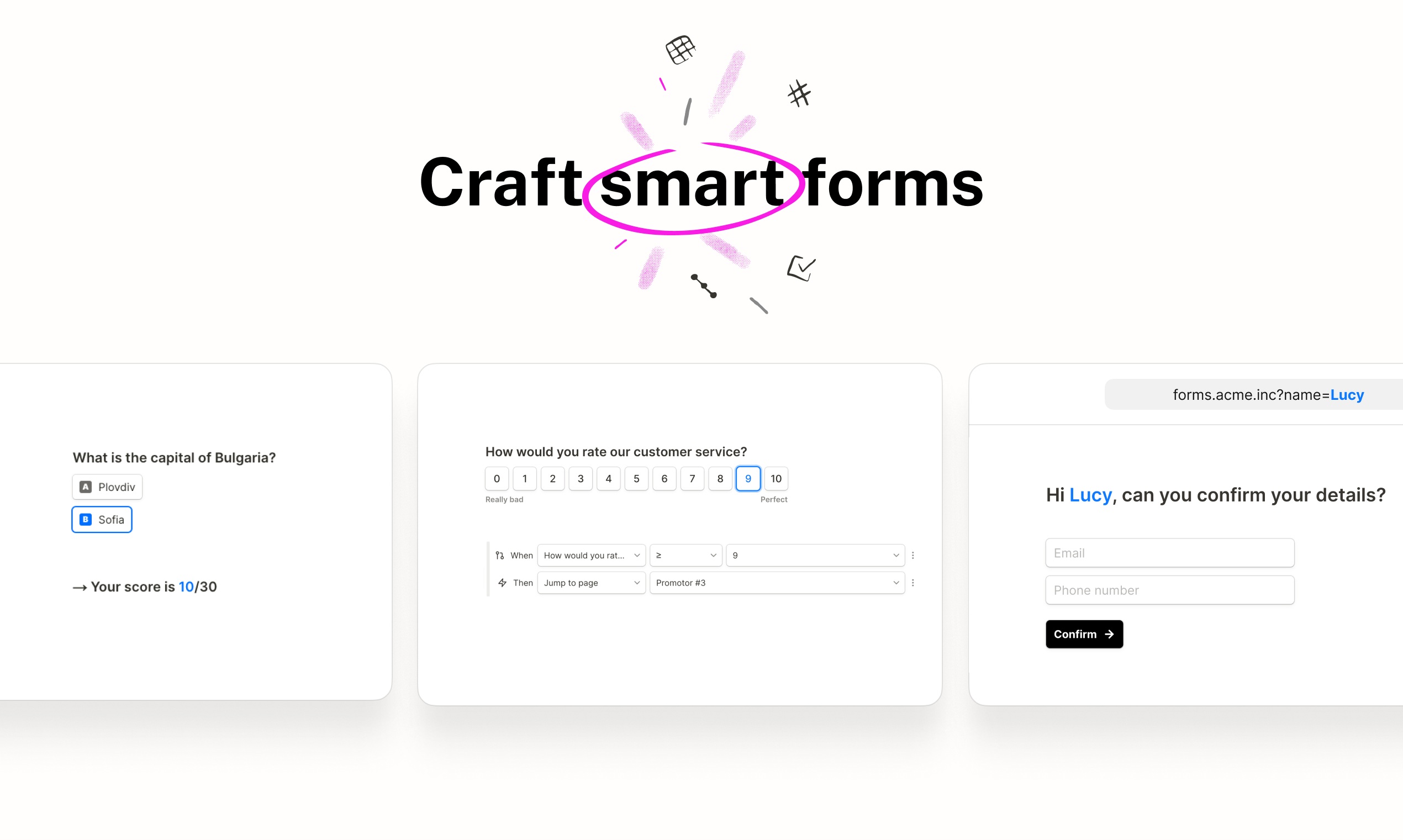
The alternatives include Typeform, Jotform, Google Forms and Paperform. Tally’s argument is the combination of a document-style editor and a generous free tier. That makes it especially interesting to small teams testing an idea, where buying a subscription before learning anything can feel like paying admission to your own experiment.
The free plan pays in visibility
Free forms carry a Tally badge. Someone completes a form, notices the tool behind it, and becomes a creator themselves. The thing customers already distribute becomes the introduction to the next customer. This is a useful arrangement for a company selling something inherently shareable.
The company made that loop possible by giving away more than a sample. Unlimited forms and responses, conditional logic, signatures and file uploads are available free under fair-use rules. In June 2025, Tally said about 2% of users eventually upgraded. A small paying share can support a large audience, provided the economics and distribution cooperate.
Four reported ARR milestones
It did not look inevitable at the beginning. Growth slowed in summer 2021, and the founders questioned whether they had found a market. They sent a satisfaction survey. Of respondents, 59% said they would be very disappointed to lose Tally. That was evidence of attachment among the people who answered, rather than proof that every signup would stay. It gave them a clearer reason to keep improving the product.
The bill, and the human cost
Pro costs $29 a month, or $290 a year. It buys custom domains, removal of Tally branding, collaboration and other advanced features. Business costs $89 a month, or $890 a year, adding controls such as automatic submission deletion and email verification. The annual options average roughly $24 and $74 monthly, but require annual billing.
“Unlimited” also has boundaries. Sustained usage around 50,000 submissions a month, or substantial storage and notification volumes, can trigger a custom plan. Free uploads have a 10 MB per-file limit. Payment forms connect to Stripe: Tally adds no transaction surcharge, while Stripe’s standard charges still apply.
“We spend 50% of our time talking to our users and answering questions”
Marie Martens, June 2022
That early allocation of time gives the model its less glamorous texture. Customer-funded software still needs customer care. The founders described support work that followed them into holidays. A large free audience creates a bill in human attention as well as infrastructure. Keeping the team small requires deciding which requests to decline.
Answers need somewhere to go
A submission becomes more useful when it leaves the form. Tally connects to Notion databases and Google Sheets, while tools such as Zapier and Make extend the workflow. Imagine a feedback form whose answers become rows in the team’s existing workspace. Collection stops being a separate administrative island.
For someone choosing a tool, the practical move is to test one real workflow: write the questions, add only the necessary branches, connect the destination, then submit several different answers. Tally’s own logic documentation recommends testing alternative paths. No-code removes the need to write software; it still leaves you responsible for asking sensible questions.
Trust has a technical bill
Tally says form data is stored in Europe and encrypted in transit and at rest. That matters to teams evaluating privacy requirements. It also deserves precision: form creators remain responsible for the information they collect, and optional integrations involve additional service providers.
In August 2026, a vulnerability in internal analytics provider Metabase exposed Tally account email addresses and password hashes. Tally says accounts and form data were not accessed. It removed Metabase and brought those statistics in-house. The incident makes the dependency behind a convenient tool visible.
The distinction is useful for buyers: hosting location, access controls and third-party dependencies answer different questions. A privacy claim should lead to examining the actual workflow, especially when answers move into another application.
A business worth keeping
By September 2026, Tally reported 2.5 million users and a ten-person team. Optional AI tools had joined the product; the familiar manual editor remained available. Its founders continue to describe a business they want to keep running, funded by customers rather than venture capital.
In its January 2026 plans, Tally put product quality ahead of a revenue target. That preference fits the way it sells: customers can keep using the free version, so the paid offer has to earn its place. Public roadmaps and direct feedback make the argument visible in ordinary product decisions.
The useful lesson is selective. A shareable product can turn free usage into discovery; a private back-office tool may struggle to repeat that loop. Tally’s bet rests on useful forms traveling between people. Make the chore easier, and the person receiving the result might become the person making the next one.
Try the form. Meet the makers.
Open the editor, browse the product notes, or watch the founders explain the business.