Somewhere between a manager deciding to hire and a new employee finding the coffee machine, a company has to perform a small administrative miracle. Someone approves the vacancy. Someone checks the application. Someone remembers the interview, the offer and the forms. Multiply that sequence across countries and departments, and the miracle becomes a coordination problem. Taleo built a business inside that gap.
- The job: organize sourcing, applications, interviews, offers and onboarding.
- The bet: large employers would rent recruiting software delivered over the internet.
- The outcome: Oracle agreed to buy Taleo for approximately $1.9 billion in 2012.
The queue behind the vacancy
The useful way to understand Taleo is to follow a job opening rather than a résumé. A vacancy needs permission, a description, a destination and a person responsible for moving it forward. Applications then need to arrive somewhere that multiple employees can use. An applicant tracking system gives that sequence a shared memory. The candidate sees an application form; the employer sees a process.
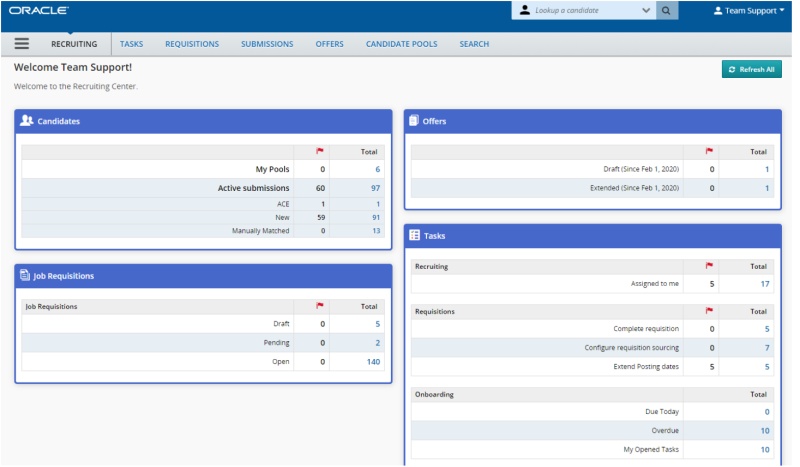
Oracle’s Taleo recruiting documentation describes screening, assessments, interview management, offers and compliance records. Its sourcing tools help employers advertise positions and develop candidate pools. Onboarding carries the work beyond acceptance. These are ordinary tasks with an extraordinary capacity to get separated from one another. The attraction is continuity: the next person can see what happened before.
First, persuade the people with the money
The corporate story starts in 1999, when Recruitsoft was incorporated in Delaware. Its earlier roots reach back to Martin Ouellet’s Canadian job-board venture. Ouellet and Louis Têtu became the founders associated with the recruiting-software business. Recruitsoft became Taleo in March 2004 and reached Nasdaq in 2005. Behind that tidy sequence was a much less tidy argument about how software should be sold.
In a 2008 interview with Sramana Mitra, Têtu recalled investors doubting whether large-company technology chiefs would accept the application service provider model, an early name for hosted software. They also questioned whether a specialist could survive alongside broad HR systems. The initial obstacle was investor conviction. The business had to make rented software look financially sensible.
Têtu pointed to orders from Hewlett-Packard and other large companies as evidence. He described a $10 million round led by Omnicom in early 2000 and $25.5 million led by Bain Capital Ventures in January 2001. His explanation emphasized customer lifetime value against the cost of winning and serving customers. Michael Gregoire estimated spending before the IPO at roughly $60 million. This was an expensive lesson in recurring revenue.
Oracle’s announced transaction value, net of Taleo’s cash and debt. The offer was $46 per share.
Recruiting was the door. Talent was the house.
Taleo’s ambition widened beyond getting someone hired. Performance, compensation and learning gave it reasons to remain involved after the offer letter. One concrete move came in October 2010: the acquisition of Learn.com for $124.2 million in cash. Training became another part of the commercial proposition. Recruit a person, understand their work, then help develop them.
That expansion also had a distribution advantage. Josh Bersin reported from TaleoWorld in 2011 that only 12 percent of customers had deployed the performance product. His observation reveals both the opportunity and its boundary. An installed recruiting customer was a potential buyer of another module, but an existing relationship did not automatically turn into a wider deployment.
By the acquisition period, Taleo served more than 5,000 customers. Contemporary accounts named employers such as Starbucks, Hyatt and United. The common thread was organizational complexity. A hotel group and an airline sell different things, but both need people in particular places, at particular times, with particular qualifications. Recruiting becomes operating infrastructure when a vacancy can interrupt the business.
- 01Approve
- 02Assess
- 03Offer
- 04Onboard
A simplified workflow, not measured performance data.
The revealing number is the waiting time
Consider the less glamorous promise of analytics. In an Oracle customer statement, DaVita’s Randy Larson said the company discovered process bottlenecks after implementing Taleo analytics. The revelation was that delays had been hiding inside an established routine. A report made the routine visible enough to question.
“We then were able to identify and fix the behaviors that created these bottlenecks.”Randy Larson, DaVita, in an Oracle customer statement
There is a practical lesson here for anyone managing a hiring process: give every handoff an owner, retain its history and examine where work waits. Software makes those habits easier to maintain. The inference is straightforward: measuring how quickly candidates advance can reveal a problem that counting applications alone would miss. More applicants do little for an offer stalled in an approval queue.
Configuration has a bill attached
Taleo sold subscriptions and services. Its 2010 filing described typical Enterprise agreements of three years or more and Business Edition agreements of one year. Those are historical terms, rather than a current price offer. Oracle’s integration documentation supplies another useful detail: requirements outside the standard Fusion HCM connection can involve tailored work and additional charges. Budgeting therefore means considering implementation alongside access.
That is also a fit question. Oracle positions Enterprise Edition around configurable hiring at scale, while Business Edition offers recruiting automation and talent-management tools. A small team with a simple process may find that configuration creates more administrative work than it removes. Alternatives include specialist recruiting systems such as iCIMS and broader suites such as Workday and SAP SuccessFactors. The relevant comparison is the employer’s workflow.
Oracle bought it. Oracle also offers the next move.
Oracle announced the acquisition in February 2012 and completed it on April 5. Taleo remains an Oracle product name; Oracle Recruiting is a separate offering within Fusion Cloud HCM. Oracle’s current Taleo page invites customers to consider moving between them. Its migration material emphasizes connected HR data and easier applications, including removing account creation as an initial hurdle. The proposition has shifted toward fewer boundaries between systems.
Taleo’s distinctive contribution was to make the journey from vacancy to employee something an organization could inspect and repeat. The enduring question is wonderfully concrete: who has the application now, and what must happen next? For a company that depends on hiring, being able to answer can be worth a great deal.