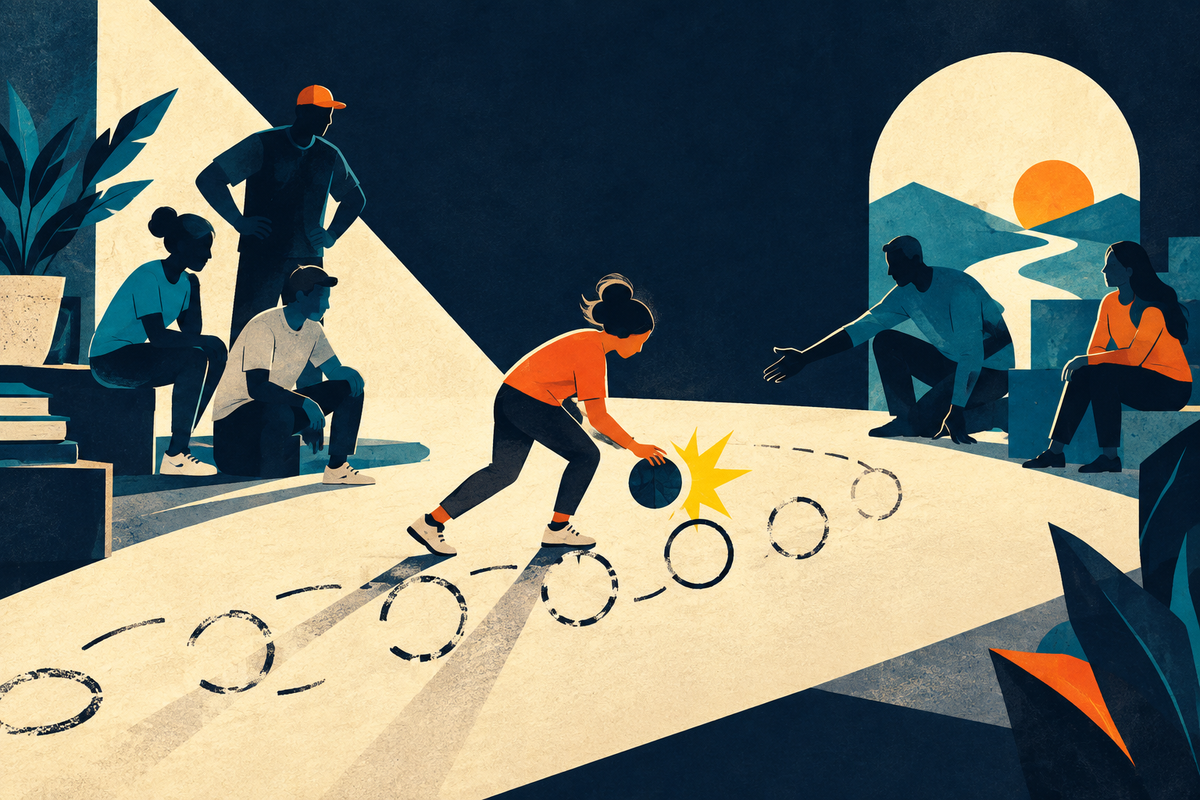
The lone genius makes a terrific poster. One person, one spotlight, one apparently supernatural gift. Ernest Hemingway at the typewriter. Michael Jordan in flight. Steve Jobs onstage. Daniel Coyle thinks that framing is not merely incomplete; it leaves out the machinery that would actually help the rest of us. The writer on human potential asks us to move the camera back. Behind the exceptional performer, he says, is almost always an exceptional environment: relationships, models, feedback and a particular attitude toward struggle. Talent stops looking like magic when the room comes into view.
That change in perspective is the central move in Coyle's interview. Peak individualism trains us to hunt for the champion's private habits or rare biology. Those stories are irresistible because they turn achievement into character: the great person simply had more grit, discipline or sparkle than everybody else. But they also make excellence remote. If genius belongs to the chosen, all the observer can do is admire it.
Coyle offers a more practical question: what repeatedly happened around the person while the skill was taking shape? He spent five years visiting what he calls talent hotbeds, places producing an improbable concentration of excellent musicians, athletes and thinkers. Their shared feature was not luxury. Many looked makeshift—“chicken wire Harvards,” in his phrase, with cinder blocks holding up stairs and little energy spent on appearances. The physical message was blunt: this is a workshop. Comfort is not the craft.
“An elite development environment is not one where every luxury is given to you. It's a place of work. It's a place of craft.”Daniel Coyle
Six minutes that beat a month
The clearest picture of productive work comes from Clarissa, a 15-year-old clarinetist studied by psychologist Gary McPherson. In one six-minute passage, Coyle says, she made more progress than she usually made in a month. The scene was not fluent or pretty. Clarissa played a fragment of “The Golden Wedding,” made an error, stopped, studied the page, hummed the notes, tried again and stopped at the next miss. She was not performing the piece. She was wrestling with it.
Coyle calls this deep practice: reaching to the boundary of current ability, sensing failure, making a correction and reaching again. The mistake is not a final grade on the learner. It is the next instruction. That distinction sounds semantic until you imagine its effect over hundreds of repetitions. A verdict closes a door. Information tells you which door to try.
The deep-practice loop
This explains Coyle's sharp comparison between children on skateboards and the same children in algebra class. The skateboard reports mistakes instantly through balance, speed and gravity. It makes the learner act, fail, adjust and act again. In a passive classroom, knowledge can wash over a student without provoking the same corrective loop. The difference is not a hidden learning gene. It is the velocity built into the setting.
At Meadowmount School of Music, students intensify that loop by cutting a sheet of music into strips, mixing the lines in a bowl and pulling them out one by one. The whole piece becomes a set of small, concentrated problems. At Spartak, the tennis club outside Moscow, coach Larissa Preobrajenska had young players rehearse strokes slowly without a ball. Wrist, elbow, movement, repeat. Only after the stroke had been built and grooved did competition enter the picture. Both places resisted the urge to rush toward a recognizable performance.
The sweet spot tastes bitter
Coyle's rule of thumb is an 80–20 split: success on roughly four attempts in five, mistakes on the fifth. Perfect practice is suspicious because the learner is probably staying inside established ability. Practice dominated by failure is merely sour. In between sits the useful discomfort of deliberate practice—hard enough to demand full attention, possible enough to sustain another attempt.
Futebol de salão, the compressed five-a-side game embraced across Brazil, is his grand-scale example. A small ball, narrow passing lanes and a court-sized space mean there is almost no time to coast. Players receive more decisions, touches and control problems. The environment keeps tipping them toward the edge. The familiar story says Brazil produces brilliant players because it is warm, people love soccer and beaches invite play. Coyle points out that many countries are warm and soccer-mad. What distinguishes this system is the practice it generates.
That is also why “10,000 hours” is an incomplete prescription. Hours alone do not guarantee mastery, and biology matters more in some pursuits than others. Yet there is no shortcut around building the circuitry of a skill. The repetitions must contain attention, correction and a small journey past yesterday's limit. Seen that way, repetition is not dull recurrence. Each good repetition lands somewhere new.
Photo source: Zillow Lawsonville listings. Used here as a visual interlude.
Stare, struggle, steal
Deep practice is not solitary punishment. The hotbeds Coyle visited were social systems. Learners could watch someone better, borrow a move and test it. Florence's Renaissance guilds supply his historical model: apprentices prepared surfaces, mixed pigments, carved stone and watched masters work on real projects. They accumulated fundamentals alongside people who embodied what the craft could become. The workshop made imitation respectable and improvement visible.
Coyle compresses the pattern into three mischievous verbs: stare, struggle and steal. Stare at work that makes you want to participate. Struggle where errors can be seen and repaired. Steal useful ideas from the people around you. None of this means copying a finished identity. It means treating knowledge as something that moves through a community instead of remaining sealed inside individual stars.
“A mistake is information. It's information over where you should reach next.”Daniel Coyle
For leaders, this flips the job description. The leader is not the source of everybody else's excellence. The leader designs the conditions in which people can grow together. Coyle reaches for the Tao Te Ching: with a good leader, people praise the leader; with a great one, people say they did it themselves. Control gives way to ecology. The practical work becomes arranging contact, feedback, challenge and belonging.
Motivation arrives from outside
Skill still requires a reason to endure all that edge-of-ability discomfort. Coyle calls the spark “ignition.” We experience motivation as private, but he argues that it often begins as a social encounter: a glimpse of somebody we might become. In an experiment he recounts, students read a mathematician's biography. For half the class, researchers changed the mathematician's birthday to match the student's. Those students later spent three times as long on an unsolvable math problem. The connection was arbitrary, yet it plucked what Coyle calls an internal guitar string.
Talent hotbeds can be traced to similar sparks. A player from your club reaches Wimbledon's final stages. A baseball player from your island hits three home runs in a World Series. Suddenly “someone like me” has done the distant thing. Coyle's point is not that representation replaces practice. It supplies energy for practice by making a future identity feel close enough to chase.
On baseball fields in Curaçao, he saw about a hundred players divided into groups, with older children teaching younger ones. The younger player did not have to project across generations toward an authority figure. A slightly older version of the self was standing a few feet away, demonstrating both a technique and a trajectory.
The shortest culture memo
Pixar turns that invitation into an onboarding ritual. According to Coyle, Ed Catmull told newcomers: “Whatever you did before, you're a movie maker now. We need you to help us make our films better.” Then the studio backed up the sentence. Rough films were screened to the whole company; baristas, engineers and IT staff could point out what might improve. One IT worker Coyle met suggested a detail for a scout badge in Up, and the idea made the movie.
The ritual matters because it does three jobs at once. It grants an identity, makes contribution legitimate and places unfinished work in public view. It says you belong before you have proved your brilliance. It also says the work is allowed to have flaws because everybody is responsible for finding them. Coyle describes Catmull carrying versions of these practices into Walt Disney Animation, moving desks to increase encounters and creating group meetings to identify weaknesses together.
This is the stealable playbook inside the interview. Do not begin by asking employees, students or children to be more motivated. Give them a model close enough to touch. Do not tell them that mistakes are welcome while rewarding only seamless performance. Engineer short loops in which the error produces a usable correction. Do not reserve the meaningful critique for the credentialed few. Invite everyone into the craft.
The better question is not “Who has talent?” It is “What does this room make easier to learn?”
The lone-genius myth survives because it makes a clean story. Coyle's ecological account is messier: talent passes through cramped courts, sliced-up sheet music, slow-motion swings, shared screens and one person catching sight of a possible self in another. But messy is good news. Magic cannot be managed. Environments can.
The work, then, is to build a place where people can stare without envy, struggle without shame and steal without secrecy. Let one attempt in five go wrong. Make the correction quick. Put the future in view. Repeat tomorrow. The spotlight may still find an individual at the end, but the real achievement belongs to the whole room.