real-estate-investing
(11)
Yieldstreet opened the door. Who holds the keys?
Now called Willow Wealth, the private markets platform has moved from picking individual deals to building portfolios. Its history explains why easier access still demands difficult questions.
Grand Coast Built a $470 Million Lending Machine in the Gap Banks Left Behind
Banks like tidy buildings and long timelines. Grand Coast found its business in the messy middle - the 12 to 18 months when a serious property investor needs money now, not after the opportunity is gone.
The $10 Door Into Wall Street's Private Room
Fundrise started by letting neighbors buy a piece of a Washington property. It now manages billions across real estate, credit and venture - an ambitious attempt to give ordinary investors institutional-style access without pretending private assets are as simple as stocks.

The $671 Billion Machine Built on Private Credit
Ares grew from a Los Angeles credit shop into a sprawling private-markets platform by learning to lend where banks pulled back - then carrying that playbook into property, infrastructure, secondaries and insurance.

Sunwater Capital Built a Portfolio Where Warehouses, Health Data and Medicare Share an Address
The Maryland investment firm makes an unusual promise: patient capital, operator experience and permission to cross category lines. Its portfolio connects buildings, care delivery and data in ways a conventional sector fund rarely attempts.

Revolution’s Bet: The Next Great Startup Won’t Need a Coastal ZIP Code
For two decades, Steve Case’s Washington investment firm has argued that venture capital’s map is too small. Its answer is a three-stage fund platform, a bus-tour-born national network, and a willingness to treat geography as an edge rather than a handicap.

Landa
Landa was a New York fintech that let anyone buy fractional shares of single-family rental homes for as little as $5 through a mobile app, collecting monthly dividends from rent and any appreciation. Founded in 2019 by Yishai Cohen and Amit Assaraf, it packaged each property into its own LLC, managed the homes with proprietary software, and ran a secondary marketplace for trading shares. After raising $33M in equity and roughly $62M in debt and surpassing 200,000 registered users, the platform went dark in 2025 amid lender lawsuits, missed dividends, and a court-ordered receivership over 119 properties.

Plotify
Plotify is a New York-based wealthtech, proptech and fintech company that lets sophisticated and high-net-worth investors around the world buy, finance and manage income-generating residential rental homes in the US and UK through a single app. Its signature 'Plot' - a single tenanted property held in its own single-owner LLC/SPV - bundles underwriting, optional point-of-purchase financing, property management, tenant management, insurance, tax and accounting into a tradable unit, compressing a single-family-rental purchase from an industry-average 52 days to about 10 minutes.

Deferred
Deferred is a technology-powered Qualified Intermediary (QI) that facilitates 1031 real estate exchanges without charging a service fee. Instead of billing customers, it holds exchange funds in FDIC-insured, segregated accounts and shares a portion of the interest those funds earn back with clients. The platform pairs veteran QI staff with software that drafts exchange documents, tracks the strict 45- and 180-day IRS deadlines, and offers ARTE, an AI assistant trained on thousands of pages of tax law. Founded in 2024 by the team behind Open Listings and Balance Homes, Deferred aims to give individual real estate investors access to a tax strategy long dominated by institutions.
Tirios
Tirios is an Austin-based proptech platform that lets everyday investors buy fractional shares of single-family rental homes for as little as $100. It uses AI to source and underwrite properties, records ownership on blockchain via tokenization, and manages the homes end-to-end - collecting rent, paying expenses, and distributing quarterly dividends. Founded in 2021 by former Icahn Enterprises executive Sachin Latawa, Tirios is SEC-qualified under Regulation A+ and pitches itself as a vertically integrated, low-fee way to make real estate investing accessible to millennials and first-time investors.
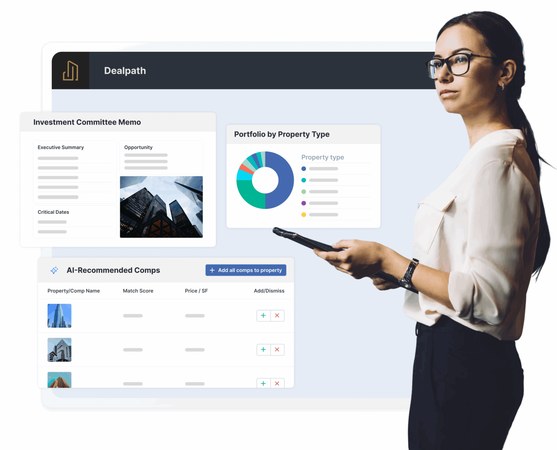
Dealpath
Dealpath is a San Francisco-based cloud platform that serves as the system of record for commercial real estate investment teams. It centralizes deal pipelines, files, tasks and analytics for firms like Blackstone, AEW and Oxford Properties, and has supported more than $10 trillion in transactions globally.