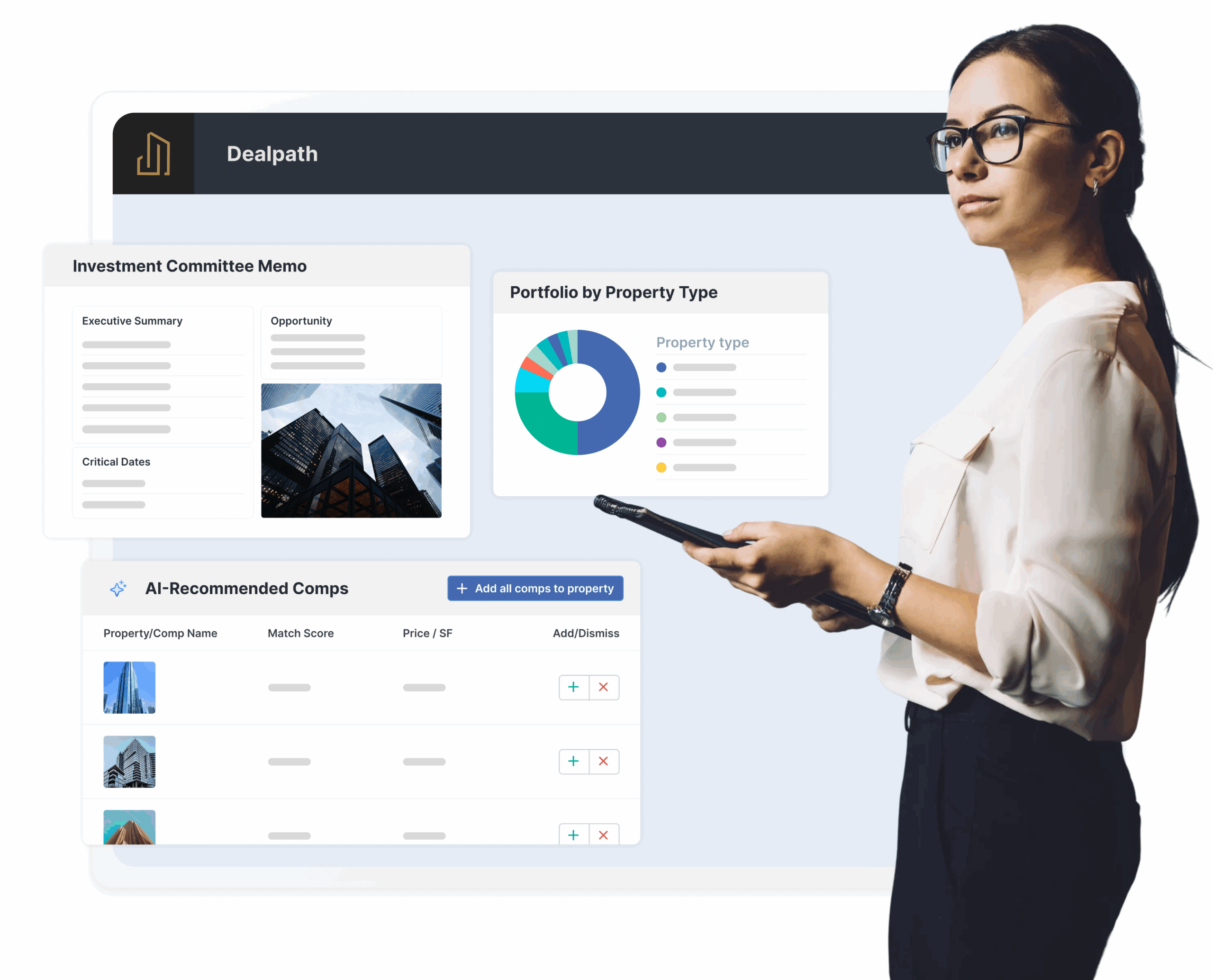
§The Command Center for the World's Biggest Asset Class
It is a Tuesday morning at a private equity real estate firm. Somewhere on the 34th floor, an analyst is trying to remember whether the offer on the Phoenix warehouse came in at 4.2% or 4.4%. Three years ago, she'd be re-opening attachments, hunting through Slack threads, asking the associate, asking the associate's associate. Today she opens one tab. The number is there. The OM is parsed. The committee deck is half-written for her.
That tab is Dealpath.
It is, at the unsentimental core of things, a SaaS platform - a cloud-based system of record for commercial real estate investment teams. But describing Dealpath as "deal management software" is like describing the New York Stock Exchange as "a building with a bell." The platform sits underneath more than $10 trillion in transactions. It is what Blackstone, AEW, Oxford Properties, Principal Real Estate and roughly 297 of their peers reach for when a deal moves from spreadsheet to investment committee.
§An Industry Held Together by Email Attachments
The strange truth about commercial real estate - the world's largest asset class, larger than equities, larger than bonds - is that for most of its modern history it has been managed in Excel. Not in some respectable, version-controlled, audit-trailed way. In the way where someone names a file DealsQ3_FINAL_v2_REAL.xlsx and emails it to seven people who then save seven slightly different copies.
For acquisitions teams running 200 live deals across a dozen markets, that was the operating model. Pipeline lived in someone's head. Offering memorandums lived in inboxes. Investment committee memos lived in PowerPoints written the night before. Every firm built the same broken process. Every firm paid the same hidden tax.
This was the gap Mike Sroka, Andy Lee and Kenter Wu noticed in 2014. Sroka had come up through real estate finance and then a hedge fund, watched how institutional firms hoarded and lost data, and concluded - with the diagnostic patience of someone who has seen too many slide decks - that the back office of the world's largest asset class was, in technical terms, a mess.
§What Three Co-Founders Bet On
The bet was not that real estate investors would adopt software. They had software. Plenty of it. The bet was that they would adopt one place - a single, vetted system of record where pipeline, files, tasks, approvals and analytics could finally agree on the same version of the truth.
It is a deceptively unsexy bet. Building a system of record means you spend years getting the boring parts right. Permissions. Audit logs. Configurability that makes the platform feel native to each firm's idiosyncratic workflow. The flashy demo comes later, if at all. The reward is that, once you're in, you are very, very hard to rip out.
By 2016, 8VC and Formation 8 had led a seed round. By 2018, GreenSoil PropTech Ventures and LeFrak had joined a Series A. By 2020, Blackstone, the largest real estate investor on the planet, made a strategic investment - which is the kind of validation money can almost buy and trust cannot.
§What the Platform Actually Does
At its center, Dealpath is a pipeline. Every deal a firm is looking at - the warehouse in Phoenix, the mixed-use in Austin, the multifamily portfolio in Toronto - lives as a structured record. Around that record orbit the things deals are actually made of: the OM, the underwriting model, the broker call notes, the committee memo, the closing checklist.
The cleverness is in the configurability. A debt fund and a development shop want completely different fields, workflows, approval chains. Dealpath was built so admins can model their own logic without filing a ticket. Then, in 2023, the company layered AI on top: an OM abstraction tool that reads a 90-page offering memorandum and pre-fills the deal record. Customers using it reported evaluating roughly 20% more deals - which, in a business where opportunity cost is real money, is the kind of number CFOs frame.
Pipeline Tracking
Every live deal, every stage, one dashboard. Bye, Excel.
OM Abstraction
Reads offering memorandums and pre-fills the deal record.
Deep Search
Full-document search across the firm's entire deal history.
Custom Approvals
Investment committee logic, modeled the way each firm actually works.
Live Analytics
Pipeline dashboards that don't go stale by 10am Monday.
Open API
Connects to Salesforce, market data feeds and internal stacks.
A Brief History of Dealpath
- 2014Mike Sroka, Andy Lee and Kenter Wu found Dealpath in San Francisco.
- 2016Public launch; seed round led by 8VC and Formation 8.
- 2018Series A: $12M, joined by GreenSoil PropTech and LeFrak.
- 2020Blackstone announces strategic investment.
- 2021Series B: $21M with JLL Spark and Nasdaq Ventures.
- 2022Series C: $43M led by Morgan Stanley Expansion Capital.
- 2023Launches AI-powered OM abstraction and search.
- 2023Platform expands into Canada.
- 2025Brand refresh; new logo inspired by a building silhouette.
§The Numbers, Behaving Themselves
It is one thing to claim category leadership. It is another to print receipts. Dealpath has the receipts in trillions - cumulative transaction volume tracked by firms running on the platform, growing roughly in step with the platform's market share.
Cumulative Deal Volume on Dealpath
Approximate, public-reporting basis Values are approximations derived from press releases and company communications. Trillions, but you knew that.The customer roster reads like a financial-press headline: Blackstone (also an investor), AEW, Oxford Properties, Principal Real Estate, Bridge Investment Group. Behind the scenes there are 300+ firms, many quieter, all dealing with the same fundamental problem: more deals than the team can humanly track, and bosses who want to see them all.
§Digitizing the World's Largest Asset Class
Sroka uses a phrase in interviews: digitize the world's largest asset class. It sounds like a slogan and is in fact a project plan. Equities went digital decades ago - exchanges, screens, algorithms, trillions of trades a day. Bonds followed, awkwardly. Real estate, the largest of the three, has lagged because each deal is bespoke, each property is a snowflake, and the buyers are notoriously fond of how things have always been done.
Dealpath's mission is not to make CRE look like a Bloomberg terminal. It's to make sure that the next time the industry has a cycle - the next time interest rates lurch, the next time a city's office market collapses - the firms running on its platform will know, in real time, what they actually own and what they are actually bidding on. That is the boring, important sort of mission that builds an enduring company.
§Where This Goes Next
The interesting thing about a system of record is what you can build on top of it once it exists. Dealpath now has structured data on a meaningful share of institutional CRE activity. That is, quietly, one of the most valuable datasets in finance. The next chapter - the AI chapter, the benchmarking chapter, the predictive-underwriting chapter - is the kind of thing that only works if someone first did the unglamorous job of getting the data clean.
The firm has spent a decade on that unglamorous job. Now the interesting work begins.
Back to that Tuesday morning on the 34th floor. The analyst closes her laptop. The deal moves to committee. Nobody had to ask the associate's associate. Somewhere on California Street, a piece of software has done its job - again, quietly, in trillions.
The Receipts
Where to read more, watch more, follow along.