point-of-care
(16)
OptimizeRx Put Pharma Ads in the Doctor's Office. Then It Paid $95 Million to Follow the Patient Home
The company started with copay coupons inside prescribing software. Now its bigger wager is that pharma marketing works best when the patient on the sofa and the clinician at the screen receive coordinated messages at the moment a treatment decision is forming.
The Waiting Room Was Dead Time. CheckedUp Turned It Into Media Inventory.
CheckedUp gives clinics its screens for free, then sells life-sciences brands a measured place inside the medical conversation. The bet works only if education stays useful, advertising stays credible, and every play can be proved.
The Pregnancy Test That Could Catch a Killer Before the Doctor Does
Preeclampsia kills tens of thousands of mothers a year, mostly because no one catches it in time. A team that started as classmates in Durham and Kampala wants to move that first warning from the hospital lab to the bathroom shelf.
C8 Health
C8 Health is a healthtech company building an AI-powered best-practices implementation platform for hospitals. It consolidates scattered clinical protocols, guidelines and reference material into a single, site-specific source of truth, then delivers vetted, role-aware answers to clinicians at the point of care through search, mobile-friendly formats and a natural-language AI assistant. Founded in 2022 and used across 100+ U.S. hospitals, the company aims to close the gap between medical evidence and day-to-day clinical practice.
Cytovale
Cytovale is a San Francisco-based medical diagnostics company that built IntelliSep, an FDA-cleared blood test that helps emergency departments identify patients at risk of sepsis in about eight minutes. Instead of hunting for a pathogen, the test reads the immune response by measuring the biomechanical properties of white blood cells using microfluidic deformability cytometry, high-speed imaging and machine learning. Founded on academic research that began in 2007 and incorporated in 2013, the company is applying its rapid host-response platform to one of medicine's most time-sensitive and deadly conditions.

Vim
Vim is a healthcare technology company that builds a middleware and developer platform connecting data to clinical workflow at healthcare's 'last mile' - the point of care. Its EHR-agnostic Vim Connect layer sits on top of popular electronic health records, pulling in insights and applications from payers, health plans, and digital-health innovators and surfacing them directly inside a provider's existing workflow. By automating tasks such as care gap closure, diagnosis capture, prior authorization, referral management, and chart retrieval, Vim helps payers and providers align on value-based care while reducing administrative burden for clinicians.
Harae Dx Corp.
Harae Dx Corp. is a Pleasanton, California medical device startup building what it calls the world's smallest portable, automated system for early cancer detection. Founded in 2021 by serial medtech entrepreneur Sanjeev Saxena, the company pairs a proprietary lab-on-a-disc centrifugal microfluidic platform with a biomarker panel exclusively licensed from Lawrence Livermore National Laboratory to deliver a non-invasive early breast cancer test that returns results in roughly 30 minutes - without shipping samples to a third-party lab. Backed by SOSV/HAX and Fusion Fund, Harae Dx aims to make low-cost cancer screening portable enough to run at the point of care.
Belle.ai
Belle.ai (legally BelleTorus Corporation) is a Cambridge, Massachusetts company building AI that reads skin from an ordinary smartphone photo. Its Belle 1K Skin AI engine uses geometric image analysis to surface comparable references across more than 1,600 skin conditions and to produce objective severity scores for immune-mediated diseases like psoriasis, eczema, acne, vitiligo and alopecia. The goal is practical: give general practitioners, estheticians and providers in places with few dermatologists a tool to assess, document and track skin at the point of care. The technology is used across more than 60 countries and 1,000-plus provider sites, and the company has drawn contracts and recognition from ARPA-H and CMS.

HueDx
HueDx is a Philadelphia diagnostics company - formerly Group K Diagnostics - that turns any smartphone camera into a reader for lab-grade, quantitative color-based tests. Its patented HueCard color-correction hardware and AI-powered HueTools/HueCloud software let researchers develop, validate, and deploy paper-based colorimetric assays without proprietary readers or lab infrastructure, aiming to make quantitative results available at the point of care and at home.

IO Health
IO Health is a Pasadena-based healthcare technology company building an AI-powered workflow intelligence platform for home health and hospice agencies. Rather than replacing an agency's electronic medical record, its software sits on top of the existing EMR as a real-time overlay, catching documentation errors, OASIS inconsistencies, and compliance gaps at the point of care - before they reach a QA reviewer or a Medicare auditor. Founded in 2023 by home health operators and led by CEO Dr. David Bell, the company closed a $2 million seed round led by Nina Capital in October 2025.

JuneBrain Inc.
JuneBrain Inc. is a Baltimore medtech startup building a wearable, AI-powered eye-scanning system that brings optical coherence tomography (OCT) out of the eye clinic and into neurology, primary care, and the home. Its flagship Neuro-i SS-OCT captures high-resolution retinal images without a technician, and its AI software turns those images into quantitative biomarkers clinicians can use to monitor diseases like multiple sclerosis, Alzheimer's, and Parkinson's between visits. Founded in 2017 by neuroscientist Samantha Scott after her own diagnosis with a neuromuscular disorder, the company is a WBENC-certified women-owned business on track for FDA submission in 2026.
PrescriberPoint
PrescriberPoint is a Boston-based, AI-enabled point-of-care platform that supports clinicians at every step of the prescribing journey - from researching FDA-approved drug information to checking coverage and out-of-pocket costs, submitting prior authorizations, and enrolling patients in savings programs. Spun out of work with Eli Lilly and BCG, it consolidates fragmented prescribing resources for tens of thousands of medications into one portal, and in 2025 reached more than 5 million healthcare professionals - one of the largest active HCP networks in digital health.
identifeye HEALTH
identifeye HEALTH (formerly Tesseract Health) builds an AI-powered retinal imaging platform that turns a quick eye scan in a primary-care clinic into a window onto whole-body health, helping clinicians screen for diabetic retinopathy, glaucoma and macular degeneration without dilation or specialty equipment.
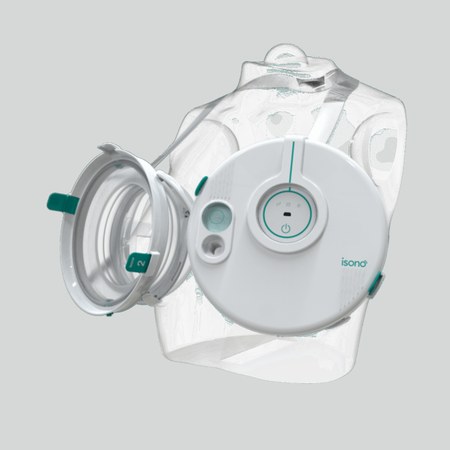
iSono Health
iSono Health builds ATUSA, an FDA-cleared wearable 3D ultrasound platform that scans both breasts in about two minutes without a specialized sonographer. The South San Francisco startup uses AI to make breast imaging portable, reproducible, and accessible at the point of care.

CorVista Health
CorVista Health is a medical technology company applying machine learning to cardiovascular diagnostics. Its FDA-cleared CorVista System is a non-invasive, point-of-care device that captures cardiac and hemodynamic signals and analyzes them in the cloud to assess the likelihood of coronary artery disease and pulmonary hypertension - delivering results in minutes, without radiation, contrast, injections, fasting, or exercise. The company aims to shorten the path from symptoms to diagnosis so patients can be treated earlier.
NovaScan
NovaScan is a Chicago-based clinical-stage oncology company building low-cost, point-of-care devices that detect cancer in real time. Its platform pairs spectral bioimpedance with machine learning around a single biophysical signal - the Cole relaxation frequency, which differs by orders of magnitude between cancerous and healthy tissue. Two lead products, nsCanary for assessing biopsy cores and MarginScan for checking surgical excision margins, aim to deliver answers in seconds instead of the days that conventional pathology can take.