The most valuable square foot in a doctor’s office may be the wall nobody notices. A patient is waiting, mildly anxious, thinking about one specific condition. A physician is minutes away. The phone is in hand, but the context is unusually focused. CheckedUp built a company around that interval.
Its products are not mysterious: a 43-inch connected television called Explorer for the waiting room and a 32-inch touchscreen called Consult for the exam room. Explorer cycles through health programming, practice information and sponsored messages. Consult gives clinicians a library of specialty material, annotation tools, video playlists, email guides and more than 40 interactive 3D anatomical diagrams. One screen fills time. The other helps explain a knee, an eye or a tumor while the patient and doctor are looking at the same picture.
The business underneath those screens is more interesting. Practices and hospitals pay nothing for the equipment, implementation or service. Life-sciences manufacturers, agencies and healthcare brands buy targeted campaigns across the network. Patients get education; clinicians get a teaching aid; sponsors get access to an audience at the moment a diagnosis or treatment is being discussed. CheckedUp is simultaneously a hardware operator, content studio, software platform and media seller.
The first enemy was the photocopier
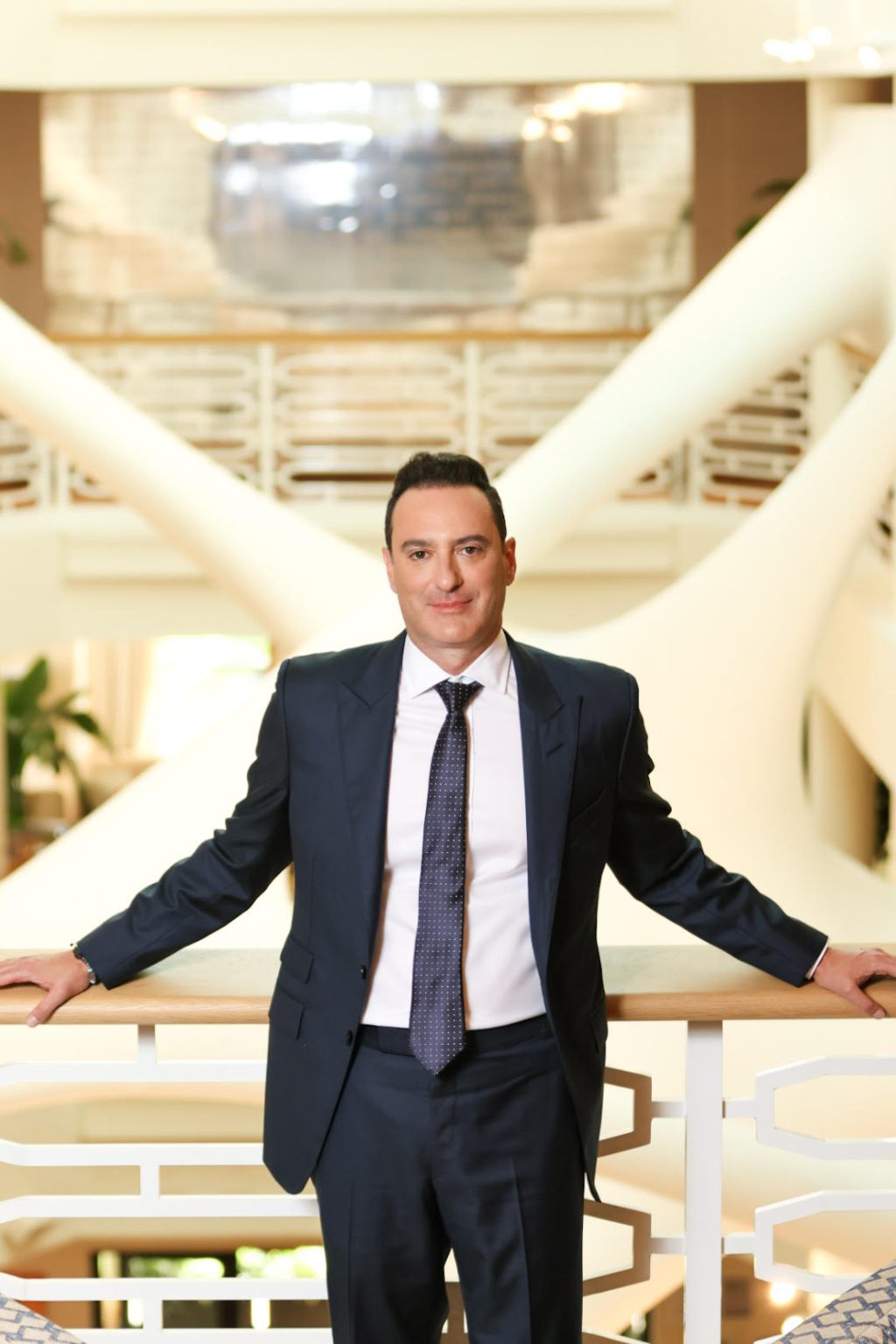
CheckedUp began in 2012 with a physician’s annoyance. Co-founder and CEO Richard Awdeh, then practicing ophthalmology, saw patients arrive confused about conditions and overwhelmed by treatment choices. At the same time, physicians had less time per visit and more options to explain. Clinic technology had raced ahead in diagnosis and surgery, but patient education still meant a DVD or a photocopied brochure.
That was the first thing to fail: not a startup feature, but the old workflow. Awdeh’s response was to make education visual, specialty-specific and available across the visit. His brother Mark Awdeh joined as co-founder and president. The company’s original strength in ophthalmology was not an arbitrary beachhead. Cataract and refractive care force doctors to explain anatomy, trade-offs and premium treatment options under time pressure. If an interactive wallboard could make that conversation clearer, the same logic could travel.
I created it because of the contrast I saw between our day-to-day use of technology outside the office and what was happening in the clinic.Richard Awdeh, on replacing DVDs and photocopied brochures
A product with two clocks
Explorer and Consult work on different clocks. The waiting-room television has several minutes to earn attention with a rotating mix. The exam-room screen may have seconds to help a clinician point, draw and clarify. Consult therefore has a gallery mode for passive content and advertising, plus a consultation mode built for active use. The design won a 2024 Red Dot award in medical devices and technology; the jury praised the way the hardware and medical content formed one system.
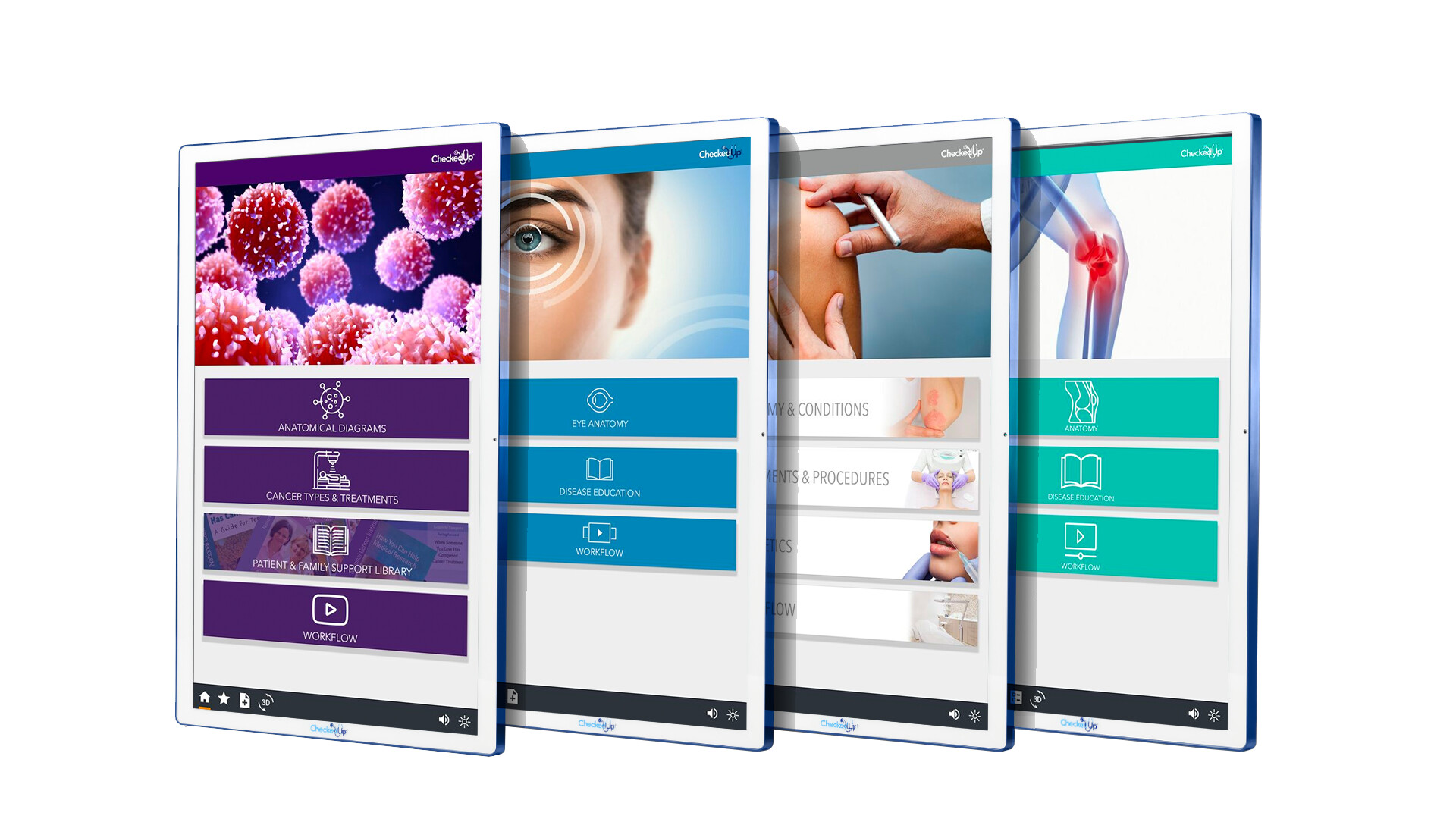
The company says content comes from reputable U.S. medical institutions, educational partners and its own production team. Its partnership with the American Society for Dermatologic Surgery brought material on cosmetic, reconstructive, Mohs and medical dermatology into both products. The American Academy of Ophthalmology lists CheckedUp among systems licensed to deliver Academy patient education. Practices can add physician biographies and local service information; partners can make videos, brochures and savings cards available through a Brand Resource Center.
This is where CheckedUp differs from a generic digital-signage vendor. A television bolted to drywall is a commodity. Specialty distribution, approved medical material, clinician-facing interaction and campaign reporting are not. The closest scaled comparison is PatientPoint. The broader alternatives include a practice’s own signage, printed handouts, EHR education modules and whatever a patient finds in a search result. CheckedUp’s pitch is that none combines its particular context, workflow and national media inventory.
The ad has to finish before it exists
Giving the screen away removes the clinic’s budget objection, but it creates a tougher obligation. Sponsors must believe the campaign ran where and when CheckedUp promised. In June 2026, the Media Rating Council accredited the company’s reporting for TV video ad plays and Explorer waiting-room TV engagement. PatientPoint had received the category’s first accreditation in 2024, making CheckedUp the second point-of-care digital advertising service to clear that bar.
The machinery is pleasingly literal. Each device logs an event only after an ad finishes. A composite key made from the device, timestamp and ad identifier rejects duplicates. Plays outside a clinic’s verified office hours are filtered. Demonstration devices are excluded. If a screen loses its connection, events can remain on the device for up to 60 days and synchronize later. Campaign analysts review launch reports and weekly results. The screen may look passive; the audit trail is busy.
That accreditation matters because the business contains an unavoidable tension. The same screen is meant to educate a patient and deliver a commercial message. Too much advertising weakens the utility that persuaded a clinic to install it. Weak clinical material makes the message less credible. Loose reporting makes the inventory less valuable. CheckedUp’s defensibility is less about inventing the screen than balancing those constraints at scale.
Capital followed distribution
CheckedUp’s path from founder-run platform to private-equity asset accelerated after 2019. The company said revenue more than doubled between 2019 and 2021. Rockbridge Growth Equity partnered with it in December 2021, providing undisclosed growth capital; Fifth Third Bank supplied senior debt. Rockbridge’s stated plan was to fund technology, people and add-on acquisitions.
The add-on arrived quickly. In October 2022, CheckedUp bought Health Media Network, another in-office healthcare content operator with strength in cardiology, neurology, women’s health, infectious disease, orthopedics and other verticals. The price was not disclosed. The combination expanded inventory, enterprise relationships and content breadth. This was the mind-changing event for the growth strategy: distribution could be bought and integrated, not built one practice at a time.
Built from an ophthalmologist’s frustration
Richard and Mark Awdeh start a specialty patient-education platform.
Rockbridge funds the expansion
Growth capital arrives after revenue more than doubles in two years.
Health Media Network adds reach
The acquisition broadens CheckedUp’s specialties and media footprint.
Design, programming and proof
A Red Dot award, original shows and MRC accreditation deepen the product.
Providence agrees to take control
Varsity and management remain invested; closing is expected in the third quarter.
By August 2026, transaction materials said CheckedUp reached more than 17,000 specialty healthcare providers and worked with a majority of the top 40 pharmaceutical manufacturers. That month, Providence Equity Partners agreed to acquire a majority stake from Rockbridge. Varsity Healthcare Partners will join as a strategic minority investor, and the Awdeh brothers will continue leading the company. Again, financial terms were not disclosed.
Providence is known for investing in media, communications and education. CheckedUp sits neatly at their intersection, with healthcare regulation layered on top. The acquisition is a bet that point-of-care media can become more strategic, measurable and accountable - language that would have sounded grand for a waiting-room TV a decade ago and now describes a real channel.
What to copy - and where it breaks
The transferable lesson is not “put ads on a screen.” It is to find an expensive moment of friction, remove the end user’s budget objection, and charge the party that values access to the resulting workflow. CheckedUp did not ask patients to download another app or ask physicians to create another lesson plan. It installed itself where attention and relevance already existed.
The copyable playbook
- Start with a narrow workflow where the founder has firsthand credibility.
- Subsidize the tool for the side that controls distribution.
- Give the audience utility before asking for attention.
- Sell sponsors context and measurement, not merely impressions.
- Turn operational details - uptime, content review, field support - into trust.
The model will not travel everywhere. It needs repeat foot traffic, enough dwell time, a sponsor category willing to pay, and content specific enough to belong in the room. It also needs clinic density to cover hardware and service costs. In a low-volume practice, an underfunded specialty, or a setting where commercial messages would corrode trust, the subsidy loop can collapse. And if independent measurement stops being convincing, advertisers can buy easier reach elsewhere.
CheckedUp’s 2020 launch of Virtual Visits offers another useful caution. It answered a real pandemic need, but telehealth is absent from the company’s current main product menu. The durable advantage was not being everywhere a patient might go. It was owning a particular physical moment unusually well.
That leaves CheckedUp with a deceptively modest proposition. A screen can help a patient ask a better question. A doctor can explain something faster. A brand can appear when its category is relevant. The company’s job is to keep all three statements true at once. The moment one overwhelms the others, the wall becomes just another television.