Company Profile / Oncology Diagnostics
NovaScan.
Cancer, answered in seconds.
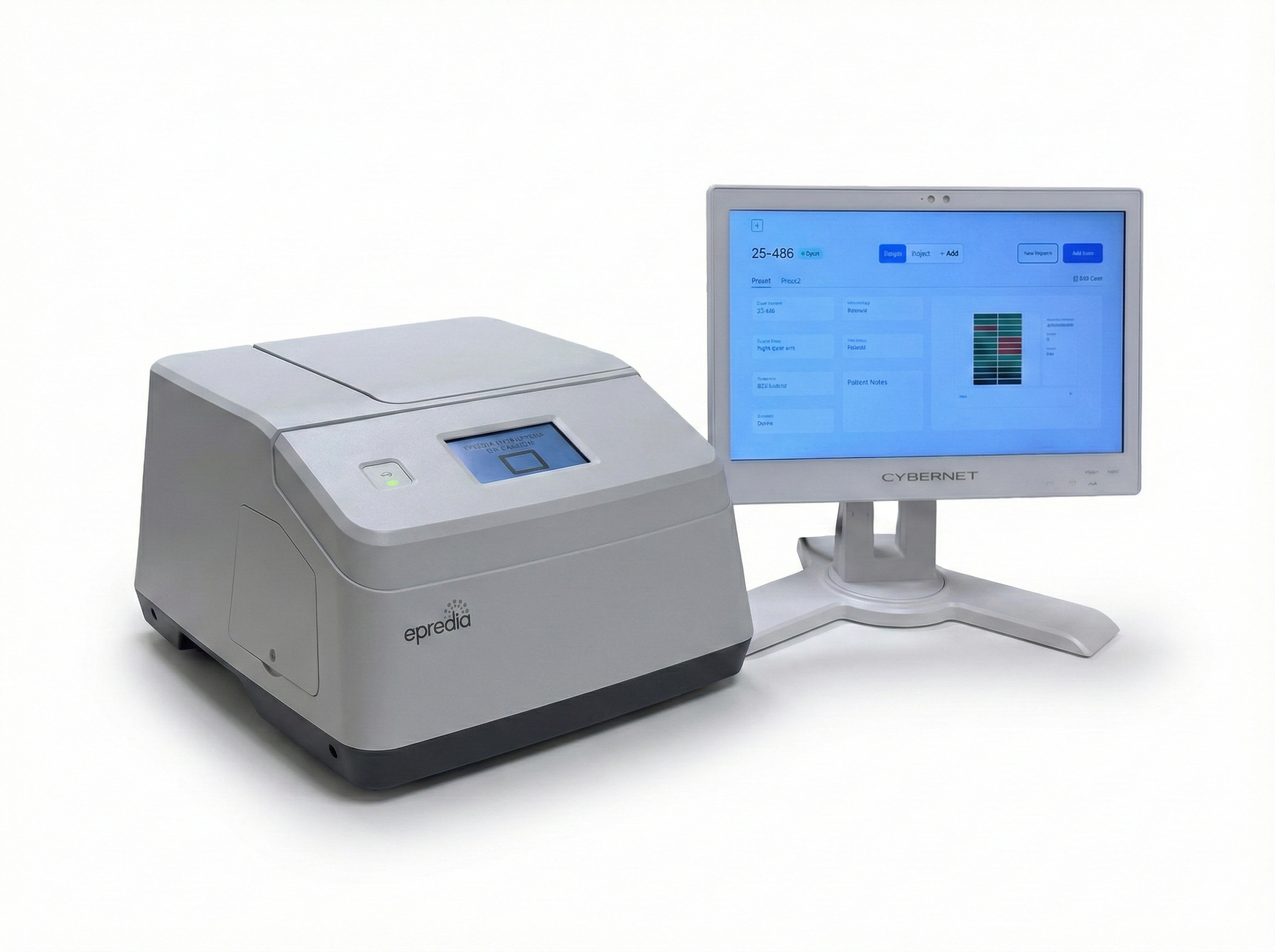
MarginScan, NovaScan's pocket-sized verdict machine. It looks like a gadget; it behaves like a second opinion that never makes you wait.
Somewhere in an operating room, a surgeon stops. The tumor is out, probably. The margins look clean, probably. The next move is to wait - sometimes minutes for a frozen section, sometimes days for full pathology. NovaScan exists to delete that pause.
NovaScan is a clinical-stage oncology company in Chicago with roughly fourteen people, two flagship devices, and one stubborn conviction: that you should not have to send tissue to a lab to learn whether it is cancer. Its tools press against a sample and return a reading in seconds. Not a picture to interpret. A number.
It is a small company taking on one of medicine's most expensive habits: waiting. And it is doing it with physics that has been sitting in the literature, mostly ignored, for decades.
Pathology is rigorous, careful, and gloriously analog. A sample gets fixed, sliced, stained, and read by a human who trained for a decade. That rigor is a feature. It is also a bottleneck, and bottlenecks have a habit of showing up at the worst moments - mid-surgery, mid-biopsy, mid-decision.
Take Mohs surgery for skin cancer. A surgeon removes tissue, then waits while it is frozen, sectioned, and examined. If a margin still shows cancer, they go back in. Repeat. The patient sits. The clock runs. The room stays occupied. Take a needle biopsy of the pancreas, where you cannot always tell in the moment whether the needle even caught the lesion. So you take another core. And another.
NovaScan's wager is that a lot of that waiting is avoidable - if you stop trying to look at cancer and start trying to measure it.
The science traces back to William Gregory, an emeritus professor and former Dean of Engineering at the University of Wisconsin-Milwaukee. Not a coastal biotech lab. A Midwestern engineering department. Gregory zeroed in on the Cole relaxation frequency - an electrical impedance parameter that describes how tissue responds to alternating current.
Here is the part that makes the whole company make sense: as cells turn cancerous, that frequency shifts by roughly three orders of magnitude. Not a few percent. A thousandfold. Cancerous and healthy tissue end up so far apart on this measure that they barely overlap. NovaScan claims to be the first to identify a single parameter that separates the two this cleanly.
Turning a physics insight into a device that surgeons trust is, of course, the easy part - said no one, ever. That job fell to Craig Davis, a medtech investor and operator who had previously helped build Merge Healthcare (later bought by IBM for around a billion dollars). Davis became CEO, raised the capital, and pointed the team at the clinic. In 2022, WiSys named both men Innovators of the Year.
NovaScan did not build a microscope. It built measurement tools, each combining spectral bioimpedance with machine learning. The AI is not there to look clever; it is there to read the impedance signature and decide which side of that thousandfold gap a sample falls on.
A digital "smart ROSE" platform that tells you, in seconds, whether a biopsy core actually contains pathologically relevant cancer - before you take another one. Early targets: pancreatic, biliary, and lung.
A compact device that detects and localizes cancer at the edges of a surgical excision in seconds. Non-destructive, no dedicated pathology resources, and it does not interfere with standard histopathology. First target: Mohs skin surgery.
The shared promise is workflow that does not flinch. No frozen-section detour. No dedicated operator standing by. No steep learning curve that keeps a tool stuck in a research drawer. Press, read, decide.
A bold claim about electrical signatures is worth exactly nothing without data. So here is the data NovaScan points to: across multiple cancer types, studies report sensitivity in the 91%-100% range and specificity from 85%-100%. The company's framing is that the Cole relaxation frequency does not vary with mass, and that there is virtually no overlap between cancerous and benign tissue.
There are partners, too, which matters more than press releases usually let on. PHC Holdings - a serious medical-device manufacturer - signed on in 2023 to assess MarginScan for Mohs skin surgery. Academic centers including the University of Chicago and the University of Illinois Medical Center host the trials. None of this is FDA clearance yet. MarginScan is investigational, with first skin-cancer clearance targeted for 2027.
NovaScan's stated mission is unglamorous in the best way: make cancer detection fast, low-cost, and available at the point of care. No expensive capital equipment. No specialist required to run it. The democratizing instinct here is real - a tool that works in a community clinic is worth more than one that only works in a flagship hospital.
That is also the commercial logic. NovaScan is a B2B device company. It sells hardware and AI to hospitals, surgeons, and labs, and it grows through distribution deals like the PHC partnership. The competition is partly other intraoperative imaging players, and partly the status quo itself - the frozen section, the ROSE workflow, the lab down the hall.
If NovaScan is right, the implications fan out fast. A skin surgeon clears margins in one sitting instead of three. A biopsy team confirms a good core before the patient is off the table. A clinic without a pathology lab gets a credible read anyway. Multiply that across five cancer types and the savings stop being about minutes and start being about whether a diagnosis happens at all.
The honest caveats remain. Clearance is years out. Small teams burn capital. Reported numbers are not the same as regulatory endorsement. Skepticism is the correct posture here, and NovaScan would not be the first company to make a clean signal look messier in the real world.
So return to that operating room. The surgeon stops. The tumor is out. In the old world, this is where the waiting begins. In the world NovaScan is trying to build, the surgeon presses a small device to the tissue, reads a number, and keeps moving. The pause - the one that used to cost days - is simply gone. That is the entire point.