The South San Francisco startup that strapped a 3D ultrasound onto a vest, scanned both breasts in two minutes, and asked a market worth fourteen billion dollars to please move over.
There is a small, unromantic room in a clinic somewhere off El Camino Real where a woman is putting on what looks like a sports bra wired to a tablet. She doesn't ask the sonographer where to press. There is no sonographer. The device is doing the pressing - quietly, mechanically, in a pattern it has rehearsed thousands of times. Two minutes later, both breasts have been scanned in three dimensions, the volume is in the cloud, and an AI has already flagged the spots a radiologist might want to look at twice.
This is what iSono Health built. They call it ATUSA. The FDA calls it cleared. The market - the part of it that has been waiting for breast imaging to stop depending on the geography of trained sonographers - is starting to call it back.
The company has been at this since 2014. CEO Neda Razavi and CTO Shadi Saberi met around the question of why breast ultrasound, a forty-year-old technology, still required a specialist hovering with a wand. Saberi, fresh from a PhD at UCSF's Department of Radiology and Biomedical Imaging, thought the answer was a transducer that could move on its own. Razavi, an operator, thought the answer was a business that could ship one.
What followed was twelve years of the kind of work that doesn't fit on a slide. Y Combinator. SBIR grants. Engineering reviews. Clinical reviews. Regulatory reviews. In May 2022 the FDA cleared ATUSA as the world's first automated and wearable 3D breast ultrasound. In January 2023, Abdul Latif Jameel Health signed on as the exclusive distributor across 31 markets in the Global South. By late 2025, Draper Associates and Transform VC were leading another seed extension. By early 2026, the company was shipping commercially and quietly opening a Series A.
The math of the problem is unsubtle. Roughly half of women have dense breast tissue, which makes mammograms harder to read. Supplemental ultrasound helps, but US breast imaging centers are bottlenecked on sonographer time, and that time is not evenly distributed across zip codes - never mind across countries. An automated scanner that any nurse or medical assistant can fit and run rearranges the bottleneck. That's the bet.
It is not, despite the obvious temptation, a pitch about disruption. iSono Health doesn't want to replace the radiologist. It wants the radiologist to keep their job and lose the rate-limiting step.
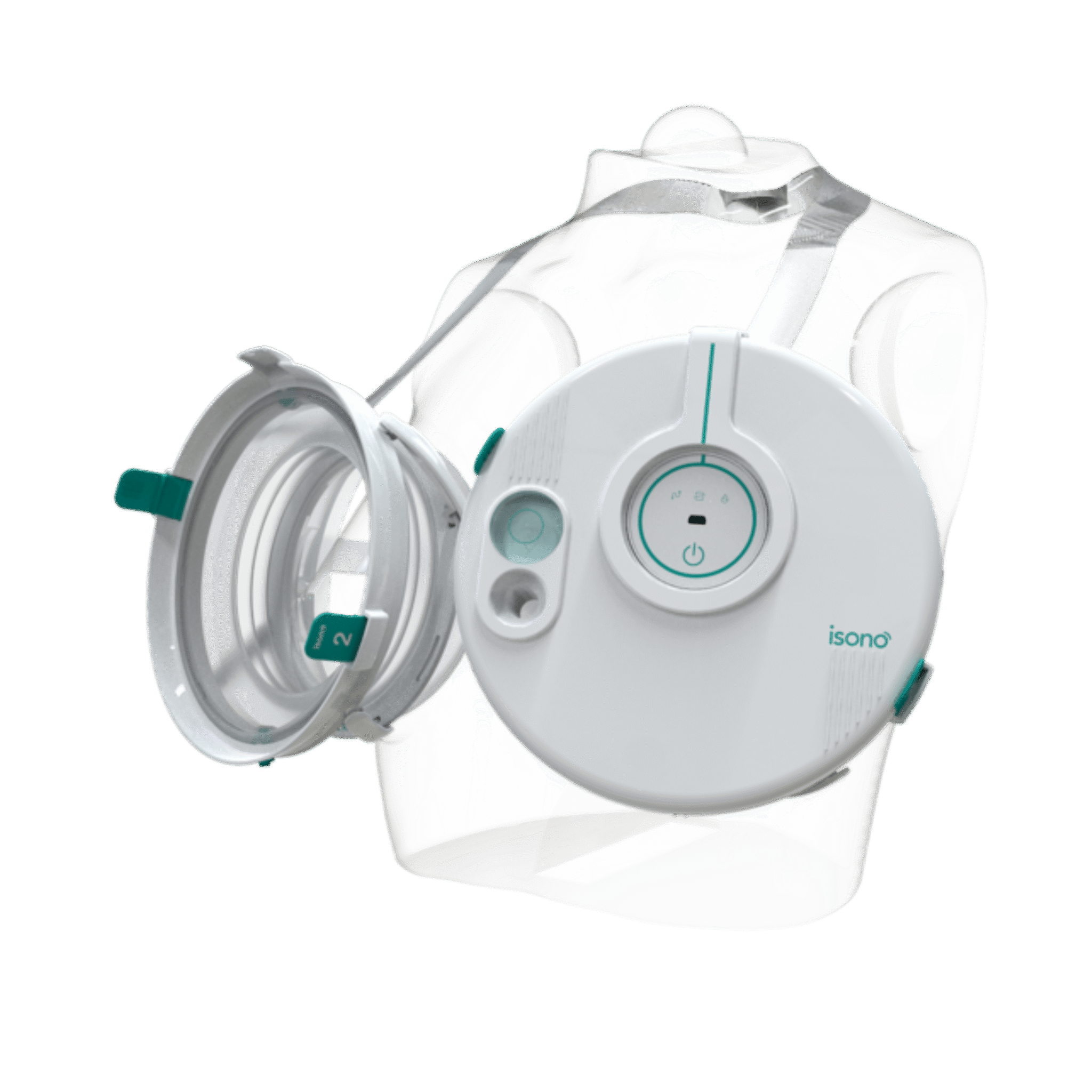
"Two minutes. Two breasts. The exam goes to the patient now, not the other way around." — YesPress paraphrase of iSono Health's commercial launch, 2026
The transducer drives itself across a known geometry. A medical assistant can run it. That breaks the dependency on a specialty workforce that simply does not exist at the scale the world needs.
Every scan covers the full breast volume on a repeatable path, which means follow-ups can be compared apples to apples. Handheld scans, almost by definition, cannot.
Images stream to the cloud, AI assists with lesion localization, and a radiologist anywhere in the world can read them. Point-of-care meets point-of-expertise.
Stanford-trained operator turned femtech CEO. Razavi runs the company and the cap table and, increasingly, the room when investors ask why anyone would attempt hardware in women's health.
UCSF Radiology and Biomedical Imaging PhD. Saberi designed the imaging stack, the hardware, and most of the patents that allow a transducer to scan a breast on its own.
Rounds: Draper Associates · Transform VC · JSK Investments · GreenSand Equity · The Josephine Collective.
The Saudi-headquartered health distributor signed on as exclusive partner across 31 Global South markets at Arab Health 2023. The deal is the first real test of whether an automated scanner can be deployed in clinics that have never had a sonographer to begin with.
NIH-backed multicenter clinical trial evaluating ATUSA in high-risk patients. Its data is what will eventually determine whether ATUSA is a screening tool, a monitoring tool, or - if the company is right - both.
The woman in the clinic puts the device back on the counter. The image is in the cloud before she's out of the chair. A radiologist in another city has already opened the file. There was no anxious shoulder-tap, no apology about the wait list, no rebooked appointment three weeks out. The exam happened in the time it takes to make tea.
That is what iSono Health has built. Not a wand. Not a software trick. A small, stubborn re-arrangement of who has to be in the room for a breast scan to happen at all. The next chapter is the boring one - Series A, more clinics, more countries, more data - and that is exactly what the company should be doing now. The interesting part already happened.