electronic-design-automation
(10)
Fab2 wants to put the factory on the production line
Sam Zeloof and Jim Keller are building a factory that makes chip factories. The wager behind Fab2: semiconductor progress could depend as much on cheaper experiments as on smaller transistors.

The Five-Minute Check That Changed the Chip Schedule
A chip team cannot fix a bug it has not seen. Real Intent’s wager is that the useful warning is the one engineers can afford to read today, while the design is still easy to change.
The Chip Bug Nobody Wanted to Read
ChipAgents sells autonomy in the least forgiving corner of computing. Its clearest proof begins with a humbler assignment: read the datasheet, build the testbench, and find the bug before it becomes silicon.

Atrisa
Atrisa (formerly Refortif AI) is a Y Combinator P26 startup building AI agents for analog circuit design. Its agentic workflow lets hardware engineers describe, design, debug and simulate analog circuits in natural language, encoding the 'tribal knowledge' of experienced analog designers that general-purpose LLMs never learned. Founded in 2026 in San Francisco by Sayan Mitra, Atman Kar and Rithik Jain, Atrisa integrates with existing PDKs, design docs and workflows to help engineers reason about topologies, parasitics and layout without leaving a chat-based interface.

Silimate
Silimate is a Mountain View startup building an AI copilot for chip designers. Its AI-native tools find and fix functional bugs and power, performance and area (PPA) issues in digital chip designs, aiming to make hardware development move closer to the speed of software. Founded in 2023 by Ann Wu and Akash Levy, Silimate was the first EDA company Y Combinator backed (S23) and runs on-premise for Fortune 500 enterprises and chip unicorns building GPUs, CPUs and AI accelerators.

Diode Computers, Inc.
Diode Computers is a New York-based startup building an AI-powered, code-first platform for designing and manufacturing custom printed circuit boards. Its open-source toolchain - a Rust-based PCB compiler that treats schematics as Python-readable code - lets AI agents and engineers generate, validate, and manufacture boards in days rather than months, with human-in-the-loop verification. Founded in 2024 and backed by a $11.4M Series A led by Andreessen Horowitz, Diode serves hardware teams in aerospace, robotics, and defense.
Synopsys, Inc.
Synopsys is an American electronic design automation (EDA) company that builds the software, IP, and simulation tools chipmakers use to design, verify, and manufacture advanced semiconductors. Founded in 1986 around logic-synthesis technology, it is one of three companies that dominate the EDA market and, following its $35 billion acquisition of Ansys in July 2025, has expanded from chip design automation into full silicon-to-systems engineering across electronics, structures, fluids, and optics.
Cadence Design Systems
Cadence Design Systems is a San Jose-based computational software company that builds the electronic design automation (EDA) tools, hardware systems, and semiconductor IP used to design chips, printed circuit boards, and full electromechanical systems. Under its Intelligent System Design strategy, Cadence software sits behind a large share of the world's advanced silicon - powering everything from smartphones and data-center accelerators to cars, aircraft, and, increasingly, AI-driven design automation and drug discovery.
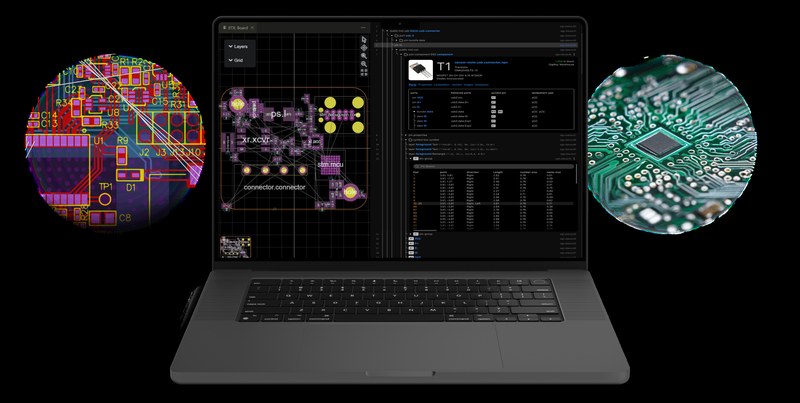
JITX
JITX is a Berkeley- and San Jose-based software company building a code-driven, AI-assisted platform for circuit board design. Instead of dragging parts around a canvas by hand, electrical engineers describe what a board must do in code, and JITX selects components, places parts, routes traces, and checks the design against electrical, mechanical, and manufacturing rules. Spun out of UC Berkeley and backed by Y Combinator and Sequoia Capital, the company is used by hardware teams at firms like Honeywell Aerospace, Lockheed Martin, Northrop Grumman, OpenAI, and HP, who report 5-20x productivity gains on complex multi-layer designs.
Synopsys Inc
Synopsys is the quiet giant behind the world's chips. Its electronic design automation (EDA) software, semiconductor IP, and AI-driven design tools are used to design and verify nearly every advanced silicon chip on the planet - from smartphone processors to AI accelerators. Founded in 1986 by Aart de Geus and led today by CEO Sassine Ghazi, the Sunnyvale company turned the impossibly hard task of laying out billions of transistors into a software problem, and now layers AI on top of it. Its 2025 acquisition of simulation leader Ansys pushed it deeper into multiphysics and systems engineering.