ecommerce-marketing
(29)
Become.com Built a Better Shopping Engine. Distribution Sent the Bill.
It crawled billions of pages to separate shopping research from shopping itself. Then Become.com learned the less romantic law of comparison engines: the best answer is worthless until someone can afford to put it in front of a buyer.

The postcard that refused to stay small
Brandon began with a camera on the Carolina coast. Sixty-seven years later, the same family business sells an unusually broad promise: strategy, creative and performance that share one scoreboard.

The Agency That Put a Spreadsheet Behind the Story
Roar Media began with a simple marriage: old-school press instincts and digital measurement. Eighteen years later, its most interesting work still happens where a headline meets a dashboard.

The Agency That Fixes the Plumbing Before It Turns on the Faucet
Best Practice Media manages more than $35 million in annual ad spend. Its more interesting habit is knowing when not to spend it.
The Agency Built for the Places the Spreadsheet Flattens
The Collective Agency began with a stubborn observation: Latin America is a region, but it is not one market. Its answer is a network that shares tools and senior talent without sanding away the local details.

Junction 37 and the Three-Cent Media Plan
A New York media agency built its reputation by distrusting the obvious channel, following the shelf, and charging toward the strange result. Sometimes the winning ad is six minutes long. Sometimes it costs three cents to watch.
The Agency That Told a Client to Spend Less
Responsory began with direct mail, survived the internet, and kept the useful part: an almost stubborn insistence that creative work should answer to a number.
The Agency Where the Clever Idea Has to Survive Discovery
L7 Creative has spent a quarter-century turning the mess of marketing into a machine. Its best idea may be the rule that every other idea must earn its keep.
Everything Branding wants the checkout after the headline
A TODAY Show appearance can make a brand famous for a morning. Chelsea Gladden’s agency is built around the less glamorous question: what happens after the audience clicks?

Wishare Media Group and the art of finding the right crowd
A California agency connects audience research, creative work, and the page that closes the sale. A small WeChat proposal shows why choosing the audience comes before choosing the ad.
Navazon asks what happens after the click
A new website is easy to admire. A better path from visitor to customer is harder to see. Navazon builds both, with cameras, code, and an eye on the handoff.
The Engine Is Red lets the brief lose the argument
A client asked for a campaign. The answer was a cost-estimating app. Inside the independent creative agency that makes room for a better question.

Kr8 Agency and the business after the celebrity photo
A famous face can get a fashion label noticed. Kr8 Agency’s more interesting proposition is what happens next: turning the placement into material for press, retail, and the online store.
MC Squared knows who should be on the guest list
A luxury home launch in a fashion boutique. False eyelashes with a literary pedigree. The Los Angeles agency makes a business of finding audiences in unexpected company.
Netpeak Built a Marketing Agency. Then It Built the Tools.
An SEO business born in Odesa grew into a marketing operation with a software habit. Its most useful lessons are hiding in the campaign repairs, awkward delays, and bills behind the growth charts.

The 44-Year-Old Agency Learning to Sell in a World Without a Funnel
Stella Rising began when marketing to women was treated as a specialty. Now it is betting that the next durable agency advantage is seeing the whole shopping system - from a TikTok discovery to an Amazon cart to an untraceable purchase at the grocery shelf.
Elit-Web Wants to Turn Marketing’s Messiest Promise Into Math
The Illinois agency sells an increasingly rare commodity in digital marketing: a single team accountable for discovery, clicks and conversion. Its pitch is built on tailored strategy, visible reporting and a stubborn preference for revenue over activity.
The Janitorial Startup That Became a $220 Million Marketing Machine
Grayson Lafrenz started a cleaning company, hired an SEO agency he couldn't understand, and brought the work in-house. What grew out of that frustration now runs roughly $800 million in ad spend through software Power Digital wrote itself.
Yotpo Bet on Everything. Then It Chose Trust.
The e-commerce software company spent years assembling an all-in-one retention suite. Now it is making a narrower wager: that authentic reviews, useful rewards and the data beneath them will matter even more when shoppers ask AI what to buy.
PebblePost Put the Pixel in the Mailbox - Now It Wants the Living Room
The New York ad-tech company made direct mail behave like digital retargeting. Its next act is applying the same transaction-powered engine to connected TV - with the household, not the cookie, at the center.
The Medellin Agency That Learned to Sell to America in Two Languages
It began in 2003 with one text message. Two decades later, SM Digital runs paid search, social, and lead-gen for brands across two continents - and built its whole model on the idea that the fastest-growing market in the U.S. speaks Spanish.

Insider One
Insider One wants to replace the marketer's cluttered tool belt with one operating system - a wager that unified data, a dozen-plus channels and autonomous agents can make customer engagement feel less like campaign assembly.

Topview AI
Topview AI is a Singapore-based generative AI company that turns product links, images, and text into short-form marketing videos. Its AI Video Agent uses digital-human avatars, voice cloning, and automated editing so ecommerce brands, agencies, and creators can produce UGC-style ads and product videos without cameras, actors, or editors. Founded in 2022 by Jensen Wu and Albert Chen, Topview closed a $14M Series A led by Kamet Capital and, by early 2026, reported more than 5 million users generating over 500,000 videos a day.
MediaGlobe
MediaGlobe is a Boston-based paid media company that gives online businesses access to enterprise-grade, whitelisted agency ad accounts on TikTok, Facebook and Meta - alongside media-buying tools, consulting and dedicated account management. Founded in 2020 by CEO Jake Vadeboncoeur, the company positions itself as a strategic partner that helps eCommerce, affiliate, lead-gen and info-education brands scale ad spend without the bans, spend caps and throttling common to standard consumer ad accounts.
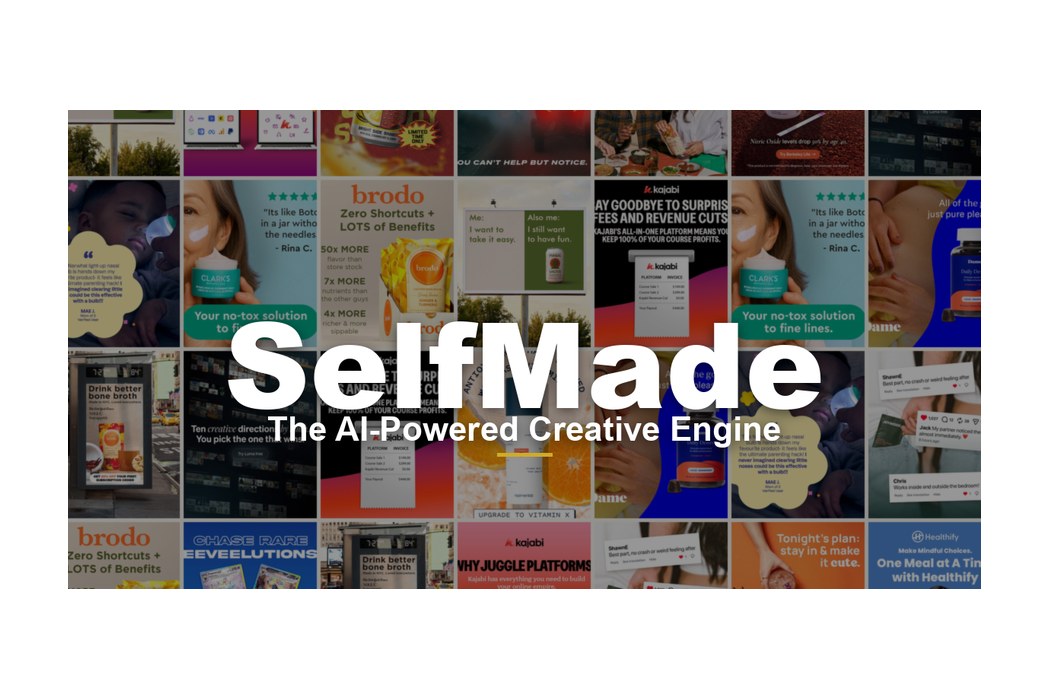
SelfMade
SelfMade is a New York-based AI creative company behind Skipper, a creative intelligence platform that scrapes customer reviews, Reddit threads, Amazon feedback and social comments to build audience personas and generate on-brand performance ads at scale. Originally founded in 2015 as an Instagram commerce app, the company pivoted through agency work before rebuilding around AI-driven creative production for e-commerce and direct-to-consumer brands.

The Brandtech Group
The Brandtech Group is a marketing technology holding company built to help the world's largest brands do their marketing better, faster and cheaper using technology - and, increasingly, generative AI. Founded by former Havas CEO David Jones in 2015 as 'You & Mr Jones,' it has grown through a string of acquisitions into a digital-only group of roughly 7,000 people across 40+ countries, spanning in-housing agency Oliver, performance-media group Jellyfish, and its flagship generative-AI ad platform Pencil Pro. Clients include eight of the world's ten largest advertisers, and after a $115M Series C in 2024 the group was valued at about $4 billion.

Talkable
Talkable is a San Francisco-based B2B SaaS company that builds referral and loyalty marketing programs for e-commerce brands. Founded in 2010 as Curebit and backed by Y Combinator, the platform turns existing customers into marketers by rewarding them for referring friends. It offers referral tracking, incentive management, A/B testing, segmentation, fraud detection, and real-time analytics, and is used by 250+ retail and D2C brands including TOMS, Rothy's, L'Occitane and Alo Yoga.

Creatify AI
Creatify AI is a Mountain View startup building an end-to-end AI ad platform that turns a product URL into ready-to-run, UGC-style video ads. Founded by former Meta and Snap AI leaders, it generates scripts, voiceovers, and lifelike avatars, then tests and optimizes ads across TikTok, Meta, YouTube and more. The company crossed $9M in ARR within roughly 18 months and raised a $15.5M Series A in May 2025 co-led by WndrCo and Kindred Ventures.
Attentive
Attentive is an AI-powered marketing platform that helps consumer brands talk to customers the way customers actually want to be reached - over text, email, RCS, and push. Founded in 2016 by Brian Long and Andrew Jones, the company pioneered compliant, personalized SMS marketing and now serves more than 8,000 brands, powering tens of billions of dollars in customer revenue and crossing $500M in annual recurring revenue in 2024.