customer-insights
(14)
The Tiny Audience That Made The Yaffe Group Think Bigger
A Detroit-area agency discovered that the smaller the target, the less room there was for lazy thinking. Its answer was Humanalytics - data with a pulse.
The 13-Person Agency That Helped Move $250 Million
Marketing SI makes an unusual promise: think like the client, work inside the team, and let the numbers decide whether the idea was clever.
Feefo puts a receipt behind the stars
The British review platform built its business around a simple restriction: customers need an invitation. Now it is selling what happens after the stars - from better advertising to a clearer view of what needs fixing.

Before You Launch, Ask Phase 5: The Toronto Firm That Finds the Blind Spot in the Brief
Phase 5 has spent three decades making expensive decisions less guessy. Its most useful trick is not a dashboard or a slogan - it is knowing when a client is asking the wrong question.

Sprig
Sprig transforms manual survey workflows with a system powered by research agents, enabling enterprise teams to move from question to defensible insight without compromising rigor.
Kapiche
The AI feedback analytics platform that reads every customer conversation - not just the 5% who fill out your survey - and tells you what it costs you.
Condens
Bring all your customer knowledge together, analyze it fast, and surface evidence-backed insights your team and AI agents can both act on.
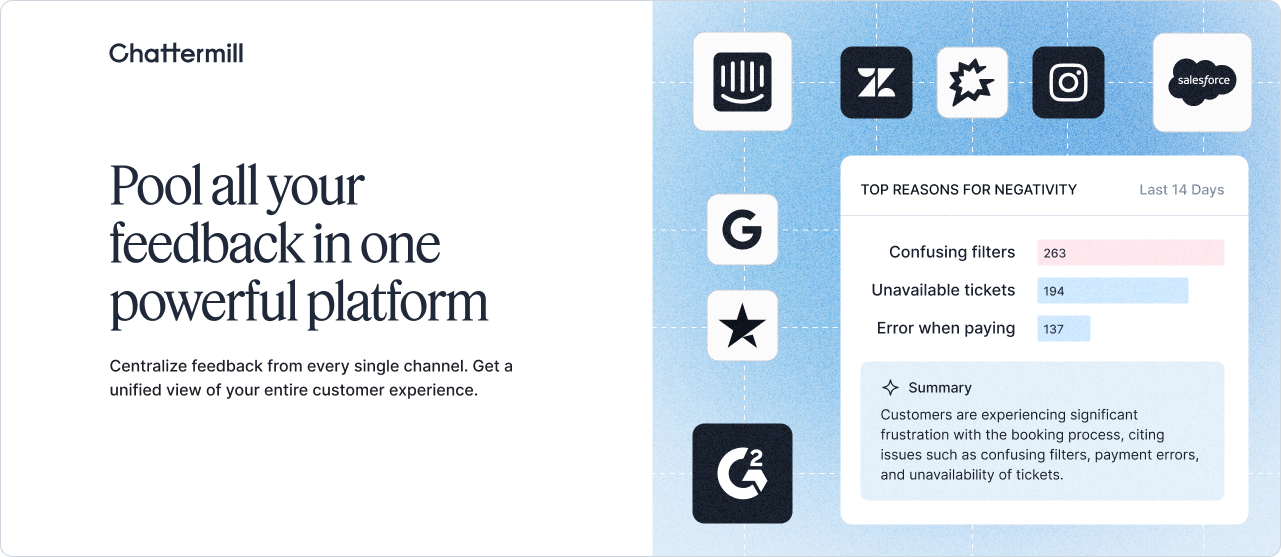
Chattermill
A new kind of customer intelligence platform, purpose-built for the agentic era. Trusted by CX, product and insights teams from the world's leading enterprises.

Aurelius
A research repository built by two UX veterans in a Minneapolis basement, Aurelius helps product teams turn piles of interview notes into searchable, shareable insights - without losing a single finding to a forgotten spreadsheet.
Clootrack
Clootrack is an AI-driven customer experience analytics platform that helps enterprises understand the 'why' behind customer behavior. It ingests structured and unstructured feedback - surveys, reviews, call transcripts, chats, social and support tickets - across 95+ languages and 1,000+ integrations, then applies unsupervised thematic analysis and GenAI agents to surface the drivers of churn, NPS, returns and satisfaction in near real time. Founded in 2017 by serial entrepreneurs Shameel Abdulla and Subbakrishna Rao, the company positions itself as a faster, more granular alternative to survey-first Voice-of-Customer suites.

Askable
Askable is an Australian, AI-powered user research platform that combines a global panel of verified participants, certified human researchers, and research-specific AI into a single system meant to replace a team's whole research stack. Founded in 2017 in Brisbane, it started as recruitment software - the self-described 'Uber for user testing' - and has grown into an end-to-end product research suite used by teams at brands like Atlassian, Canva, Wise and Toyota. After roughly six years bootstrapped and profitable, the company raised a A$22M Series A led by AirTree Ventures in 2024 to expand in the US and UK and deepen its AI tooling.

PlaybookUX
PlaybookUX is an all-in-one user experience research platform that helps product, design and research teams recruit participants, run studies, and analyze results in one place. It combines a vetted panel of millions of testers with a full toolkit of qualitative and quantitative methods - unmoderated and moderated testing, card sorting, tree testing, surveys, first-click and five-second tests, preference testing and session replays - and layers AI on top to transcribe, summarize, tag and report on findings. Founded in 2018 by Lindsey Allard and Kristen Giovanniello and headquartered in New York, the company is bootstrapped and grew to roughly $6.5M in revenue and 300+ customers by 2024.

Pienso
Pienso is a no-code AI platform that lets domain experts - not just engineers - train, fine-tune, and deploy their own machine learning and large language models without writing a single line of code. Founded by MIT Media Lab alumni Birago Jones and Karthik Dinakar, Pienso keeps humans in the loop and data in the customer's control, with cloud or on-premise deployment for governments, media companies, and regulated enterprises.

Marvin
Marvin (legally Equafin Inc., operating as HeyMarvin) is an AI-native customer insights platform that helps product, design, and research teams capture interviews, analyze qualitative data, and turn scattered customer feedback into a searchable, shareable repository.