climate-risk
(21)
thinkPARALLAX and the Art of Saying More in 66 Fewer Pages
The California agency helped shrink Snap’s sustainability report from 113 pages to 47. Its bigger project: getting corporate ambition, evidence, and storytelling to agree.
Updapt Wants to Put ESG’s Paperwork to Work
Everstone uses Updapt to monitor more than 185 sustainability KPIs. The software company’s bigger bet is that the same data can help businesses decide what to change next.

EVORA Put a Climate Accountant Inside the Building
Its first software supplier folded before the contract ink dried. EVORA answered by spending millions on SIERA, buying the pipes that feed it, and turning sustainability paperwork into an investment tool.
ESG Book Wants to Turn the Sustainability Questionnaire Into a Shared Ledger
The old ESG market sold answers in black boxes. ESG Book is betting that banks and companies would rather see the workings - and fill out the form only once.
Novata Wants to Turn Private-Market Sustainability Data Into Something Investors Can Actually Use
Private companies were asked to prove their climate and social claims with tools built for accounting by email. Novata’s bet is that one shared data layer - backed by benchmarks, carbon math and human advisers - can turn that annual scramble into useful business intelligence.

The Insurance Policy That Watches the Weather, Not the Wreckage
Arbol turns rainfall, wind speed and temperature into financial triggers. Its wager is that climate insurance can move faster when the argument over damage is replaced by a line in the data.
The Quiet Machine That Helps Insurance Price the Unthinkable
Before an insurer prices a hurricane, spots a suspicious claim, or estimates a ruined kitchen, there is a good chance Verisk is somewhere in the workflow. The 55-year-old data company has become part utility, part software network, and part laboratory for risk.

Aon Built a $17 Billion Business Out of the Question Nobody Can Answer
When catastrophe models, employee benefits and billions of dollars of insurance capacity meet, uncertainty becomes a product. Aon has spent decades learning how to package it.

Marsh
The 155-year-old professional services firm has turned uncertainty into a $27 billion business. Its real product is neither a policy nor a spreadsheet, but a better-informed decision before the bill comes due.

Pathzero
Pathzero is a Sydney-based climate-tech company that builds a unified software platform for financial institutions to measure, share and disclose carbon emissions across public and private markets. Its data-sharing network connects asset owners with more than 500 fund managers, giving investors direct-from-source, audit-ready emissions data where information has historically been hardest to obtain - private markets. Founded in 2020 inside the Antler incubator, Pathzero has grown into what it describes as the world's largest private-markets carbon emissions data network.

Straterix
Straterix is a New Jersey-based fintech that builds AI-driven scenario generation and stress-testing software for banks, insurers, pension funds, corporates and regulators. Founded in 2015 by Alla Gil, Joseph Dafni and Dan Galai, its platform uses machine learning and data mining to generate thousands of forward-looking economic scenarios, letting institutions run reverse stress tests, optimize capital and liquidity, and turn regulatory compliance exercises into strategic planning tools.

Sustainability Roundtable, Inc.
Sustainability Roundtable, Inc. (SR Inc) is a Boston-based, certified B Corporation that provides membership-based strategic advisory and support services in enterprise decarbonization. For more than fifteen years it has helped executives at nearly 100 Fortune 500 and high-growth companies set sustainability goals, drive progress, and report results through shared-cost research, one-on-one consulting, and a peer community. Its two flagship offerings are the Sustainable Business & Enterprise Roundtable (SBER) advisory service and the Net Zero Consortium for Buyers (NZCB), a confidential corporate renewable-energy buyers' community and transaction platform.

ClimateAi
ClimateAi is a San Francisco-based climate-tech company that builds an AI-powered climate resilience platform. Founded at Stanford in 2017 by Himanshu Gupta and Max Evans, its ClimateLens platform combines patented machine-learning models with physics-based climate and weather data to forecast risk from weeks to decades ahead. Food, agriculture, and water-dependent companies - including Dole, Suntory, Oatly and McCain - use it to protect sourcing, planting, and procurement decisions against a more volatile climate.

GeoX
GeoX is an Israeli-founded geospatial AI company that turns aerial imagery, satellite data and ground-level images into detailed 3D models of individual buildings. Insurers, reinsurers, banks and public agencies use its property database - covering roughly 160 million US properties and expanding across Europe, Japan and Australia - to assess roof condition, elevation and exposure to fires, floods and storms without sending anyone into the field. The company raised a $19M Series A in 2024 (led by Flashpoint), bringing total funding to $23M.

Eventual
Eventual is a New York-based climate fintech that helps American property owners escape the whiplash of rising home insurance costs. Its flagship product, the Premium Lock Guarantee, uses AI models trained on data from 20 million homes and 150,000 commercial properties to forecast how a property's insurance premiums will move over the next several years - and reimburses homeowners when their bills climb past that forecast. Sold through a network of more than 1,000 independent insurance agents and available in all 50 states, Eventual turns unpredictable, climate-driven premium spikes into a fixed, multi-year expectation. The company raised a $7.5 million seed round in July 2025 led by AlleyCorp and Upfront Ventures.
Geolava
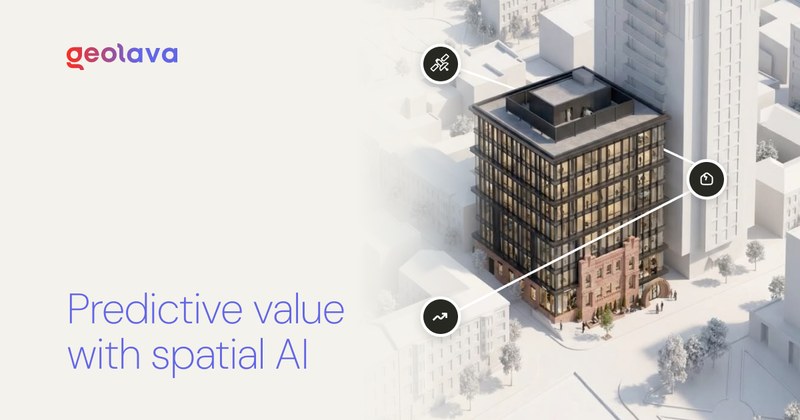
Geolava is a San Francisco startup building a world model for the built world - a spatial intelligence layer that fuses satellite, LiDAR, aerial, street-level and government data into a foundation model you can query in plain language. It lets real estate owners, investors, lenders, insurers and operators analyze, underwrite, monitor and forecast physical assets, turning slow, manual property surveying into predictive property intelligence.

Helios AI
Helios AI is an agricultural-intelligence software company that helps food, commodity, and procurement teams see supply shocks before they happen. Its platform aggregates hundreds of billions of climate and economic data points to forecast prices, weather risk, and supply disruptions for 50+ agricultural commodities across most of the world's export-growing districts, up to a year in advance. Founded in 2022 by Francisco Martin-Rayo and Eden Canlilar, the company sells tools like CommodiTrack, the Helios Horizon AI co-pilot, and Supply Chain Climate Audits to CPG manufacturers, traders, and Fortune 100 buyers.

Sunairio
Sunairio is a Baltimore-based climate-and-energy analytics company that builds next-generation grid forecasting software where weather, climate, and energy meet. Its flagship platform, Sunairio ONE, generates 1,000 ensemble forecast paths - versus the 50 typical of legacy methods - to capture the extreme, hyperlocal weather events that break grids and portfolios. Spanning timescales from the next 15 days to the next 15 years, Sunairio helps utilities, renewable developers, traders, and investors plan for volatility instead of being surprised by it.

Delos Insurance Solutions
Delos Insurance Solutions is a San Francisco insurtech and managing general agent that uses satellite imagery, fire science, and machine learning to insure California homeowners in wildfire-prone areas that traditional carriers have abandoned. Founded by two aerospace engineers, Delos models wildfire risk at the individual-property level using NASA Earth-observation data, climate science, and hundreds of risk parameters, allowing it to write coverage on homes the rest of the market deems uninsurable.

Archipelago
Archipelago is an AI-powered risk data platform that connects large commercial property owners with their insurance markets, turning messy schedules of values, loss runs and engineering reports into clean, broker-ready submissions. Founded in 2018 by RMS co-founder Hemant Shah, the San Francisco-based company digitizes property risk for portfolios totaling trillions of dollars in insured value.
Stand
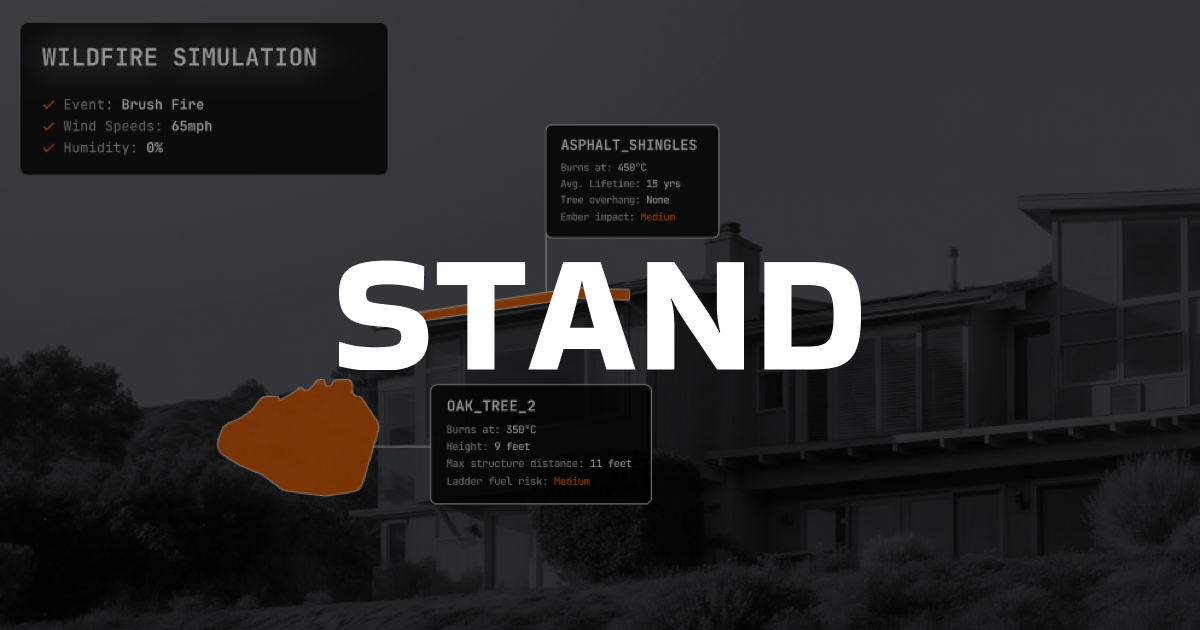
Stand is a San Francisco insurtech that uses physics-based simulation and AI to underwrite and insure homes in places most carriers have abandoned - the wildfire belt of California and the hurricane corridors of Florida. Instead of statistical averages, Stand builds a digital twin of each property and models how embers, wind, and water would actually attack it, pairing coverage with concrete mitigation upgrades.