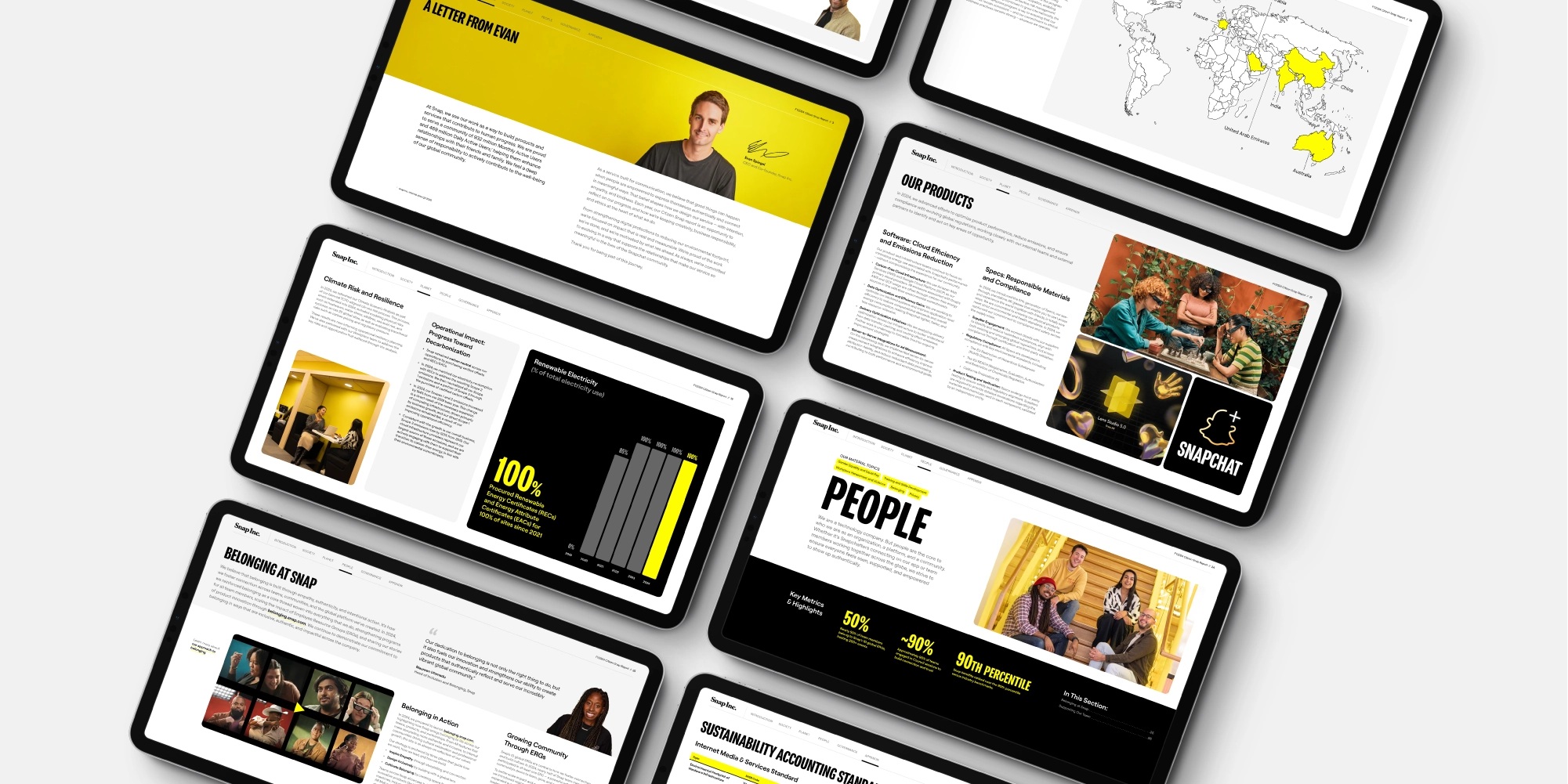
Sixty-six pages disappeared. In thinkPARALLAX’s account of its work for Snap, a 113-page sustainability report became a 47-page publication, with stronger visual storytelling and a clearer focus. For anyone who has opened a corporate report and immediately checked its length, that is an unusually relatable consulting achievement.
The assignment captures the agency’s business: help companies work out their sustainability priorities, organize what they can substantiate, and communicate it to people with other things to do. Snap’s engagement began in 2020 and also included its Code of Conduct. The creative brief reached into how the company explained itself.
66 fewer pages. About 58% shorter.
Page counts reported by thinkPARALLAX; percentage calculated.
A $600 invitation opens the door
The business started in a garage in 2003. Co-founders Guusje Bendeler and Jonathan Hanwit built a graphic design firm called Parallax Visual Communication. Its first assignment was an event invitation for a Big Four accounting firm. Bendeler later remembered the fee with refreshingly little corporate polish: “I was ecstatic to bill $600 for the project!”
By her 15-year retrospective, the business had rebranded at least five times. Digital work prompted a move into branding and interactive projects. A recurring theme in the client work then suggested a narrower focus on positive social and environmental impact. The niche emerged from assignments already passing through the door.
Hanwit’s account of the difficult parts is less photogenic than the garage. In a 2018 interview, he identified finding suitable projects, clients, and employees as the central struggle. A person who looked ideal on paper might disappoint in practice. Hoping a new hire would arrive and solve everything had not worked reliably either.
That is the useful correction to a tidy founding myth. An agency can change its description faster than it can assemble the people to deliver it. His advice centered on deciding what the business does, whom it serves, and who can do the work. Technology and office problems looked smaller beside those questions.

The report is only one assignment
Today, thinkPARALLAX sells professional expertise across strategy, reporting, and communications. A company can commission an assessment of its priorities, a sustainability roadmap, a climate risk review, a report, or a campaign. The deliverable might be a management plan, a designed publication, a website, or training for employees who need to explain an environmental claim.
The range gives it a particular position in the market. A buyer looking for this combination could otherwise assemble a sustainability consultancy, a reporting specialist, and a creative agency. thinkPARALLAX offers those functions together. That arrangement makes most sense when the strategic questions and the communication problem are entangled: what should the company do, what can it demonstrate, and what should it say?
Its June 2024 partnership with North Star Carbon Management adds another ingredient. North Star supplies carbon accounting technology; thinkPARALLAX combines that capability with advisory work. The arrangement shows how a service firm can extend its technical toolkit through a partner instead of developing every tool internally.
The revenue model follows the assignments: corporate consulting and creative services, repeat reporting work, and packaged engagements. The company says 90% of clients renew annually and reports a client Net Promoter Score of 88. Those are its own relationship measures, useful for understanding its pitch rather than measuring the environmental performance of the companies it serves.
Before the olive oil slogan, the homework
Pompeian provides a grounded example of the sequence. Beginning in 2022, the olive oil company worked with thinkPARALLAX over three years, moving from a strategic foundation toward communications. The agency benchmarked five peers and conducted a materiality assessment to identify the issues that deserved attention.
It then developed a roadmap covering immediate, intermediate, and longer-term objectives, including metrics and resource planning. The resulting communication platform connected the groves, the company’s future, and human health. Purpose and values work accompanied the sustainability narrative.
The order matters more than the eventual wording. A reader borrowing the method could begin by gathering existing programs, comparing relevant peers, choosing priorities, and assigning resources before commissioning a campaign. Otherwise, the writer inherits an unresolved management discussion and is asked to make it sound decisive.
- 01Compare peers
- 02Choose priorities
- 03Plan resources
- 04Build the story
Arevon, a renewable energy producer, brought a different problem. Its climate risk project used virtual workshops with executives to examine exposure across operations and the value chain. The work considered two future climate scenarios and produced a climate disclosure report aligned with the TCFD framework.
In the agency’s description, the workshops also developed next steps for managing risk. That puts the assignment close to the decisions leaders actually control. A scenario exercise earns its place when participants can connect an identified exposure to a response, an owner, or a question that needs further investigation.
Verathon’s brief sat nearer the product launch. The medical device company needed to explain bio-attributed plastics in a video laryngoscope. thinkPARALLAX developed messaging and internal claims training alongside launch materials, website pages, social content, and trade-show concepts. Technical understanding had to travel with the campaign.
The agency reports more than 580,000 views for the launch video. That is a measure of attention. The more instructive detail is the preparation behind the message: teams were trained on the claims they would make. A company copying the approach should connect the person writing the headline with the person who understands the material and its evidence.
Employees need their own version
Interface’s Climate Take Back work took the agency out of the report and into the workplace. thinkPARALLAX researched employee perspectives and developed a global campaign, described in its earlier project account as spanning eight languages. Materials reached homes, offices, and factories.
The kit included a storybook, posters, conversation guides, and interactive walls. These are modest objects compared with a corporate climate ambition, which is their point. A guide gives a manager something to discuss. A wall gives colleagues somewhere to contribute. Translation determines who gets to participate in the first place.
Greif’s reporting assignment exposed a related mismatch. Its established sustainability reporting was thorough, but customers needed a more accessible explanation of the packaging company’s initiatives and how those could support their own goals. thinkPARALLAX developed narrative and graphics suited to that audience, including a value-chain visualization.
One pleasing detail: the report incorporated photographs from an employee contest. Actual colleagues supplied some of the imagery. The broader lesson is to decide which audience a piece serves before asking it to serve everybody. Technical disclosures, sales conversations, and employee discussions place different demands on the same underlying information.
“Keep it real”
ONE OF THINKPARALLAX’S STATED VALUES
When the market stopped cooperating
In May 2025, Hanwit published a notably candid account of a slower market. Economic uncertainty and delayed regulation had pushed the firm to reconsider what clients needed. Its responses included a 12-week Climate Risk Sprint, team members embedded in organizations unable to hire full-time, and new training on communicating sustainability claims.
The adaptation was practical: reshape expertise into an engagement that fits the buyer’s immediate constraint. A team with a hiring restriction may still need a specialist. A company hesitating over a broad program may have a bounded assessment it can move forward. The same capabilities can be packaged around different decisions.
For prospective clients, that suggests arriving with a precise brief. Name the decision, the audience, the information already available, the internal owner, and the deadline. Ask the agency to separate the research, advisory, and production tasks. A clearer scope makes a proposal easier to evaluate and makes disagreements about the assignment visible earlier.
Leadership involvement remains a condition for useful work. In a Benevity interview, thinkPARALLAX’s strategists stressed the value of a senior sponsor and involving leaders as goals take shape. They also described the need to build employees’ understanding before asking them to change behavior. A campaign cannot grant authority to someone whose organization will not act on the underlying plan.
A different perspective, with a travel budget
The name refers to how a change in viewpoint changes what someone sees. The company has given that idea a literal budget. In its account of the 2024 PARALLAXploration program, employees received an $1,800 stipend and extra paid time off to explore a place they had never visited.
That year’s theme encouraged destinations connected with personal history. Trips ranged from European cities to American landmarks and national parks. It is an unusually specific culture benefit: money, time, and a reason to encounter something unfamiliar. The stated purpose is to bring new perspectives back to the work.
Closer to home, the office has also served a community role. A 2023 interview about Perspectives Space described opening underused workspace to local art shows and workshops as remote work changed the office’s rhythm. The response to spare capacity was to invite other people in.

B Lab records the firm’s certification beginning in January 2016. Its current team page lists Janna Irons as CEO and Hanwit as founder and chairman, alongside sustainability strategists, writers, designers, and operations staff. The business that began with an invitation now has to coordinate all those specialties.
The portfolio offers a straightforward way to judge the result. Does the report help its reader find the point? Can a manager explain the goal? Does the product claim match the evidence? Those questions are small enough to ask in a meeting and demanding enough to occupy an entire agency.
Follow the work
Explore thinkPARALLAX, browse its client projects, or read its latest thinking.
Watch Janna Irons and Stewart Rassier discuss sustainability strategy on Benevity’s Social Impact Show, or listen to Jonathan Hanwit’s 2023 conversation with The Underswell.