YesPress Profile · Insurtech
Stand.
A San Francisco insurer that treats your house like an engineering problem - and treats wildfire like physics homework.
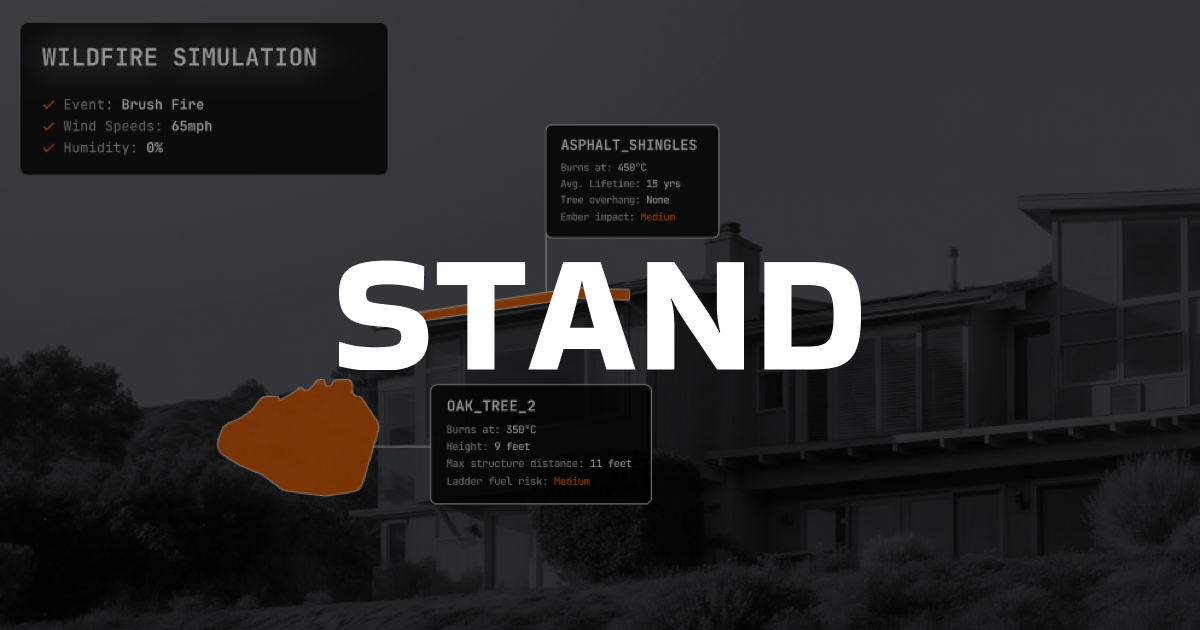
A San Francisco insurer that treats your house like an engineering problem - and treats wildfire like physics homework.
It is a perfectly ordinary house. Cedar shingles, a juniper hedge, a view that costs money. Its owner just received a non-renewal letter from a carrier whose name everyone knows. The house is, by the standards of 21st-century actuarial science, uninsurable.
And yet a small team in San Francisco is, at this moment, building a digital copy of it - the roof pitch, the eave depth, the species of every shrub within thirty feet - and dropping virtual embers onto it to see what happens. That team is Stand. The simulation will run a few thousand times. If the math comes out, Stand will write the policy the big carriers won't. If it doesn't, Stand will hand the homeowner a list - replace this vent, swap this juniper for a maple, gravel here instead of mulch - and quote again next month.
This is what home insurance looks like when physicists are allowed in the room.
The American home insurance market, for roughly a century, was a quiet business of large numbers. Carriers pooled risk across many places, charged a touch more than the average claim, and went home. The system worked because the average kept its promises.
Around 2017, the average stopped showing up to work. Wildfires that used to come once a generation began arriving once a season. Hurricanes intensified faster than the models said they could. The carriers did what carriers do when models break: they left. State Farm, Allstate and Farmers paused or pulled new policies in California. Florida lost a dozen insurers in a few years. Whole towns became, on paper, uninsurable - which is to say unmortgageable, unsellable, and quietly, expensively, stranded.
The official story was that climate change had made these places impossible to underwrite. The actual story, Stand argues, was that the industry had been underwriting an abstraction - the zip code - rather than the thing that actually burns: the house.
Dan Preston had run an insurance company before. He was the CEO of Metromile, the pay-per-mile auto insurer that Lemonade acquired in 2022. He had also, before that, been a Stanford-trained engineer. The frustration of his Metromile years was that the industry punished detail. Carriers asked seven questions. They priced on the answers. They moved on.
Preston, along with co-founders Jason Mueller (former CPO of Policygenius), Sam Shank (former CEO of HotelTonight) and Bill Clerico (founder of WePay, now of Convective Capital), bet that the next insurer of catastrophe-exposed property would not look like an insurer at all. It would look like a SpaceX simulation team that happened to sell policies. They hired physicists. They hired wildfire scientists. They borrowed computational fluid dynamics techniques from aerospace. Their chief risk officer holds a Ph.D. from MIT in atmospheric science and a physics degree from Caltech - a combination, it should be said, that no large insurer has ever required of anyone.
Investors paid attention. Inspired Capital, Lowercarbon, Equal Ventures and Convective put in roughly $30M in late 2024. Eclipse led a $35M Series B in October 2025. Total raised: $65M. Total deployed into wildfire-prone California in year one: more than $1 billion in insured value.
Preston and co-founders assemble a team of physicists, wildfire scientists and insurance veterans in San Francisco.
$30M in seed/A funding. California homeowners product goes live. Backed by Inspired, Lowercarbon, Equal, Convective.
Stand crosses $1B in insured value in its first market - mostly in California zip codes the incumbents abandoned.
Files into the Florida homeowners market alongside a small wave of new entrants attempting hurricane-zone coverage.
$35M led by Eclipse. Existing investors all re-up. Climate Data Commons goes public.
A Stand quote does not begin with a zip code. It begins with a satellite image, a drone pass, a public-records pull, and a conversation. From this, the platform constructs a digital twin of the property: the materials, the slopes, the vents, the vegetation, the distance to the nearest tree, the wind exposure of the deck. Then it runs simulations - fire spread, ember showers, hurricane wind fields, surface flooding - on that specific structure.
The output is two documents. One is a price. The other is a mitigation plan: a prioritized list of physical changes the homeowner can make to lower their actual risk and, with it, their premium. Replace the attic vent. Move the firewood pile twenty feet. Swap the juniper for a maple. Insurance, for the first time in a long time, is offering specific advice instead of a generic "good luck."
Wildfire-aware coverage for California properties, including many high-value homes other carriers won't quote.
Hurricane-and-wind coverage for catastrophe-exposed Florida homes, launched in late 2025.
A simulation of the home plus a prioritized list of upgrades. The plan is the policy's other half.
An open data initiative sharing catastrophe modeling with researchers and the broader industry.
Stand publishes its own milestones; the chart below uses figures the company has disclosed or that have been reported in press. They are imperfect snapshots of a moving target, but the direction is clear.
Figures: company statements & press releases, 2024-2025. Year-one insured value is California-only.
Stand's mission, written in the plain words the company prefers, is to keep climate-impacted homes inside the insurance system. That sounds modest. It is not. A house without insurance is a house without a mortgage. A house without a mortgage is a household one unlucky storm from financial ruin. And the number of such houses, on every coast and in every fire-prone valley, is rising.
The deeper mission is structural. Stand argues that the way insurance has historically rewarded risk reduction - that is, slowly, vaguely, after the fact - has actively contributed to the catastrophe gap. If a homeowner cannot see that swapping their vents will drop their premium, they will not swap their vents. Stand's wager is that the country can be made measurably safer, one house at a time, by paying it to be.
The dirty secret of the climate transition is that nobody wants to talk about who pays for insurance. Carbon markets are interesting; flood insurance is not. But the household-level economics of climate - whether a family in Paradise, California or Cape Coral, Florida can keep their home - are decided not in Davos but in underwriting offices.
If Stand's physics-first approach holds up over a few real catastrophe seasons - and the next few years will tell - it implies a future in which insurance becomes a tool for adaptation rather than a record of failure. Premiums become a real-time signal. Mitigation becomes a market. Houses that today are uninsurable become, after a weekend of work and a list of swaps, something an actuary can sign for again.
If it doesn't, the experiment will still have done something useful. It will have shown that the alternative to abandoning the climate-exposed home is to underwrite it more carefully, not less.
The juniper is gone. A maple, still small, sits in its place. The vents have been replaced. The mulch is gravel now, in a ten-foot ring around the foundation. The owner has a policy and a list of things still to do. None of this is dramatic. None of it makes the news.
And next time a fire skirts the ridge, a few thousand simulated embers, run on a quiet morning in San Francisco, will have done their job. The house will be on a different list.
- end of dispatch