The most revealing Syncfusion customer story begins with an estimate. Staffan Piledahl, co-founder of laboratory-software company Briefly Bio, needed a spreadsheet inside his product. His team considered building it. Then they considered what “spreadsheet” really means: formulas, formatting, selection, copy and paste, keyboard behavior, import, export, the little expectations Excel has trained into millions of hands. The estimate, he later said, was “just insane.” He tried roughly five alternatives before Syncfusion’s component fit.
That moment is Syncfusion’s entire business in miniature. A customer does not wake up wanting a component library. The customer wants to ship legal software, a trading terminal, a hospital dashboard or a lab notebook. Then a small rectangle on the screen threatens to become a quarter’s work. Syncfusion sells the escape hatch.
The product is the month you get back
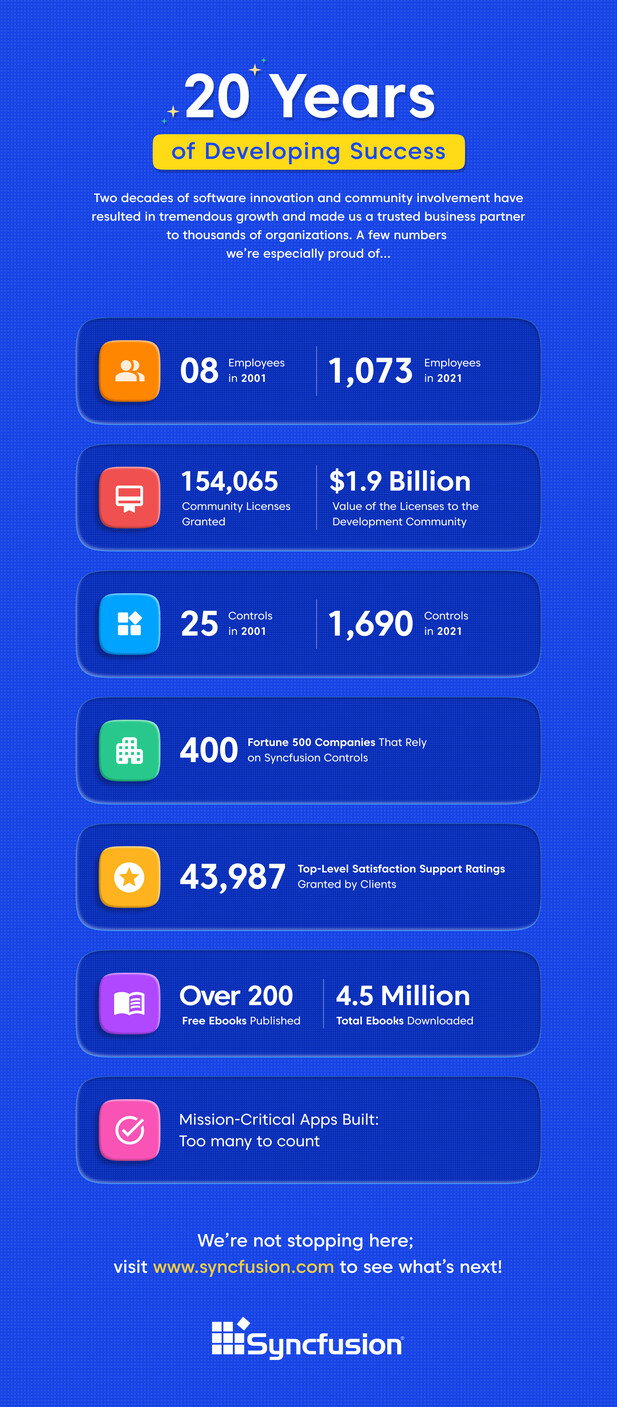
Syncfusion started in Cary, North Carolina, in 2001, when Microsoft’s .NET framework was still approaching its first public release. Eight founders with C++ and component-software experience saw an ecosystem being born. Stefan Hoenig architected Essential Grid and served as the first CEO. Daniel Jebaraj worked on charting and now runs the company. Clay Burch shaped product support; Davis Jebaraj, Praveen Ramesh, Prakash Surendra and Arun Srinivasan worked across early products and infrastructure. Entrepreneur Ellis Gregory rounded out the original group.
Their first bundle, Essential Suite, went on sale in 2002. It included source code, an unusual and confidence-building offer in the early Visual Studio controls market. The first license sale brought relief followed immediately by a less glamorous fear: could eight people answer the support requests that would arrive with more customers? Nothing dramatic “failed first” in the company’s published history. Support was the first system the founders expected to strain.
That anxiety left a useful scar. Support forums, release notes, direct access to technical teams, a large demo catalog and thick documentation became part of the offer. The free WinForms FAQ appeared in 2002. A decade later, the company started Succinctly, a series of technical ebooks designed to explain a topic in about 100 pages. The material attracts developers, but it also reduces the risk of buying a library with hundreds of unfamiliar parts.
A catalog built to survive fashion
Essential Studio now covers data grids, charts, schedulers, Gantt charts, rich-text editors, diagrams, maps, file managers and scores of other interface parts. Document libraries create or manipulate PDF, Word, Excel and PowerPoint files without requiring Microsoft Office on the server. The same broad jobs appear in React, Angular, Vue, JavaScript, Blazor, ASP.NET, WinForms, WPF, WinUI, .NET MAUI and Flutter.
That breadth is the differentiator and the burden. A pure React specialist can obsess over one ecosystem. Syncfusion has to make selection, keyboard controls, accessibility, data virtualization and exporting behave across a small parliament of frameworks. When Microsoft moved developers from WinForms to WPF and Silverlight, then the web scattered into JavaScript frameworks, Syncfusion’s job was to follow. Its moat is partly the willingness to perform that migration again and again.
Build the interface
Essential Studio supplies the visible machinery: grids, charts, schedulers, editors and navigation.
Work the document
Document SDKs read, write, convert, view and annotate office files and PDFs.
Run the workflow
BoldSign and BoldDesk package signatures, tickets and customer conversations as SaaS.
Explain the data
Bold BI and Bold Reports turn the underlying data and rendering parts into deployable applications.
The Bold family is the company’s second act. Bold BI handles embedded dashboards and analytics. Bold Reports designs and distributes operational reports. BoldSign competes in electronic signatures. BoldDesk handles customer-support tickets. These are complete products rather than boxes of parts, but the family resemblance is obvious: documents, data, controls and enterprise workflows. Syncfusion is using its own parts bin.
Its customer list is correspondingly unromantic and wide. Financial institutions need grids that can scroll through heavy data without wheezing. Hospitals and labs need forms, schedules and documents that preserve exact details. Legal teams need PDF viewing and annotation inside case-management software. SaaS builders need charts that look native without becoming a permanent side project. Syncfusion says more than 400 Fortune 500 companies use its controls, alongside consultants and small product teams. The common customer is not an industry. It is an engineering manager staring at a backlog where infrastructure work has crowded out the feature customers will actually pay for.
Free at the moment of maximum doubt
The pricing strategy is more interesting than a discount. Qualifying individuals and small organizations can get Essential Studio under a Community License for $0. The current agreement puts boundaries around that generosity: organizations must generally remain below $1 million in annual revenue, no more than $3 million in outside capital, ten employees and five developers. Cross those lines and commercial licensing begins.
A current public cart lists a five-member team subscription for the .NET MAUI UI Edition at $4,740 a year. Project, division and global arrangements are scoped by sales. This is not automatically cheap. The honest comparison, though, is not another download. It is a developer-month, the maintenance after that month, and the opportunity cost of making a spreadsheet instead of the product around it.
Wyngate Solutions illustrates the change of mind Syncfusion wants. The legal-tech company found that open-source UI kits were fine for starting but demanded too much custom code to keep a consistent interface. Founder Ameet Phadnis had used Syncfusion before, returned to it for his new venture and began on the Community License. Using the React PDF Viewer and DataGrid, the company says it completed a major feature in three days. This is a vendor case study, not a controlled benchmark, but the decision logic is portable: estimate the full behavior, not the demo version.
Where the bargain gets complicated
The approach works best in data-heavy business applications where users expect mature behavior and the interface is important but not the customer’s unique advantage. It is weaker when a team needs only two simple controls, has a fiercely custom design system, cannot accept proprietary dependencies, or wants to minimize client-side bundle weight. A giant suite can turn procurement into architecture.
Licensing deserves the same care as the APIs. Syncfusion’s commercial editions are subscriptions, and the agreement distinguishes named-user, team, project, division and global rights. Community users must track continued eligibility. A company building a long-lived product should model renewal, developer growth, source-code access and the cost of replacing components later. Saving three months now is less attractive if the exit takes six.
Competition also changes by layer. Telerik, DevExpress, Infragistics, Kendo UI, Wijmo and ComponentOne fight for the paid-component budget. Material UI, Bootstrap and dozens of open-source packages offer narrower or cheaper routes. Bold BI meets Power BI and Tableau; BoldSign meets DocuSign and Adobe; BoldDesk meets Zendesk and Freshdesk. Syncfusion’s answer is consolidation: more of the stack, one support relationship, less vendor stitching. Whether that is convenience or concentration risk depends on the buyer.
Now the controls take prompts
In 2025 and 2026, Syncfusion reorganized Essential Studio into editions for UI, documents, PDF viewing, DOCX editing and spreadsheet editing, while adding standalone SDKs. It also pushed into AI-assisted development with Code Studio, coding assistants, agent skills and agentic UI builders for React, Angular and Blazor. BoldDesk added a virtual agent; BoldSign added natural-language document search and integrations with Salesforce and HubSpot.
The move is defensive and sensible. If AI writes more application code, a component vendor cannot assume developers will keep browsing catalogs and copying examples. It needs to make its controls legible to agents. Syncfusion’s 300-plus public GitHub repositories, sample applications and documentation become machine-facing distribution as well as human education.
The company says more than one million people use its products and more than 400 Fortune 500 companies are customers. Its supplied company data estimates roughly 2,800 employees; the careers site counts more than 1,900 in Chennai alone. Public materials do not describe a venture-capital story. The more instructive story is accumulation: one product became a suite, the support office became a development center, the components became applications, and the documentation became fuel for agents.
That pitch will not make a movie trailer. It does make a durable company. Syncfusion found the work that is essential, difficult and adjacent to what its customers actually want to build. Then it kept doing that work as the platforms changed underneath it. The boring stuff, it turns out, is only boring until you have to build it yourself.