A prescription for a hospital bed is a peculiar kind of promise. It specifies what someone needs. It does not, by itself, establish who has the bed, whether the insurance paperwork is complete, who will bring it upstairs, or who answers when something goes wrong. Between a clinical decision and a bedroom sits a small administrative obstacle course. Synapse Health has built its business inside that course.
- Synapse coordinates medical equipment orders, documentation, suppliers and billing.
- Its customers span health plans, care facilities and the people supplying care at home.
- Centralizing responsibility offers clarity. Delays reveal how much depends on execution.
The Illinois company works in durable medical equipment, usually shortened to DME. Think wheelchairs, oxygen equipment, hospital beds and recurring medical supplies. These are physical objects with a surprisingly elaborate digital and financial shadow. Someone must qualify the order, check coverage, match a supplier, arrange delivery and reconcile payment. Synapse offers to take responsibility for much of that work.
A business built around the handoff
The family tree matters. Synapse PDI began in 2016 serving hospice and skilled nursing facilities. In November 2021, it joined forces with Triple Aim Partners to form Synapse Health. The sequence explains a company that arrived at home care through the less glamorous business of organizing equipment for institutions. Its early problem was concrete: get the right order to the right supplier without making the care team supervise every step.
One useful early move was integration. In December 2021, Synapse PDI announced a connection to PointClickCare’s electronic health record platform through its Marketplace APIs. The announcement said close to 1,000 PointClickCare nursing facilities already used Synapse. Reusing patient data made sense in a workflow where entering the same information twice creates another opportunity to get it wrong.
Today, Equip serves hospice and skilled nursing organizations with ordering, reporting, supplier coordination and consolidated invoicing. Its website advertises operations in 49 states, while noting that availability depends on coverage and local requirements. That qualification matters. National software can be available everywhere; a suitable supplier still has to be available nearby.
Three portals. One actual delivery.
InHome makes the division of labor visible. Connect receives the order and supporting documentation. Synapse checks insurance and paperwork, then matches a supplier. Fulfill gives supplier operations staff a place to process the order and coordinate inventory or problems. Deliver captures the final handoff. Confirmation connects order completion to the payment process.
- ConnectOrder + documentation
- FulfillSupplier + stock
- DeliverEquipment + proof
Patient visibility runs alongside the workflow.
The patient gets a different window onto the same process. The Patient Portal supports online forms, information updates, order tracking and eligible resupply. There is even guest tracking by order number. That is an unusually practical detail: the person trying to discover where a delivery is may be a caregiver who does not need another account.
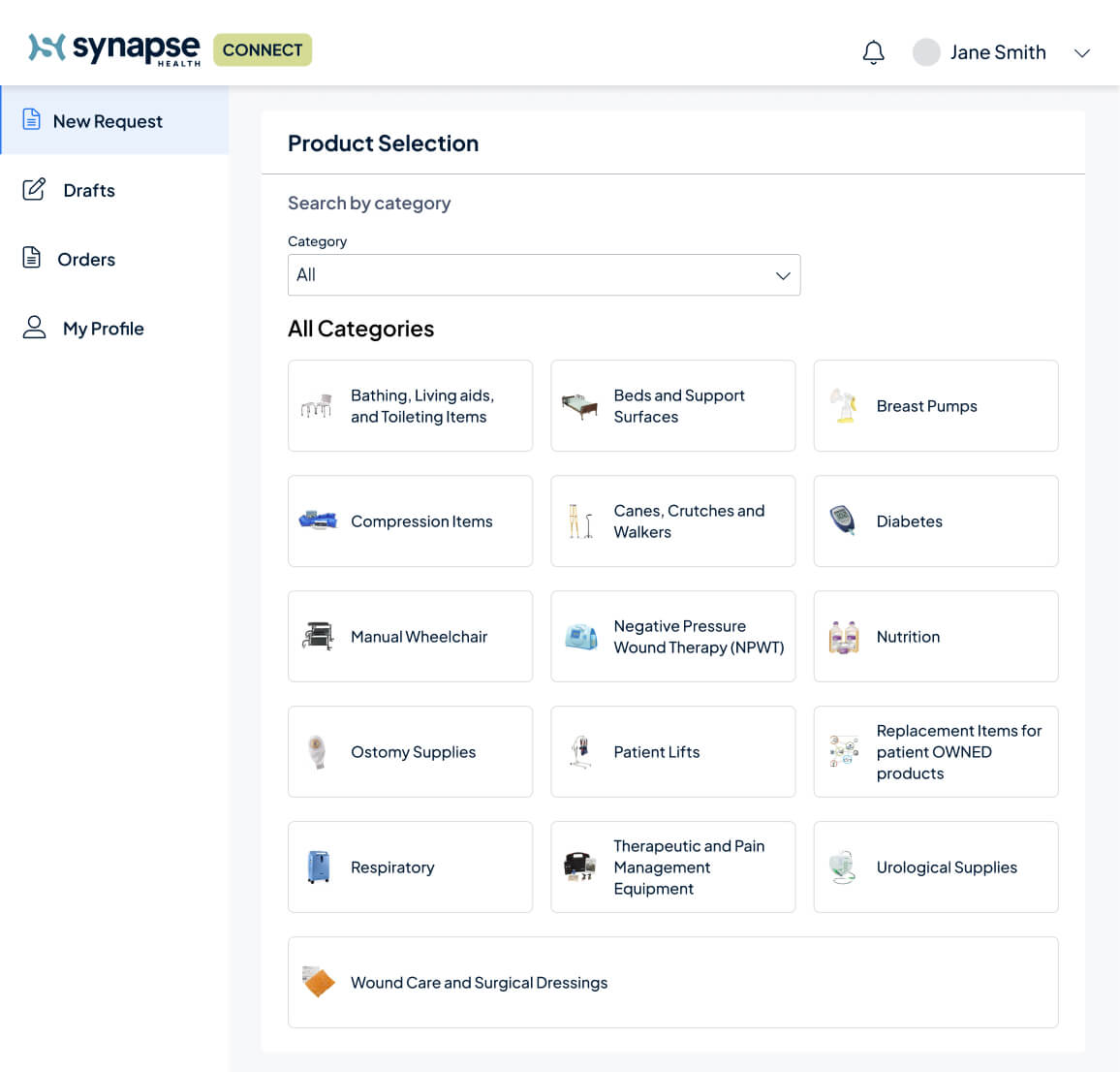
And the fax survives. Synapse accepts orders through channels beyond its portal, including fax and electronic health record workflows. The sensible interpretation is that modernization must accommodate the people already doing the work. A perfectly designed entrance is less useful if half the participants cannot walk through it.
The invoice is part of the product
Synapse’s distinction is its contractual role. Under its capitated health-plan arrangements, it becomes the provider of record and handles claims. Subcontracted DME suppliers provide fulfillment and logistics. The supplier does not simply receive a software login; it enters a different administrative relationship, with Synapse coordinating work that might otherwise sit in its own back office.
That places Synapse among businesses combining healthcare services, logistics and software. Digital ordering platforms such as Parachute Health and Tomorrow Health occupy adjacent territory. Comparing them requires attention to who carries financial responsibility and who bills the plan. An interface screenshot will not tell you that.
The proposition has a price question attached. Can administrative relief compensate a supplier for reimbursement pressure? Public contract rates do not settle that question. Funding records do establish the scale of backing: filing aggregators record $15 million in January 2023 and $25 million that September. That is financing, rather than a measure of delivery costs or savings.
Where the neat diagram gets messy
The first Georgia and North Carolina UnitedHealthcare rollout was postponed from August to September 2024. Synapse attributed the delay to onboarding and training schedules. Some suppliers questioned reimbursement and service requirements. The early warning was operational: a new agreement needed people who could actually work under it.
More serious criticism followed. In April 2026, HME News reported that the American Academy of Sleep Medicine had raised concerns with UnitedHealthcare about CPAP fulfillment. Its members described delays, repeated documentation requests and communication problems. Those are attributed reports, not a measured failure rate across all orders. They nevertheless identify the central vulnerability: a coordination layer can become another queue.

“We are more focused on how we use AI within our four walls.”
Mandira Singh · HME News · April 2026
Singh’s April interview described learning through successive launches and investing in outreach, benefits verification, exceptions and quality checks. By September, a network memo spelled out documentation and patient-contact requirements for transition payments. These are visible changes in process. They do not establish that every complaint has been resolved.
Inside the company, experimentation has a modestly specific ritual. An April 2025 Product & Technology hackathon drew ten proposals, with staff working in teams of four to six. Ideas included routing, care-gap alerts and communication tools. Those were explorations; the event offers a glimpse of working culture rather than evidence of deployed clinical results.
Borrow the discipline, test the handoffs
UnitedHealthcare announced a further expansion into Northeast markets for selected plans effective September 2026. Growth raises the stakes of a useful operating idea: assign responsibility to each handoff. For another healthcare operator, the copyable practice is to make qualification, supplier acceptance, delivery proof and escalation explicit, then test them together.
The approach depends on supplier capacity, complete documentation and workable exception handling. Without those conditions, more visibility may simply make waiting easier to watch. The decisive question belongs to the person at home: has the equipment arrived, and can someone help me use it?