At 21Factory, the messaging problem arrived without much drama. The Paris company already had software for building interactive marketing experiences. Its services could ask one another questions and get answers. What it needed next was a way to send work downstream without making the customer wait.
The team tested Kafka and NATS. Both were fast enough. In Synadia’s September 2026 account, the deciding factors were simplicity and cost. Kafka had not failed its audition. NATS asked less of the people who would have to run the show.
That small distinction explains much of Synadia. Infrastructure buyers can become wonderfully distracted by speed. Eventually someone has to answer the less glamorous question: who will look after this thing on Tuesday?
- Synadia sells managed messaging and enterprise tooling around open-source NATS.
- Its territory is software spread across clouds, factories, vehicles, and other inconvenient places.
- Customers pay for operation, control, security, and expertise around the messaging layer.
- Delivery guarantees and operating costs deserve as much attention as throughput.
First, stop memorizing everybody’s address
Imagine an application that must tell several other applications an order has shipped. One approach is to keep a directory of every recipient and contact each one. Every new recipient makes the sender’s life a little more interesting. Every moved recipient creates another opportunity for an unpleasant afternoon.
NATS uses subjects: names describing the conversation. A producer publishes to a subject; interested subscribers receive messages. Request/reply and queue groups add other patterns to the same vocabulary. The sender does not need to enumerate every listening service.
For a developer, that changes what can be added later. An analytics service can join an existing conversation. A new worker can help with a queue. Application communication becomes less entangled with the current arrangement of machines. It is a useful sort of ignorance: the sender knows what it wants to say, without knowing everyone who might care.
There is an essential qualification. Core NATS is at-most-once messaging. An offline subscriber does not get an archive of missed messages. That can suit a live reading which will shortly be replaced by another. A payment instruction demands a different bargain.
JetStream adds storage, replay, and acknowledgments. Its baseline is at-least-once delivery, which means applications must be prepared for duplicates. Deduplication and acknowledgment settings matter. A durable broker does not automatically make a bank transfer happen exactly once in a separate database. Engineers still have to design that boundary.
A free project, a paid Tuesday
Derek Collison created NATS before founding Synadia in 2017. His company builds a commercial business around the project’s expertise. The distinction matters: downloading the open-source server and purchasing Synadia are separate decisions.

Synadia Cloud runs a shared, managed NATS service. Platform offers a single-tenant arrangement, managed in the customer’s cloud or operated by the customer with Synadia support. The enterprise tooling adds account administration, access policies, stream management, observability, connectors, and distributed workloads. The choice is partly about where data should live and partly about whose pager should ring.
Its expertise has a concrete commercial expression. Platform includes architecture assistance and support options; the managed offering advertises a 99.99% uptime SLA. Buyers are purchasing an operating relationship as well as software.
The published Cloud prices in October 2026 start at a free Personal plan, then $49 a month for Starter and $199 for Pro. These come with resource allowances. Starter and Pro explicitly lack a support SLA. Enterprise adds support and design review by arrangement. A small monthly bill should never be mistaken for the whole production bargain.
Resource limits vary. Enterprise support is separately arranged.
Deploy for Kubernetes makes a different sale: deployment and upgrade tooling on infrastructure you control. Public pricing lists $1,250 monthly for three nodes and $2,000 for five, with standard next-day support. Your Kubernetes infrastructure still has to be paid for. This is a convenience subscription, with a data plane that stays on your premises or in your cloud.
The queue between a customer and an expensive GPU
The same communication problem appears in AI inference with a more conspicuous price tag. Requests arrive in bursts. GPUs have finite capacity. Point every request straight at a worker and the application must somehow reconcile those two facts under pressure.
Synadia says NVIDIA Cloud Functions uses its managed NATS supercluster, with JetStream providing durable queues across regions. GPU workers pull jobs when capacity becomes available and acknowledge completed work. A job without an acknowledgment can be redelivered. Per-function streams separate workloads and their flow control.
The principle is readily copied: put durable waiting space between volatile demand and scarce workers, then let available workers set the pace. It applies to more than GPUs. Any expensive or rate-limited downstream service can benefit from work arriving on terms it can handle.
Expensive workers should spend their time working. The queue can do the waiting.Editorial observation
The conditions matter. Storage is finite, requests have deadlines, and retried jobs need safe handling. A queue can absorb a burst; it cannot manufacture unlimited compute. The useful question is how long your users can wait and how much unfinished work your system can retain.
Factories decline to become cloud regions
At the edge, the bottleneck can be the connection itself. PowerFlex engineers describe hundreds of leaf nodes and unreliable internet at many sites. Leaf nodes let local NATS systems join a broader network while retaining local communication. JetStream supplies persistence for the data that must survive interruptions.
This is why Synadia’s market includes industrial systems, energy, automotive applications, and financial services alongside AI. Schaeffler describes interconnected Platform clusters supporting availability, latency, and data residency. Shopmonkey points to managed operation and separation of customer workflows. The requirements differ, but the geography refuses to sit still.
Competitors enter from different directions. Kafka and Confluent are familiar streaming choices; RabbitMQ is a common messaging and queueing alternative. AWS offers Kinesis and SQS. Solace and TIBCO appear in enterprise modernization discussions. Synadia’s pitch combines communication patterns and cloud-to-edge topology around NATS. Which alternative fits depends on the workload and the ecosystem already attached to it.
The number worth reading with its footnotes
In a vendor-published Sophotech migration account, a roughly 50-service Kubernetes cluster moved from RabbitMQ to NATS. Reported p99 latency fell from about 150 milliseconds to about 40. Weekly operating effort dropped from several hours to under one.
The first trouble was queue buildup during bursts, compounded by operating overhead and complex topology. The team migrated gradually through dual publishing, canary consumers, and cutover. Core NATS handled request/reply; subjects simplified routing.
The copyable lesson is the migration method and the choice of measurements. Track tail latency and time spent operating the system. Test with real bursts. Move enough traffic to learn before moving everything. The reported improvement is evidence about one deployment, rather than a universal ranking of brokers.
The business grows around the awkward details
Synadia raised a $25 million Series B in February 2024, led by Forgepoint Capital. The announcement put cumulative funding at $51 million. That bankroll supports a company whose commercial opportunity lies in the work surrounding widely available software.
Its 2026 releases make that opportunity visible. Insights, introduced in April, follows individual connections, streams, consumers, and accounts, and compares historical state. Protect, introduced in May, applies NATS-aware security policy at the network boundary. September’s rate-limit update addresses a particularly irritating possibility: an authorized publisher producing enough traffic to overwhelm its neighbors.
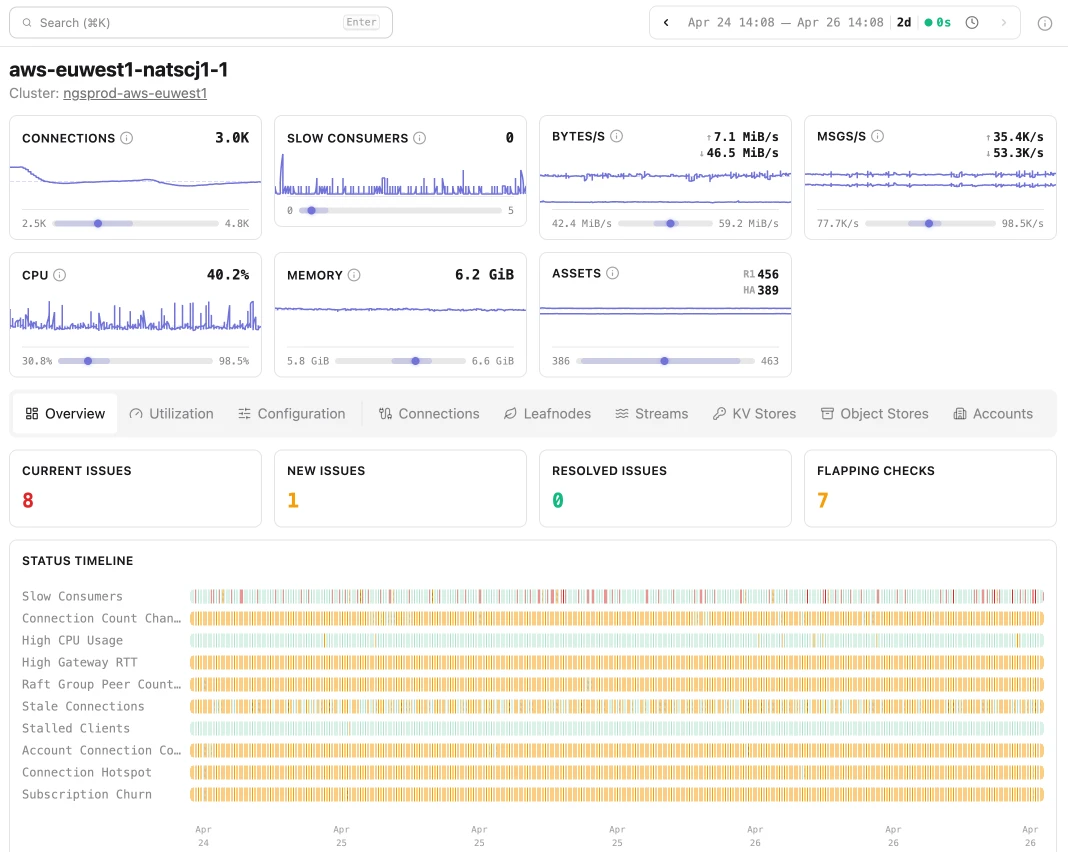
A fast messaging system can still be difficult to diagnose or police. These products sell help with those difficulties. Synadia’s stated remote culture, no-meeting days, and paid US healthcare describe how it recruits the people doing that work; they are company policies, rather than proof that anyone has abolished the bad Tuesday.
There is also the question of trust in the underlying project. In May 2025, CNCF and Synadia agreed that NATS would remain in CNCF under Apache-2.0. Project assets stayed with the foundation, and Synadia agreed to assign two trademark registrations to the Linux Foundation. The announcement followed discussions about the project’s future. For buyers, the settled governance is part of the product context.
Synadia’s proposition comes into focus here. Software scattered across places and teams needs a shared conversation. Someone then has to make that conversation durable where required, observable when confusing, and affordable to operate. The clever part is the protocol. The business is everything that happens after the first message arrives.
Keep the conversation going
Synadia website · Company blog and updates · Product documentation · GitHub · LinkedIn · X
Watch: Getting started with NATS · Persistence and streaming with JetStream · Synadia’s video channel