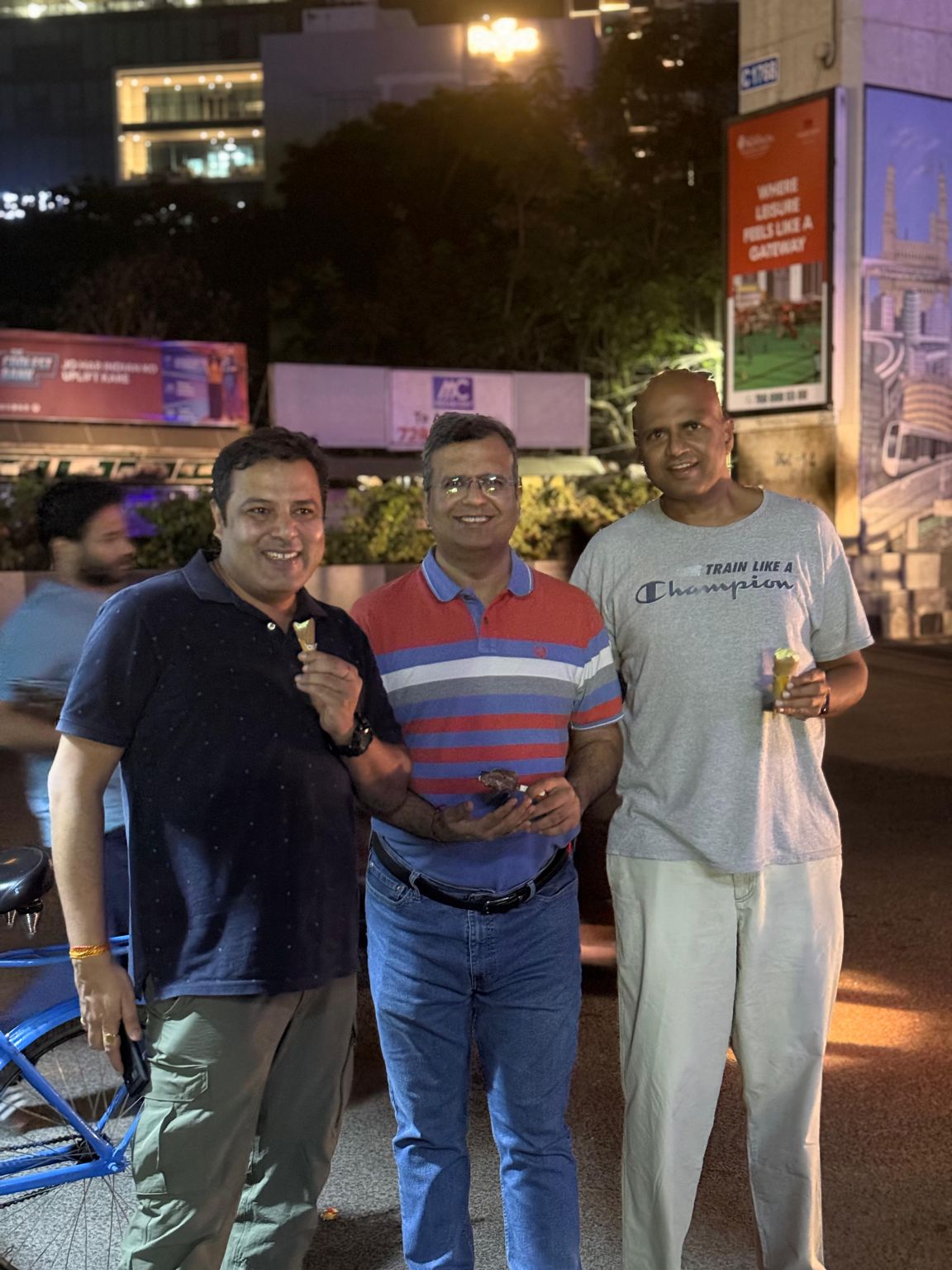
At two in the morning in Hyderabad, Suresh Kakarla was eating ice cream and talking about toll collection. In his recollection of the reunion, the conversation returned to the early FASTag years: the pilots, the banks, the road operators, and the business of getting all those parties to agree. The accompanying photograph is pleasingly ordinary. Three people, cones in hand, a city street behind them. National payment infrastructure had acquired an unusually informal reunion venue.
Kakarla had represented TollPlus on the technology side. Anurag Sinha and Vibhav Hathi had been leading payments initiatives at ICICI Bank. Looking back in February 2026, he remembered how much depended on aligning organisations with different incentives. Software was part of the job. So was persuading independent participants to trust the same transaction process. The ice cream arrived many years later; the conversation apparently still had some mileage in it.
That memory offers a way into Kakarla’s working life. He founded TollPlus, helped build its electronic toll collection business across markets, and left its chief executive role when VINCI Highways completed its acquisition in April 2022. He now leads Toucan Payments. Across those chapters, he keeps returning to the machinery behind an apparently simple act: somebody pays, and somebody else must be able to account for it.
The business behind the barrier
For a driver, an electronic toll is a brief event. For the organisations involved, it creates work that continues after the vehicle has passed. An account must be recognised, a transaction recorded, money handled, and questions answered when something does not match. TollPlus built software for that back-office world. Its product had to connect the road with the customer record and the financial record. The driver’s convenience depended on other people having considerably more detail.
The business crossed borders, although the organisations on either side were different. VINCI’s 2016 account of its investment described TollPlus as based in Phoenix and present in Hyderabad, already working on American free-flow highways while deploying a central transaction management system at nearly 350 toll stations in India. Its capabilities covered financial flows, customer relations and enforcement. The product sat among several responsibilities that a road authority had to keep connected.
A bank partnership made that work concrete. On October 7, 2019, Kotak Mahindra Bank announced that its collaboration with TollPlus had successfully integrated 16 national-highway toll facilities. The agreement covered an electronic toll collection acquiring management system and managed services. Kotak said the integration would expand to more than 100 tolls by 2021. Those were an achieved starting point and a stated expansion plan, respectively.
The distinction matters because infrastructure grows through deployments, with each additional participant introducing its own operating requirements. A bank has to understand the flow of money. A concessionaire needs a reliable account of road use. A driver wants the payment to work without a small administrative career developing around it. Kakarla’s later recollection of the FASTag pilots puts those different interests at the centre of the story.
North Texas, then the handover
When Kakarla looked back on TollPlus, he singled out the North Texas Tollway Authority implementation as a turning point for its standing in the industry. It was the kind of reference a software business could build on: a substantial customer using the product in everyday operations. His account emphasised years of investment in research and development, together with the knowledge needed to adapt a back-office product for different markets.
There is another view of that working relationship in Richard Arce’s description of joining TollPlus. Arce said he already knew the company’s capabilities and those of its founder, and described their collaboration around innovation and execution. The pairing is instructive. An idea for improving toll collection eventually has to become a working service, with customers relying on it after the presentation has ended and the project team has gone home.
VINCI Highways had owned 30 percent of TollPlus since 2016. On April 6, 2022, it announced the purchase of the remaining 70 percent. At that point, TollPlus employed more than 350 people. The acquisition brought the whole business into VINCI’s ownership after several years of working together. Kakarla’s own announcement made the personal consequence clear.
“As part of the acquisition, I stepped down as TollPlus CEO.”
Suresh Kakarla, announcing his departure in 2022
He thanked employees, customers, partners and VINCI’s management, and described the additional capital and market access that full ownership could provide. It was a departure with an operating future attached. The company would continue under a different ownership arrangement, while its founder moved to the next part of his career.
A year later, on April 26, 2023, VINCI Highways introduced ViaPlus, combining TollPlus with Cofiroute USA. Richard Arce was named as its CEO in the launch announcement. Kakarla’s connection to that business runs through the predecessor he founded and led. The sequence gives each chapter its proper owner: TollPlus’s development, the acquisition and departure, and the subsequent creation of ViaPlus.
The next company had already begun
Toucan’s history complicates the tidy idea that a founder closes one door before opening another. Its corporate timeline places its establishment in 2019, with Kakarla as its promoter and current CEO. The first deployment, a payment aggregation solution for a major Indian bank, followed in 2021. Both events preceded the completed TollPlus acquisition. The next company was already taking shape before the farewell.
When he publicly introduced Toucan Payments as his latest venture in 2023, Kakarla described TollPlus as a place where he had learned how technology could improve complicated business operations. That is a specific connection between the businesses. The earlier work dealt with tolling; Toucan addresses payments for banks, merchants and other businesses. Both require transactions to pass through multiple organisations and emerge with records that make sense.
The company’s timeline also records a Hyderabad office expansion and the opening of its first physical Dallas-area location in 2023. Kakarla’s public profile places him in Southlake, Texas, and records attendance at Thunderbird School of Global Management in 2006 and 2007. His professional geography reaches between the United States and India, the same two countries that recur in the businesses’ operating histories.
pays→Systems
coordinate→Records
agree
A colleague who stayed for three companies
For a more personal measure of continuity, there is Chakrapani Doppalapudi. In September 2026, Kakarla recalled knowing him for more than 35 years. When Kakarla was a first-year college student, Doppalapudi was already a senior. Their relationship grew to include work, mentorship, advice and friendship. Company names changed around it.
Doppalapudi had participated in his entrepreneurial work for more than 15 years, across SureIT, TollPlus and Toucan Payments. Kakarla listed contributions ranging from strategy and market research to banking, regulation and cross-border payments. Then he described something less easily fitted into an organisation chart: having someone available to challenge ideas, argue with, and learn from. It is a more useful picture of an adviser than an honorary title beside a photograph.
The Toucan team had celebrated Doppalapudi as his professional chapter closed at the end of August. Kakarla’s tribute dwelt on the length of their shared experience. Read alongside the Hyderabad reunion, it shows a founder who repeatedly brings former collaborators into the telling of his career. The technical work has an extended cast, and some of its members have stayed for decades.
What happens after “paid”
Kakarla’s recent interests remain close to the operating details. In March 2026, he announced a 24-week series of field notes on payment architecture, covering orchestration, routing, settlement and artificial intelligence in infrastructure. He framed it around what happens as systems grow, including the parts that fail quietly when transaction volume increases.
“Most conversations about payments focus on products. Very few focus on architecture.”
Suresh Kakarla, March 2026
By May, his engineering recruitment described problems involving transaction consistency, reconciliation and operational control. These are subjects with consequences for an ordinary customer: whether a transaction has completed, whether different records agree, and what happens when a provider becomes unavailable. His hiring message presented them as ongoing engineering work. A payment button offers little space to explain any of this. The systems behind it have to carry the explanation.
Toucan’s listing with the International Bridge, Tunnel and Turnpike Association brings the story back to roads. It describes SuperStream as a payment control layer that works alongside existing toll back-office systems and payment providers. Its stated functions include routing, failover and reconciliation. That positioning suggests a continuation of Kakarla’s earlier interests, with a different place in the transaction process.
In July 2026, he sought a leader to build Toucan’s cross-border payments business. He reported monthly payment volume above ₹550 crore and set out responsibilities covering corridors, customers, partnerships and commercial performance. The volume is his reported figure. The expansion is an ambition with work still attached to it. Even after a company sale, there are new participants to align and new operating arrangements to make dependable.
The ice-cream reunion provides a fitting image for that continuity. Kakarla was remembering a technical undertaking through the colleagues who had worked on it with him. Years after the pilots, and after his departure from TollPlus, the shared conversation continued on a Hyderabad street. A moving car leaves little time to consider the people behind its toll payment. They may still be discussing it long after midnight.
Keep the conversation going
- Suresh Kakarla on LinkedIn
- The Hyderabad reunion and early FASTag work
- Kakarla’s TollPlus departure announcement
- VINCI’s April 2023 ViaPlus launch
- Toucan Payments: company history
- Kakarla’s payment architecture field notes
- His tribute to Chakrapani Doppalapudi
- Kotak’s 2019 TollPlus partnership announcement