Suresh Balaraman has found a rather unglamorous place to look for the future of artificial intelligence: the plumbing. In July 2026, the founder and CEO of Datazoic published an essay about what he was hearing in capital markets buying conversations. The subject was AI. The troublesome details were data, permissions and the difficulty of getting several systems to agree about the same customer.
It is an appropriately practical subject for someone whose career has included both equities trading and the chief administrative officer’s chair. A trader and an administrator may look at the same business from different directions. Both have reason to care whether the information on a screen survives contact with the working day. Balaraman now builds software for that territory.
His story runs through financial institutions, a company founded in 2017, employee celebrations and conference rooms where people discuss the value of research. There is a recurring question beneath those settings: what happens to information after someone has collected it? An industry can possess an abundance of records while still having a great deal of work to do.
A career on both sides of the market
Balaraman is based in New York. His education includes the University of Akron, which he attended from 1996 to 1998. His professional background spans more than 20 years across the buy side and sell side. Oppenheimer, CIBC World Markets and The Savoir Club appear in his work history.
That range matters to the business he eventually founded. The buy side and sell side participate in the same financial world while bringing different demands to a relationship. Someone evaluating research and someone supplying it may agree that a conversation was worthwhile, then have quite different ideas about how to record its value. Software enters a room already furnished with such disagreements.
Datazoic was established in 2017. Balaraman’s directorship at its Indian company, Datazoic Machines Private Limited, dates to April 12 that year. He became a founder in an industry he had already worked inside, bringing experience of the people using financial systems as well as the operations surrounding them.
The company describes itself as entirely founder-funded. It serves sell-side firms across North America, Europe and Asia, with New York and Chennai among its locations. Its work brings together client relationships, research, interactions and analytics. These are familiar nouns in finance. Making them useful together is the more demanding verb.
Five years, and a thank-you
In 2022, Datazoic reached its fifth anniversary. The photographs of its annual meet offer a change of scene from the financial software vocabulary: colleagues gathered for pictures, certificates arranged for presentation, a microphone, a decorated backdrop. Balaraman appears speaking in a patterned shirt. A company occasion has its own requirements of dress.
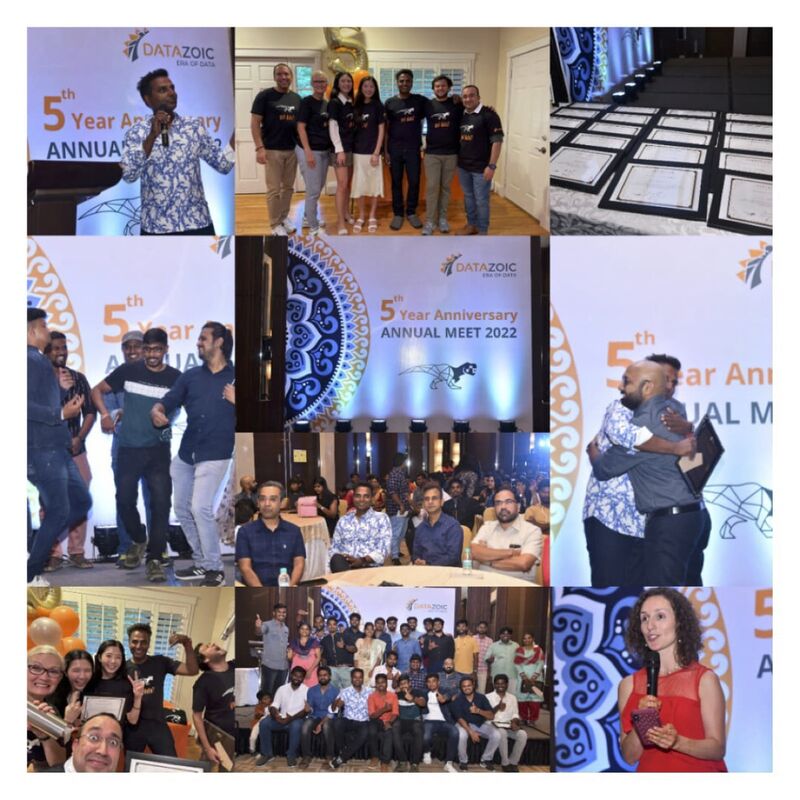
His anniversary message emphasized customer experience, ownership and responsibility. It also thanked the employees who had helped the company reach that point. The language was celebratory, as anniversary language tends to be, but the recipient of the gratitude was clear: the people doing the work.
“We couldn't have made it this far without you.”
Suresh Balaraman · fifth-anniversary message, 2022
There is a useful human scale to that moment. A founder can discuss a company as a collection of capabilities; an anniversary makes it possible to see the collection of people. The images show groups, presentations and colleagues together. The business has a product story, but it also has occasions when somebody must arrange the chairs.
After the conference, the work begins
By October 2024, Balaraman was in Chicago for TWST Events’ User Group Day. His topic was using conference data to drive sales in sell-side institutions. The panel’s photograph places him in the middle of a seated discussion, beneath a screen carrying the subject and the speakers’ names. The audience is close enough for this to look like a working conversation.
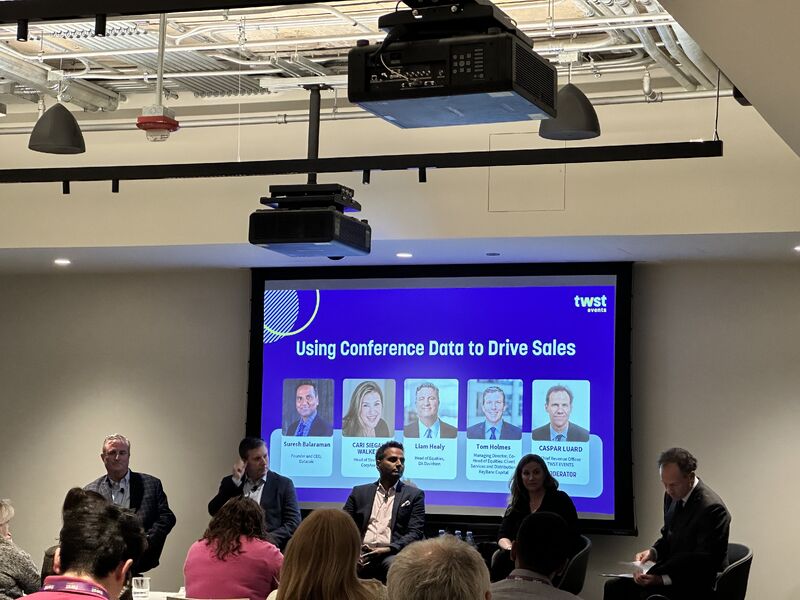
Conference data is a wonderfully specific topic. It begins with an activity that is thoroughly social: people meeting, asking questions and choosing whom to spend time with. It then asks what an institution can learn from those encounters. The badge comes off. The need to understand the relationship remains.
In November that year, Balaraman was listed on a research valuation panel at Unbundling Uncovered in London. Alongside participants from HSBC, Singletrack, Lansdowne Partners and Substantive Research, the agenda addressed the relationship between how buyers and sellers assess research. Could both sides arrive at a more aligned understanding of value?
That question has enough substance to keep a panel occupied. Counting an interaction is one task; deciding what it contributed is another. A research conversation may influence a decision without producing an immediate, tidy commercial event. The panel’s subject put those measurement questions in front of the people who have to live with the answers.
Balaraman returned to the conference circuit in 2025. In New York, he was among the technology providers asked to respond to the industry’s concerns and discuss practical results from AI. In London that November, he was again listed alongside financial technology leaders. Across those appearances, the emphasis was on what the tools could do within real research businesses.
The New York technology panel had an unusual assignment: listen to the discussions before it, then respond to the concerns raised. Its agenda explicitly called for case studies showing immediate value from AI. That sequence gives the customer’s questions a place before the vendor’s answers. For a founder selling into a specialized market, it is a useful discipline. A room full of research professionals can supply a rather demanding specification.
The London event in November 2025 continued the discussion of AI adoption among research providers and consumers. Balaraman’s fellow technology speakers included representatives of SS&C Tier1, Finster, Eidosmedia and Aiera. The company was one participant in a wider industry conversation.
The surprise inside the buying conversation
His July 8, 2026 essay, AI in Capital Markets: The Real Story Is in the Plumbing, gave that practical interest a more personal voice. Balaraman described a change in his own expectations: he had anticipated that AI adoption would resemble the early cloud cycle, with firms adding tools. In the buying conversations he reported, firms were instead examining what they could consolidate.
A founder acknowledging a surprise is more interesting than a founder announcing that events have once again vindicated him. Here, the useful detail is the revision. His account followed conversations, pilots and feedback. He presented a view from those encounters, with the limits of that vantage point attached.
His examples concerned the foundations: whether information stays identifiable across systems, whether the right permissions accompany it and whether a firm can govern the resulting workflow. These details give the plumbing metaphor its force. An elegant tap is a limited achievement if the pipes behind the wall disagree about where the water should go.
For Balaraman, the commercial discussion had also become more exacting. Procurement conversations were moving toward documentation, evaluation and responses to failure. That changes the sort of explanation a software provider must be prepared to give. The demonstration may open the door; the questions about its operation arrive with their own keys.
Research meets data in New York
On June 11, 2026, Balaraman joined Unbundling Uncovered’s New York panel on integrating data and research. Mike Carrodus moderated a discussion with participants including Jim Bode of AlphaSense, Sally Keeley of BlackRock, Michael Marrale of M Science and Scott Rosen, founder of Visible Alpha.
The agenda moved through sourcing, trialling, onboarding and integrating data into research workflows. It also asked how budgets respond when the boundaries between data and research become less clear. These are questions about organizational choices as much as technology. Someone must decide what to buy, how to use it and which part of the institution should pay.
Placed beside his Chicago appearance, this is a consistent professional territory. A conference encounter, a research product and a data purchase each leave information behind. Balaraman’s public discussions keep returning to the arrangements that let institutions make use of it. The setting changes; the question travels well.
The next room in London
As of October 27, Balaraman is listed for Unbundling Uncovered in London on November 4, 2026. The scheduled panel concerns data and research supply, governance and delivery. Fellow speakers include Jim Bode, Aaron Fuchs of M Science and Tom Hodds of S&P Global Market Intelligence, with Carrodus moderating.
The forthcoming agenda brings together the subjects threaded through his recent work: how providers deliver information, how institutions control its use and how technology fits their internal ambitions. It is a suitably concrete next appointment for a founder whose public argument has settled on the connections beneath the interface.
There is something quietly amusing about the destination. After years in markets, a move into entrepreneurship and a succession of discussions about AI, Balaraman has arrived at the pipes. They are unlikely to win a beauty contest. They do, however, have to work.