The fine print has an excellent survival instinct. Move a financial transaction into a modern office, give everyone better screens, add a conversational AI assistant, and the consequential information may still be sitting several hundred pages deep in a credit agreement. Vijay Gudipalli has made a business of going in after it.
As founder and CEO of Alphastream, he works on a particular inconvenience of finance: documents contain information, but information does not arrive ready to use. A clause must be understood. A figure must be placed in context. An amendment may change what an earlier agreement appeared to say. The computer can look wonderfully busy while a person remains responsible for getting the answer right.
Gudipalli’s professional story follows that gap between possession and understanding. It runs through an earlier data company, the founding of Alphastream in 2019, institutional credit work, and partnerships intended to put extracted information inside everyday workflows. By June 2026, it had reached an AI product with a revealing premise: the conversation is easier when the underlying data has already been put in order.
A previous company, a familiar problem
Before Alphastream, Gudipalli co-founded Almug Technologies. His public career record places him there from January 2015 to August 2019. Almug’s business covered structured and unstructured data management using AI, with products and decision support for financial professionals. The subject matter offers a clear connection to what came next.
His education was in mechanical engineering, with a Bachelor of Technology from Koneru Lakshmaiah College of Engineering. That is a pleasing detail in a career now concerned with another sort of machinery: the movement of information through an investment organization. The degree establishes his training; the businesses establish where he applied his working life.
Alphastream began in 2019. Its early work included a covenant review process for CreditSights and a financial-data extraction system developed with HSBC’s credit research team. These were specific assignments with identifiable users. A covenant is a contractual provision that someone has to examine; a financial model needs figures someone has to extract. There was plenty to do before anyone could admire the interface.
By 2021, the products had matured and the business was adding clients and building its engineering, data science and product teams in the United States and India. The trajectory gives the company a practical origin. Gudipalli’s AI business grew around tasks that credit professionals already needed performed.
The company around the documents
On May 6, 2024, Gudipalli announced a seed investment from Motive Ventures alongside two leadership appointments. Chris Ucko joined as chief revenue officer and Bala Subramanian as chief operating officer. Money and management arrived in the same announcement, a useful pairing for a founder trying to expand an institutional business.
Both appointments brought credit-market experience. Ucko had held senior roles at CreditSights. Subramanian had been its chief product and technology officer, following a series of leadership positions at S&P Global. Gudipalli described the pair as helping guide Alphastream’s strategic and commercial direction through its next phase.
He also emphasized what Motive could contribute beyond capital, including industry expertise and relationships. That choice of emphasis makes sense for software sold into established financial organizations. Knowing how an institution buys, works and evaluates a product can matter as much as the demonstration. An immaculate demo has never had to attend every procurement meeting.
The company’s product claims at that point were concrete: processing complex financial documents in under five minutes and identifying more than 800 deal terms. Those figures describe Alphastream’s stated capabilities at the time. They also show the scale of the extraction task Gudipalli had chosen to address: many distinct pieces of information, all needing a useful destination.
Finding a place on the analyst’s desk
In September 2025, Intapp made a strategic investment in Alphastream. The companies also deepened a partnership connecting Alphastream’s document intelligence with Intapp DealCloud. For Gudipalli, this was a route into a system already used to manage deals and relationships.
The intended workflow is straightforward to describe. Information inside a credit agreement, loan document or financial document becomes available within DealCloud. There, it can support the creation of deals, analysis and transaction work. The user has a reason to encounter the information in the course of doing something else.
Gudipalli framed the partnership around the combination of Intapp’s workflow and client-engagement experience with Alphastream’s credit-focused AI. It was a commercial relationship with a product implication: the extracted data would have somewhere to go. Finding a clause is valuable; making it available when a colleague needs to make a decision gives that work another use.
By that announcement, Alphastream reported more than 200 experts across New York and Bangalore. The figure describes a company that had accumulated a substantial team around its chosen problem. It also puts some human scale behind a business usually described through documents, models and software connections.
Trust, with a microphone attached
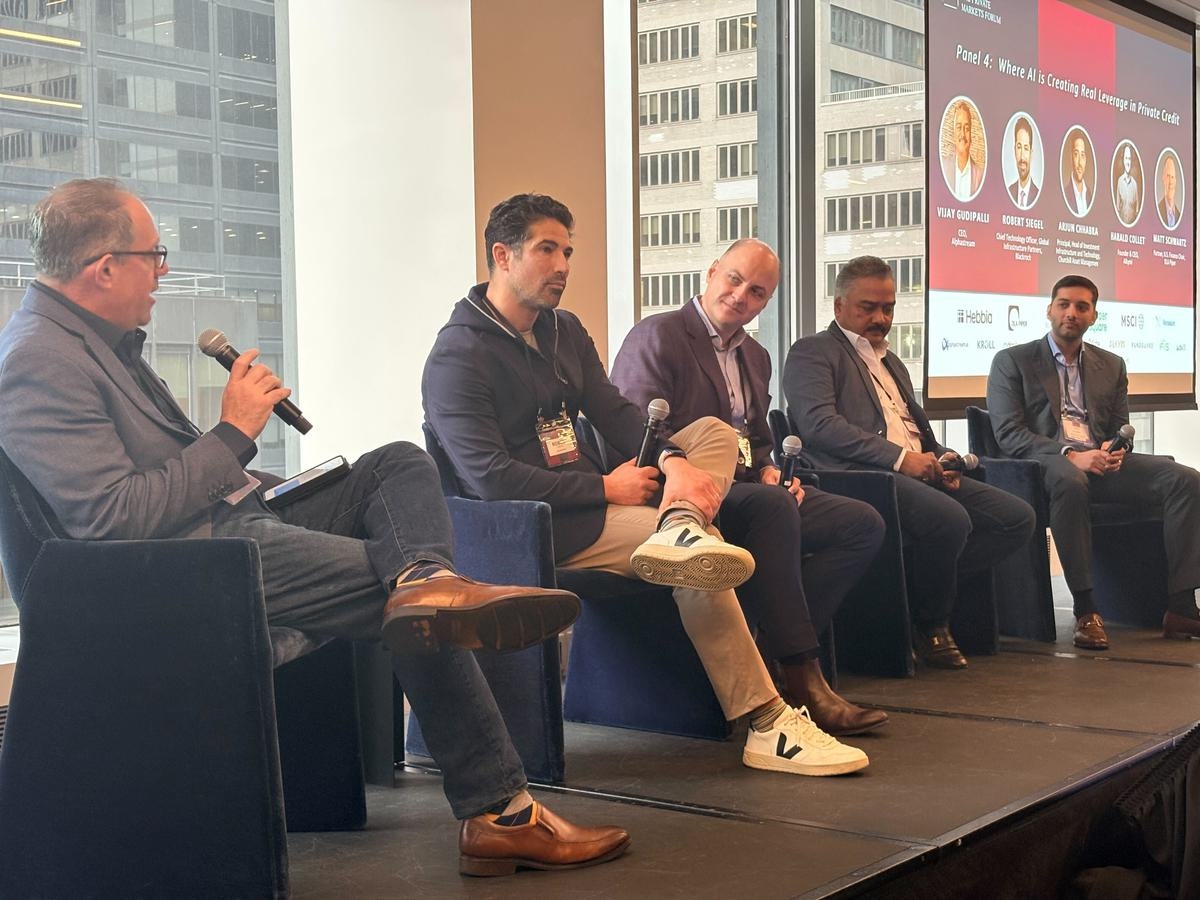
At the 2026 Private Credit Technology Summit, Gudipalli joined a panel about where AI was creating practical value in private credit. Alongside him were Arjun Chhabra, Robert Siegel, Harald Collet and Matt Schwartz, bringing investment technology, infrastructure, software and legal perspectives to the discussion.
His reflection afterward was unusually economical: “In high-stakes environments, trust drives adoption.” He went on to emphasize accuracy and reliability, and the confidence required by underwriters, operations teams and portfolio managers. The point fits the work he sells. An answer needs to be useful to the people who will carry it into the next stage of a deal.
The photograph catches an ordinary business scene: microphones, conference badges, a row of chairs, office buildings beyond the windows. It is an apt setting for this part of his story. The subject is the everyday work of institutions, and the conversation returns to whether a tool can become dependable enough to join it.
“In high-stakes environments, trust drives adoption.”
Vijay Gudipalli, reflecting on the 2026 panel
The next answer begins underneath the chat
On June 22, 2026, Alphastream launched AlphaMCP. The product connects private-markets data to AlphaAI, Claude and ChatGPT. It gives those tools access to information drawn from a firm’s documents and systems, with the company describing a foundation of normalized and validated data.
The range of material is broader than a single loan agreement. It includes amendments, company financials, limited partnership agreements, side letters, valuation memos and operational notices. For a founder whose business began in credit-market analysis, the launch extends the same organizing problem across more of an institution’s paperwork.
Alphastream describes human review as part of its extraction and validation process. It also describes answers traceable to underlying documents, with access controls and deployment options for customer environments. These are product commitments rather than decorative details. A professional needs to know both what an answer says and whether the supporting material justifies it.
- 01 / DocumentsAgreements, financials, fund records
- 02 / Prepared dataExtraction, normalization, human review
- 03 / Everyday AI toolsAlphaAI, Claude, ChatGPT
- 04 / Checkable answersReturn to the underlying document
The launch also lays out the kinds of questions the prepared data should help answer. Teams can compare documents, examine portfolio exposures and review contractual provisions across agreements. The work can involve investment staff, legal teams, compliance, operations and investor relations. Each group approaches the paperwork with a different task, which makes consistent organization useful across the business.
For Gudipalli, that broadens the audience for the work Alphastream has already done. A legal provision may matter during negotiation, later during monitoring, and again when someone needs to explain a portfolio. The company’s stated approach gives those uses a shared foundation. Its usefulness will depend on how well that foundation holds up as the documents and questions change.
There is a modest convenience here with significant consequences for adoption: analysts can use an AI environment they already know. The proposed change happens in the information available to that environment. A new product can therefore arrive without asking everyone to cultivate a fresh affection for another application.
“AI is only as good as the data it operates on,” Gudipalli said at the launch. His wider ambition is a common ontology and standardization layer: an agreed way to organize information so that documents, workflows and decisions can draw on a consistent foundation. In plainer language, the same fact should remain recognizable as it moves between tasks.
That ambition connects the stages of his career more neatly than a list of funding announcements alone. Almug worked on making data usable. Alphastream developed tools around credit documents. DealCloud supplied a destination inside deal workflows. AlphaMCP brings the prepared information to conversational AI tools.
Gudipalli has kept returning to an unglamorous but durable question: what must happen to information before someone can rely on it? His answer has become a company, a team and a series of integrations. The fine print remains full of conditions. He is trying to make reading it a less private accomplishment.