The most expensive number in a mortgage can look wonderfully ordinary: 6.375 percent, perhaps, sitting in a neat little rate box. But that number is not plucked from a banker's tidy desk drawer. It is assembled from a borrower's credit, a property's details, thousands of investor rules, live bond prices, a lender's margin, the cost of hedging and the odds that the loan will actually close. Optimal Blue is the machinery that turns that argument into an answer.
The Plano, Texas, company is not a lender and does not write checks to homebuyers. It sells capital-markets technology to the institutions that do: banks, credit unions, independent mortgage banks, brokers, housing authorities, investors and servicers. Its core product-and-pricing engine, known in the trade as a PPE, helps a loan officer find eligible products, quote a price and lock a rate. From there, Optimal Blue's software follows the risk into hedging, margin management, loan trading, compliance, analytics and the valuation of mortgage servicing rights.
That reach explains why a business largely unknown outside mortgage offices became a regulatory chess piece. In 2020, Black Knight led a $1.8 billion acquisition of Optimal Blue. Three years later, Intercontinental Exchange - owner of the New York Stock Exchange and ICE Mortgage Technology - moved to acquire Black Knight. The Federal Trade Commission objected. ICE already had a rival pricing product inside its Encompass loan-origination system, and absorbing Optimal Blue risked putting two key pricing paths under one roof.
The $700 million answer to an antitrust problem
The deal changed shape under pressure. To settle the competition case, Black Knight's Optimal Blue business was sold to Constellation Software for $700 million in September 2023. The structure was unusual enough to deserve a Post-it note: $200 million in cash and a $500 million promissory note. The FTC also required transition help and restrictions meant to keep the divested business viable.
So what changed their mind? Not a sudden loss of faith in the product. The obstacle was precisely the opposite: Optimal Blue mattered too much to mortgage pricing competition to disappear into the same corporate family as a major rival. The proposed mega-deal survived because the pricing engine moved out.
“This deal as originally structured would have reduced competition in key areas of the mortgage origination process.”Henry Liu · Federal Trade Commission
That episode is the cleanest measure of Optimal Blue's place in the market. Competitors include ICE's Encompass Product and Pricing Service, Polly, Lender Price and Mortech. But the humbler alternative is still alive in many mortgage shops: a collection of point products, spreadsheets and people manually reconciling what one system thinks the loan is worth with what another system thinks it can sell for.
What actually failed first
In mortgage capital markets, the first failure is usually the handoff. A loan officer quotes from one view. A secondary-marketing desk hedges from another. An executive reads yesterday's report. Someone changes a margin, someone else extends a lock, and the economics drift while the loan remains the same loan.
Optimal Blue's bet was that pricing becomes more valuable when it is connected to everything after pricing. Its modern platform links the front-office decision to the back-office execution. The lender can see eligibility and real-time price, lock the loan, account for hedge cost, manage a pipeline, choose a buyer, trade the loan, measure the result and feed that result into the next decision.
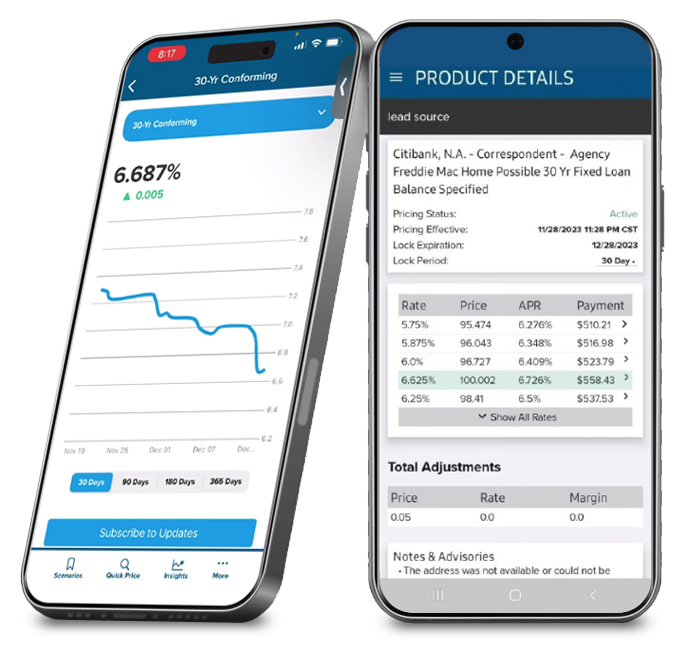
The product catalog follows that chain. Optimal Blue PPE serves enterprise lenders; Loansifter gives brokers a more turnkey way to compare products from more than 120 wholesale investors. CompassEdge connects pricing, hedge analytics, margin management and loan trading. Comergence handles counterparty oversight and third-party-originator compliance. Capture looks for borrower recapture opportunities. Data products turn direct mortgage transactions into rate indices, competitive benchmarks and market reports. The MSR platform helps value the right to service loans after they are sold.
The moat is a loop, not a feature
A rival can build a rate-search screen. The harder thing to reproduce is a two-sided information loop: many lenders generate pricing and lock activity; many investors publish products and buy loans; partner systems carry the data; executed transactions reveal what actually happened. More activity can make the benchmarks more useful, which can make the workflow more attractive, which can create more activity.
The company says its platform facilitates more than $1.1 trillion in locking and trading transactions annually. Its 2026 impact study, conducted by MarketWise Advisors with responses from 267 client institutions, reported average efficiency gains above $1,000 per loan across the broader ecosystem. That is not a universal promise; the findings were client-reported, and individual performance varies. Still, the mechanism is credible. On a high-volume operation, avoiding a small pricing error or eliminating repeated manual work can compound quickly.
The partner network matters for the same reason. Optimal Blue lists more than 70 certified connections across loan-origination systems, point-of-sale software, CRMs, mortgage insurance, data and capital-markets providers. The company's API-first language may sound like standard enterprise brochure copy, but here the plumbing is the product. A pristine price that has to be re-keyed into three systems is no longer pristine.
AI, placed where the money moves
Under CEO Joe Tyrrell, appointed in 2024 after leading ICE Mortgage Technology and Medallia, Optimal Blue has pushed generative AI into narrow, expensive decisions. Originator Assistant suggests alternate loan structures that could improve a quote. Confirm Assistant reads trade-confirmation documents. Ask Obi surfaces information from a lender's own products and data. Virtual Economist blends public economic indicators, market expectations and Optimal Blue's mortgage data to forecast rates and lock volume through text or voice questions.
The important choice is placement. These are not chatbots floating beside the work. They sit inside pricing, forecasting and confirmation workflows where a suggestion can be checked against structured data and where saving five minutes or catching one discrepancy has an obvious owner. At its 2026 summit, the company also showed tools that surface hedge costs inside the pricing engine and synchronize ratesheet decisions with CompassEdge. The theme is less “AI replaces the desk” than “the desk stops hunting through tabs.”
- Map the whole economic loop. Do not optimize the quote while ignoring the hedge, sale and feedback.
- Count handoffs before features. Every re-keyed field and delayed sync is a place for margin to leak.
- Turn operations into benchmarks. Transaction exhaust can become a product when it is normalized and anonymized.
- Integrate where users already work. A partner network can distribute a capability more effectively than another destination app.
- Put AI beside a costly decision. Narrow assistants with auditable inputs beat a general chatbot looking for a purpose.
When the playbook does not work
Optimal Blue's approach is not automatic magic, and it will not fit every lender. Enterprise pricing and secondary-marketing software carries implementation work, configuration, integrations, training and governance. A small broker with simple products and modest volume may prefer a lighter tool such as Loansifter. A lender that keeps dirty product data, tolerates off-system workarounds or cannot agree on margin rules will merely automate its disagreements.
Scale is the condition that makes the economics sing. The more loans, investors, channels and market exposure a lender manages, the more valuable consistent pricing and connected risk management become. Below that threshold, software cost and organizational change can outweigh the saved errors. Public enterprise list prices are not disclosed, so buyers have to calculate value from their own volume, error rates, staffing and execution improvement rather than a generic ROI headline.
There is also a market-structure caution. Data advantages can harden into dependency, and deep integration can make switching painful. The 2023 antitrust settlement is a reminder that infrastructure deserves scrutiny precisely when it works. Lenders benefit from one connected workflow; they also benefit from credible alternatives and open connections.
Boring, consequential, and close to the money
Optimal Blue's mission is to help lenders maximize profitability on each loan so they can keep financing homeownership. The first half is concrete; the second gives the spreadsheet a front porch. Its public culture values - take ownership, innovate with purpose, serve authentically and act with urgency - are standard-looking until placed beside the company's actual strategic history: ownership changes, regulatory separation and a product line that has to keep operating while mortgage markets convulse.
The company has survived because it sits close to the decision that determines whether a loan makes economic sense. It is enterprise software with a market-data flywheel, a transaction marketplace and a layer of human capital-markets expertise. That makes it difficult to summarize at a cocktail party. It also makes it useful.
Borrowers will continue to see a rate. Lenders will continue to see the argument behind it. Optimal Blue's job is to make sure that argument reaches a fast, consistent and profitable conclusion - then remembers what happened the next time.