Sunil Madhu crossed the Atlantic. His credit history stayed behind. In Britain, he had a financial record; in the United States, he had to begin again. The person had arrived intact. The paperwork appeared to have suffered a more complicated journey.
Years later, explaining why he helped start Socure, Madhu returned to that experience. A system designed to establish confidence had trouble recognizing someone whose history existed elsewhere. For a security architect, this was a particularly interesting sort of rejection: a legitimate person, standing on the wrong side of a perfectly functioning process.
That encounter supplies a useful starting point for his career as a founder. His work keeps returning to the same uncomfortable transaction. A business wants customers. It fears impostors. Somewhere between the invitation and the approval screen, real people disappear.
A history the computer could not see
Madhu studied computer science at the University of Strathclyde, earning an honors bachelor's degree, and management information systems at Glasgow Caledonian University, earning a master's. His professional background was in security architecture and identity and access management: the machinery that determines who may enter a system and what they may do once inside.
His experience includes Netegrity, Securent, Cisco and SunGard. He also founded Hopskoch, a venture outside the narrow confines of enterprise security. The combination matters to the story. Security asks how to prevent an unauthorized person from getting through. A consumer business has the additional problem of persuading authorized people to bother.
Before Socure, he spent time in marketing technology. Online activity began to look like material for another purpose. People generated evidence about themselves through their digital lives, while institutions continued asking whether a relatively small set of conventional records matched. He saw an opening between the evidence people produced and the evidence businesses accepted.
Socure, founded in 2012, brought Madhu together with Johnny Ayers. Madhu has described recruiting Ayers after working alongside him at General Assembly. Their chosen customers were financial institutions, including banks and card issuers. These were businesses for which recognizing a stranger was both a commercial necessity and a regulated obligation.
The price of a locked door
Identity verification sounds like a yes-or-no question. In practice, every decision has two possible embarrassments. Let an impostor in and someone may lose money. Turn a legitimate applicant away and the business loses a customer, often without ever discovering how much that customer might have been worth.
Socure's early approach combined online, social and offline information, using machine learning to assess whether an applicant was who they claimed to be. Its ID+ product delivered that assessment through an API, making it part of an existing business workflow. The ambition was to make more evidence available at the moment a decision had to be made.
In October 2016, Madhu described an identity-resolution process drawing on more than 300 data sources in about 1.5 seconds or less. Those were his figures for the product at that time. They show the scale of the task he was describing: taking a sprawling digital existence and compressing it into something useful before an applicant abandoned the screen.
He was especially interested in people with limited conventional credit records. A thin file describes the contents of a database. It can nevertheless become a judgment about the person outside it. Young adults and newcomers make that distinction difficult to ignore. Their lack of a familiar record need not mean their identities are false.
There is a peculiar commercial comedy here. A company pays to attract a customer, invites them to apply, then puts a small obstacle course between the invitation and the sale. Madhu's argument has been that the obstacle course carries its own bill. A business can become very efficient at refusing revenue.
New York was part of the business plan
Building Socure required another kind of acceptance. Madhu told of meeting roughly 150 potential investors while financing the company. Some interested Silicon Valley firms wanted the business to relocate. He wanted to stay on the East Coast, close to the financial institutions he intended to serve.
John Frankel's ff Venture Capital became an early backer. Its involvement extended into recruiting and marketing. This is a less cinematic part of founding a technology company, but a revealing one: the person explaining algorithms still needed help finding colleagues and reaching customers. A model does not schedule its own sales meeting.
In December 2016, Socure announced a $13 million Series B involving Two Sigma Ventures, ff Venture Capital, Flint Capital and Santander InnoVentures. Madhu was then CEO and co-founder. Raising money was one checkpoint; persuading large institutions to use a different method of recognizing customers was another.
His answer to a lighter question from the same period provides welcome relief from the vocabulary of compliance. Asked for a favorite New York bar, he replied, “This is New York! We're not at a loss for options.” A founder declining to narrow his addressable market, even after work.
A robot army, with reservations
Madhu could make the engineering sound mischievous. In 2017, he described an identity-verification robot with smaller robots doing parts of the work. Data preparation, model development and deployment each had a place in the scheme. The language was playful; the division of labor was quite deliberate.
He put particular emphasis on preparing the information those models consumed. He called getting the data right the hardest part. Before a system could recognize a useful pattern, someone had to assess the input, transform it and extract meaningful features. The dazzling answer depended on some distinctly undazzling housekeeping.
He also warned buyers to examine the technology beneath fashionable labels. In another 2017 conversation, he argued that technical possibility alone did not justify deployment. That caution complicates the easy portrait of a founder selling automation. His public explanations included both enthusiasm for machines doing repetitive work and a demand that customers look past the sales language.
“Getting the data right is the hardest part.”
Sunil Madhu, 2017
In April 2018, Socure appointed Tom Thimot CEO. Madhu became chief strategy officer, concentrating on platform innovation and new market opportunities. The two had worked together at Netegrity. The handover reunited former colleagues while changing Madhu's responsibilities inside the company he had helped build.
The second company asks who pays
Instnt, founded in 2019, took him back to customer acceptance with a different commercial arrangement. At FinovateFall in 2021, he appeared alongside chief product officer Justin Kamerman to present Instnt Accept. The company described a managed onboarding service that included fraud-loss insurance.
That addition changes the conversation. A verification service can help estimate the likelihood of fraud. Insurance addresses the financial consequence of a covered loss. Madhu's second venture brought the assessment and the allocation of risk into the same discussion, rather than stopping when the application received an answer.
By 2024, he was explaining how pooling risk across customers could support this approach. Instnt also offered Multipass, introduced in October 2023, to let businesses reuse verified identity credentials. Both ideas addressed repetition: repeated checks for the customer, repeated exposure to losses for the institution.
His recent writing makes the insurance mechanics more explicit. Instnt evaluates risk around approved accounts and arranges coverage backed by insurers. Coverage depends on underwriting and policy terms. The point is to put a funded payment mechanism behind an eligible loss, giving an institution another way to manage the uncertainty left after its checks.
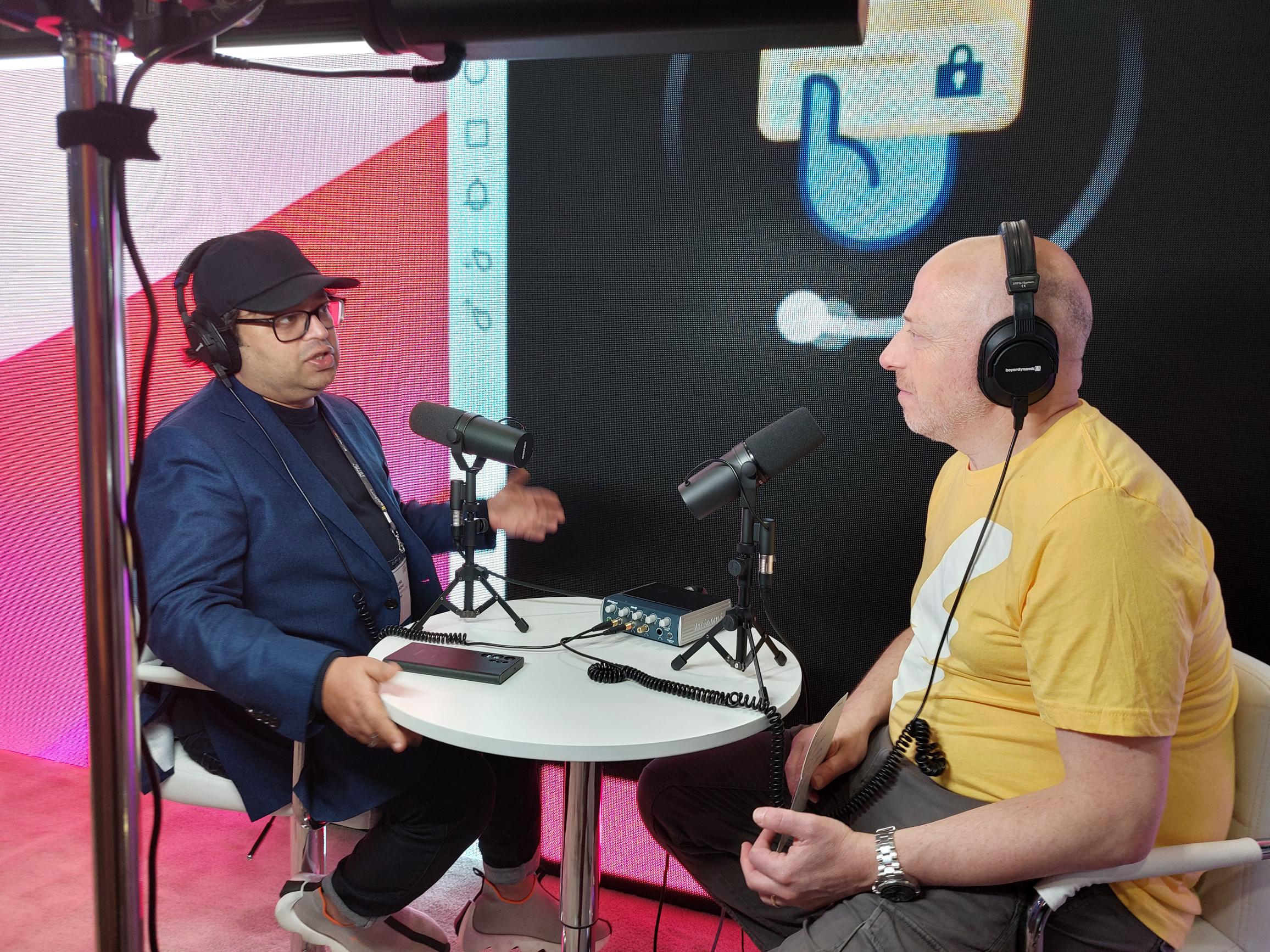
The public appearances track that change in emphasis. He discussed customer onboarding at Money20/20 in 2022, then returned to the event in 2023 with fraud insurance central to Instnt's pitch. In a January 2024 payments podcast, he described how the approach fitted into the systems financial institutions already used. The audience remained familiar: banks, credit unions and fintech companies trying to accept customers without taking on losses they could not comfortably carry.
It is a founder's version of staying with a problem after the first company. The application still has to be processed. The person still wants an answer. Madhu has continued working on what would make that answer easier for a business to give.
The ledger gets the last word
In September 2026, Madhu was writing about an awkward accounting problem: some fraud-related lending losses can end up recorded as ordinary credit losses. If an institution cannot separate the two, it struggles to understand what it should prevent, price or transfer. The diagnosis begins with classification before it reaches software.
That month he also examined loss allocation in banking partnerships through the aftermath of Synapse. His question concerned the strength of a promise to pay when several organizations share responsibility for a service. Identifying a liable party is one task. Establishing that the party can actually fund the loss is another.
The progression is striking. His earlier explanations concentrated on the evidence around an identity. His later ones follow the money after a decision goes wrong. In both, the practical difficulty lies between categories that seem tidy on a slide: known and unknown, approved and rejected, credit loss and fraud.
For the applicant, the desired ending remains modest. They want to open an account, use a service and get on with their day. Madhu has built companies around the expensive machinery behind that modest request. An Atlantic crossing once made his own financial past hard to recognize. His continuing subject is how much a business loses when it mistakes an unfamiliar person for an unacceptable one.