The laundry lockers were in the wrong place. Vijen Patel and Drew McKenna, the founders of Pressbox, had expected office workers to welcome a convenient place to drop their dry cleaning. Instead, the business found its footing closer to home, in Chicago apartment buildings. The useful distance was the distance to the wardrobe. A clean shirt has an excellent business model, provided somebody remembers where the dirty one lives.
Sundar Raman noticed the business that emerged from that adjustment. P&G had been testing its own ideas about laundry delivery. What attracted him to Pressbox was a combination of founders, a clear business model and attention to the work itself. P&G acquired the company. In his account, the appeal lay in how the service operated, with quality figuring alongside the opportunity to grow.
There is a compact introduction to Raman in that episode. He runs a business whose products sit in cupboards around the world, yet some of its opportunities begin several steps away from the cupboard. A customer may need detergent. Another may need somebody to collect the washing. Understanding the distinction takes more patience than printing a larger logo.
How much of the chore can you make disappear?
An analyst gets the keys
Raman joined Procter & Gamble in India on June 1, 1998, starting in trends and market research. He was born in Palamaneri, Tamil Nadu, and arrived with an engineering education followed by management training: an electrical and electronics engineering degree completed in 1996, then a postgraduate management diploma in 1998. His early professional assignment was to understand markets.
The move to the United States brought work in business intelligence and consumer knowledge, followed by marketing jobs in the beauty business. By 2004 he was managing Head & Shoulders in North America. He moved into Fabric Care innovation in 2008. That sequence matters because it gave him several views of the same transaction: the information behind it, the brand that encouraged it and the product expected to justify it.
His responsibilities expanded through North American Fabric Care and P&G Professional, then Home Care. He became sector CEO in 2021. The scale of the job is easy to underestimate if one pictures a detergent aisle. Fabric & Home Care generated $30.314 billion in net sales in fiscal 2026, representing 35% of P&G’s sales. The portfolio reaches from Tide and Ariel to Dawn, Febreze and Swiffer.
The results also supply a useful restraint on any tidy success story. Fiscal 2026 sector sales rose 2%, while net earnings fell 4%. A portfolio of familiar names still has to earn its way through pricing, competition and costs. Familiarity is helpful at the shelf; it does not fill in a profit statement.
A box with a different starting point
Years before the sustainability appointment now attached to his title, Raman was discussing a rather practical redesign. Tide’s Eco-Box began with the journey of an online order. The package had to move through warehouses and delivery networks before becoming something a person could use at home. That journey made different demands from a trip through a supermarket.
Inside the cardboard was a sealed bag of concentrated liquid detergent. A flap opened to reveal a dosing cup and twist tap; a pull-out stand made room for the cup underneath. The arrangement was almost domestic furniture in miniature. Its purpose was straightforward: make the container work for shipping and for the person standing beside the washing machine.
Against the 150-ounce Tide press-tap package used for comparison at the launch, the 105-ounce Eco-Box offered the same 96 loads. P&G reported 60% less plastic and 30% less water in that comparison. Those qualifications matter. The figures describe particular packages and formulas, rather than a blanket claim about every bottle of detergent.
Raman described the design method as “e-comm-back.” Begin with the environment in which the purchase happens, then work backward into the package. The phrase is industrial shorthand for a fairly human habit: noticing what a person will actually have to do with the thing you are selling.
Permission to leave the laundry behind
Tide Cleaners extended that habit into a service. Its 2019 expansion brought together places to drop clothes, cleaning services and an app that handled instructions and collection notifications. Apartment residents, students and busy households were the intended customers. The familiar orange brand now had to represent an experience that continued after someone handed over a bag.
For Raman, the promise included giving people some of their time back. That changes the competitive question. Detergent can be compared by its dose or its performance in a wash. A collection service also has to fit into a day. Drop-off arrangements and reliable handovers become part of what the customer buys.
The Pressbox founders’ change of location makes particular sense here. Office lockers sounded convenient in theory. Apartment lockers brought the service nearer the clothes. Raman’s interest in the founders and the quality of their operation suggests an executive willing to learn from a smaller company’s specific discovery. The useful idea had already met a real building and a real customer.
“I’d rather seek help and succeed.”
Sundar Raman / 2023 leadership conversation
The chore is the research brief
In his 2025 writing about household products, Raman starts with everyday tasks: dishes with food stuck to them, clothes that need to smell fresh, kitchen messes that persist. He calls these “jobs to be done.” The language keeps the brief close to the person using the product. A household rarely wakes up hoping to contribute to a category growth strategy.
He describes P&G’s Connected Homes program, which uses sensors in consenting participants’ homes to study habits in context. Those observations feed models used in developing products and services. The principle is modest even when the apparatus is elaborate: what people do at home can tell a product team something that a meeting room cannot.
Collaboration with appliance makers carries the same reasoning beyond P&G’s own formulas. Samsung and P&G’s work on a Tide POD Cold wash cycle combined detergent expertise with washer hardware and software. The 2024 collaboration involved teams from both companies. It is an example of the wider operating system Raman oversees, where the detergent must work with equipment somebody else makes.
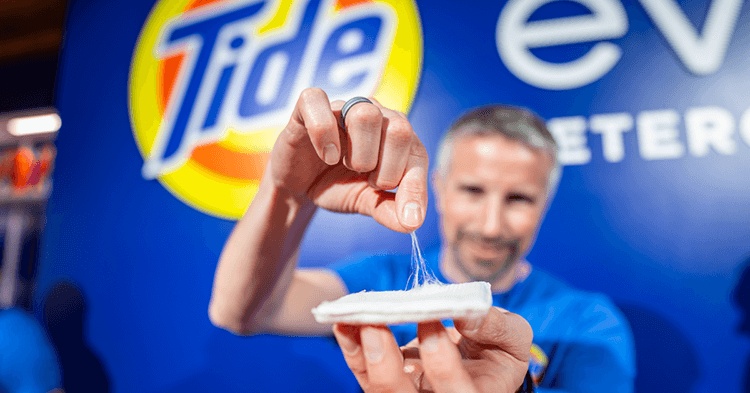
Tide evo gives that system a visibly different product to handle. Introduced at SXSW in 2024, the detergent takes the form of a fiber tile. Tens of thousands of small fibers carry concentrated cleaning ingredients; water activates the product. It uses recyclable paper packaging and is designed for cold-water washing. The apparently simple square arrived after a decade of development.
The tile is a useful antidote to the notion that a familiar household category has run out of things to invent. Changing the form means coordinating research, manufacturing, packaging and the instructions people follow at home. Raman’s job sits across those functions. The square is small; the list of people required to make it work is rather longer.
Even space has a laundry problem
Tide’s NASA collaboration takes the same problem to a location where the nearest washing machine is an unreasonable distance away. Under a Space Act Agreement announced in 2021, the work included Tide Infinity and experiments on cleaning products in space. The practical question was how to clean clothing while using fewer resources under unfamiliar conditions.
Raman has connected that research to laundry on Earth. Work in low-water, low-energy environments could inform products for ordinary households. The point of the experiment was therefore broader than sending a famous label into orbit. Resource constraints become part of the design brief, and the knowledge might travel back with more everyday applications.
His 2026 role as executive sponsor for corporate sustainability brings these concerns into an enterprise-wide remit. In August, he described the need to address water both in making products and in using them. P&G’s stated ambitions include greater facility efficiency, recycling and reuse, and restoration in water-stressed areas. These are commitments with future work attached, rather than evidence that every goal has been achieved.
There is a consistent operating question across the box, the tile and the space experiment: where is the effort being spent? Sometimes it is in moving a heavy package. Sometimes it is in heating water. Sometimes it is the customer’s own Saturday. Each demands a different kind of answer, and each begins with looking beyond the detergent formula.
The door he wants people to knock on
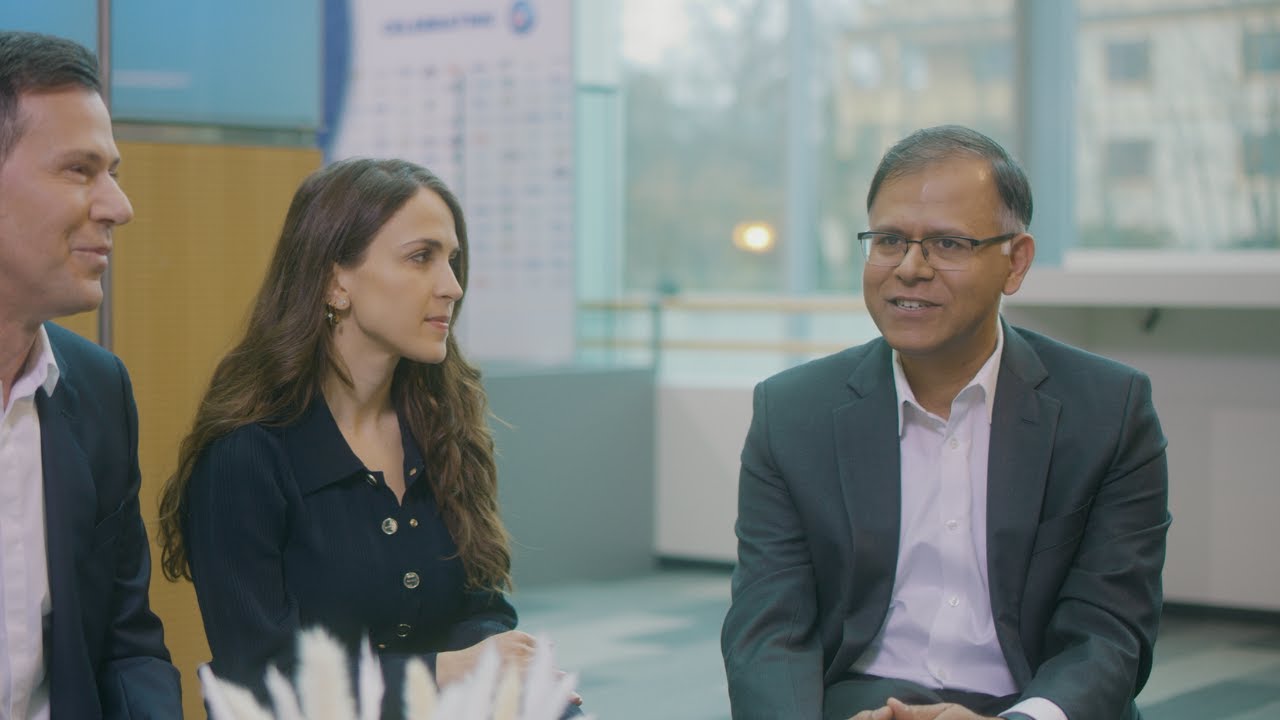
Raman’s advice about careers is less elaborate than the machinery around a product launch. In a 2023 leadership conversation, he put it this way: “I’d rather seek help and succeed.” He encouraged people to approach those who could help, describing opened doors as part of how others had succeeded too. It is practical advice from someone who has spent decades inside one organization.
The conversation also explored mentoring, inclusion and being available to people who need guidance. Those concerns fit a career built by moving between functions. An analyst entering marketing needs colleagues who will explain what the figures leave out. A brand leader taking on operations needs expertise that cannot be supplied by a promotion letter.
His responsibilities outside P&G add other settings for that exchange. He joined the Compass Group board as a non-executive director in January 2022. In April 2026 he became business vice chair of the Council on Competitiveness. Earlier service included Cincinnati’s Findlay Market and the National Underground Railroad Freedom Center. These connections place him in conversations beyond the household-products aisle.
 ▶ WATCH THE CONVERSATION ↗
Raman’s career can be read as a succession of larger titles. The more interesting thread runs through smaller observations: the locker nearer the wardrobe, the cup that fits beneath a tap, the cleaning task somebody would prefer to finish sooner. A person buying detergent has little reason to care about the organization behind it. Raman has made a career of caring about what that person does next.