Joanne Crevoiserat once had a problem with the job she now holds: she wasn’t convinced she was the type. In her mind, a chief executive was charismatic, and usually male. While she was at Abercrombie & Fitch, a mentor challenged that picture. There was no single CEO type. The thought stayed with her. At Tapestry, she would eventually have a chance to test it.
It is a useful place to begin a story about someone who sells first impressions for a living. Coach and Kate Spade New York make things people carry into rooms. Their parent company needs a leader who can think about the person entering the room as carefully as the bag on her shoulder. Crevoiserat’s career offers an argument for looking past the most obvious candidate, including the one in your own imagination.
The department store detour
She grew up in Groton, Connecticut, and entered the University of Connecticut in 1981 intending to study toward a legal career. Business classes changed her direction. She graduated summa cum laude in finance in 1985, then chose a management-training program at Hartford’s G. Fox department store over the banking career she had considered.
“I wasn’t drawn to shopping and fashion particularly,” she recalled. The attraction was the chance to take responsibility quickly. Retail got her attention through its speed: customers wanted something, a business had to respond, and the consequences arrived promptly.
There is something pleasingly unromantic about this beginning. No childhood handbag collection is required to explain it. A young graduate wanted work she could get her hands around, and a department store supplied it. Fashion would come with the job.
A wider education than the balance sheet
Her subsequent posts took her through May Department Stores, Walmart and Kohl’s. At May, she held chief financial officer roles for Filene’s, Foley’s and Famous-Barr. At Kohl’s, her responsibilities included finance and merchandise planning and allocation. In May 2014, she joined Abercrombie & Fitch as CFO; in February 2017, she became its chief operating officer.
The sequence matters because these functions encounter different versions of the same customer. Finance sees the result. Merchandise planning must anticipate it. Operations has to make the promise work in practice. A beautiful product still needs to be available where someone wants to buy it. A promising sales forecast is less delightful when the stock is sitting somewhere else.
Crevoiserat arrived at Tapestry as CFO in August 2019. By July 2020, she was interim CEO. The permanent appointment followed that October, and a seat on the board in November. A career spent widening her responsibilities had reached a job that gathered them together.
- 1985Finance degree
University of Connecticut - 2014CFO
Abercrombie & Fitch - 2019CFO
Tapestry - 2020CEO
Tapestry
The lesson that came home
One of her clearest accounts of learning to lead comes from being a working parent. Before she had children, she looked for women whose lives showed that a career and a family could coexist. Later, the limits on her own time forced a practical change. She could no longer take on every project herself or solve every problem by working additional hours.
In a 2023 essay, she described learning to consider the strengths of individual team members and to change how work was prioritized. She connected that experience to a broader question: who gets to see someone like themselves in a position of authority? That March, she announced the Women of Tapestry Taskforce.
Her account gives delegation a less grand origin than it usually receives in management books. Sometimes the calendar delivers the lesson. The interesting part is whether a manager treats that limit as an inconvenience or uses it to rethink the work. Crevoiserat describes the latter, and a team that became more effective as a result.
Who decides what is cool?
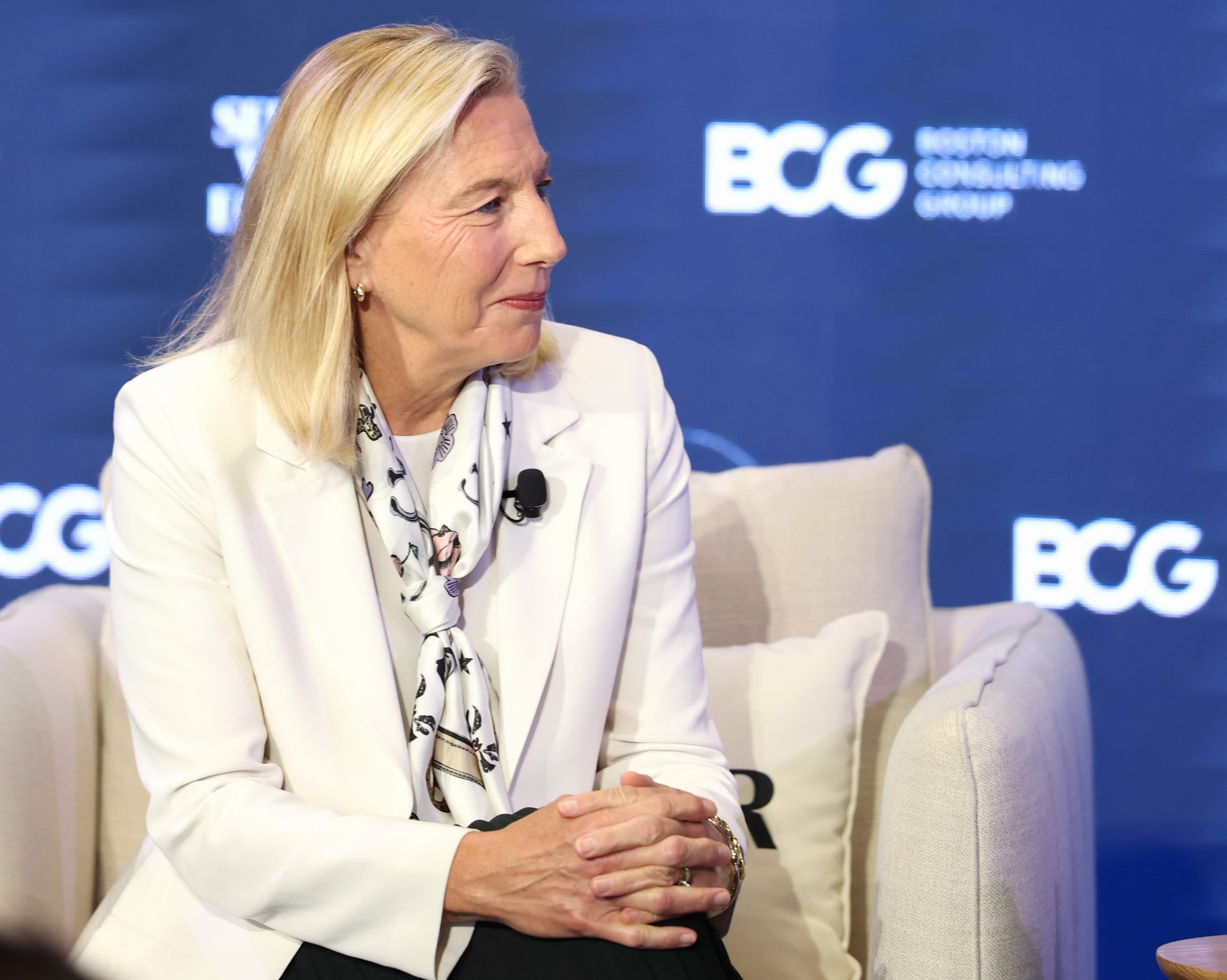
By April 2026, Crevoiserat could joke about a useful limit on executive authority. “Nobody’s asking me what’s cool or what’s fashionable,” she said during an onstage conversation at Semafor World Economy. Tapestry had deliberately focused on younger consumers, whose tastes, she explained, influence other generations too.
The company’s research extends beyond transactions to visits in consumers’ homes. The aim is to understand the circumstances around a purchase, including the tensions in a person’s life. A receipt records a decision after it has happened. It has rather less to say about the person who hesitated, tried something else, or wanted a bag to do a job the seller had never considered.
This is an unusually sensible admission for the head of a fashion business. Being able to authorize a collection does not confer the ability to know what a young customer wants. Crevoiserat’s public explanation puts the work of finding out ahead of the pleasure of being right.
“Nobody’s asking me what’s cool or what’s fashionable.”
Joanne Crevoiserat, April 2026
On the Opening Bid Unfiltered podcast that spring, she discussed the emotional significance of a first luxury purchase. Tapestry’s account of the conversation put self-expression at the center: younger shoppers want a brand to reflect who they are. The company also pointed to the opportunity represented by 25 million women turning 18 each year in its markets.
That figure explains the scale of the ambition, but the unit of persuasion remains one person. A first handbag can accompany a graduation, a new job or simply a decision to spend money on oneself. Those are examples of why the proposition might matter, rather than a claim about every shopper. The business is seeking a place in a customer’s life early enough to be invited back.
Physical shops still have a role in that plan. Crevoiserat’s podcast conversation emphasized younger consumers’ appetite for experiences and community. For a generation readily discussed through screens and shopping data, the store remains somewhere to touch the leather, try the strap and bring a friend’s opinion into the argument.
The deal that did not become the story
Her tenure also includes a very large plan that came apart. In August 2023, Tapestry agreed to acquire Capri Holdings, whose brands included Michael Kors, Versace and Jimmy Choo. The proposed $8.5 billion combination faced an antitrust challenge. In November 2024, the companies terminated their merger agreement.
Then the portfolio became smaller. Tapestry completed the sale of Stuart Weitzman to Caleres on August 4, 2025. Coach and Kate Spade New York remained.
These events complicate any tidy portrait of uninterrupted progress. Strategy can require a willingness to explain what happens after the celebrated transaction fails to happen. Customers still enter stores. Designers still need decisions. A business cannot spend the next season admiring an organizational chart it never got to use. For Crevoiserat, the test moved back to the brands already in the house.
Two brands, a larger assignment
Tapestry introduced its Amplify strategy in 2025 with four areas of focus: emotional connections with consumers; fashion innovation and product quality; experiences that support global growth; and the development of its people. The plan emphasized Gen Z, handbags and leather goods, selective expansion in footwear, and international opportunity, particularly Greater China and Europe.
Read together, those choices suggest an operating question more precise than simply getting bigger. How much more can an existing brand mean to people who have not bought it yet? The distinction makes room for design, distribution and staff development in the same conversation. Each can contribute to a sale; each can also undo the work of the others.
The fiscal 2026 results gave that approach a measurable outcome. Tapestry reported annual revenue of $8.0 billion, up 14% on a reported basis. Coach’s revenue rose 24% as reported. The company said it had achieved the revenue, operating margin and earnings-per-share commitments from its Investor Day two years ahead of plan.
The distinction between the group and the brand matters. Coach’s growth is evidence of momentum at Coach; it does not settle every question facing Kate Spade. Nor do annual results prove that a first-time customer will remain loyal. They do, however, give a finance-trained chief executive something firmer than applause to work with.
A handbag lesson for Detroit
Other companies have taken an interest in her way of thinking. General Motors announced her appointment to its board in August 2022. Mary Barra identified her use of consumer data and experience building loyalty as relevant to GM’s own expansion into new products, services and markets.
Cars and handbags are an entertaining pair of boardroom companions. Both carry a visible brand into public, although only one generally requires a parking space. Barra’s explanation rested on the relationship behind the purchase: understanding people well enough to win them, and then giving them reasons to stay.
In 2024, Barra also wrote Crevoiserat’s TIME100 tribute. The recognition placed her retail work before a wider audience. More revealing than celebrity was the connection itself: a leader in another industry saw a useful skill that could travel beyond accessories.
New tools, familiar questions
By 2026, artificial intelligence had become part of Tapestry’s account of how it works. The company described Mira, its patented decision intelligence layer, built on its Global Data Fabric. Its stated purpose was to make insight available to people making decisions across the business, rather than leaving it with a central specialist team.
“Our greatest competitive advantage will always be our people,” Crevoiserat said. That is a claim the tools will have to earn in practice. Better information is useful when someone can turn it into a better choice: what to stock, how to serve a customer, which idea deserves another look. The relevant question is what the employee can do with it.
In September 2026, she was again talking publicly about understanding consumers and earning loyalty. The vocabulary has expanded since the department store training program. The assignment has a familiar shape. Pay attention to the person making the purchase. Give the team enough room to respond. And let the customer, who has no obligation to be impressed by a CEO, have the deciding vote.
Keep the conversation going
INTERVIEWS, WRITING & FURTHER READING