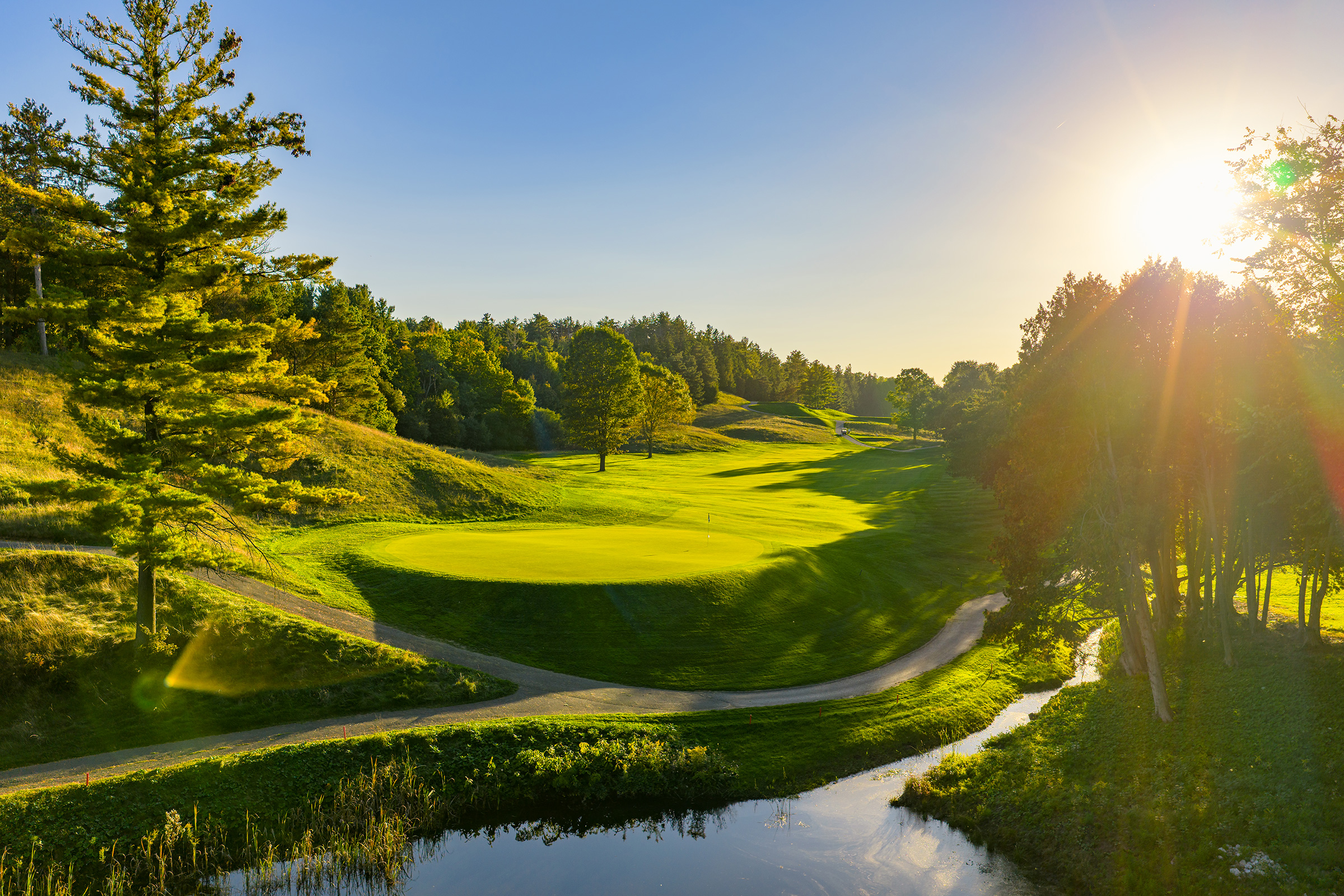
The first hole at Summit Golf Club begins with an elevated tee shot into a valley. The last climbs back out toward the clubhouse. Between them, the land does most of the talking: pitches, folds, secluded corridors and greens that make local knowledge feel like a minor superpower. It is an elegant loop, and also a neat summary of Summit's business. The club sells the pleasure of leaving the city without actually going very far from Toronto. Then it tries to give people a reason not to leave when the round is over.
That second job is why a club founded in 1912 is now living through dust, temporary dining and a multi-phase clubhouse rebuild. The kitchen, dining room, locker rooms, common areas and offices are being remade. Steel for a new addition went up in 2026. Members have been eating from a pop-up kitchen under tented seating while the permanent rooms take shape for the 2027 season.
The project is less a reinvention than a correction. Summit's course had improved faster than the building around it. A member described the ambition plainly: make the clubhouse begin to match the quality of the golf. That is a useful sentence because it contains no mood board language. The product already worked. One touchpoint lagged.
A controlled escape, sold by the year
Summit is a nonprofit, non-equity private club. Its membership is capped at 525 across categories that range from full play and intermediate to junior and learn-to-play. Members pay an initiation fee and annual dues for access to a par-71 course, practice facilities, instruction, events, dining and the quiet confidence that a tee time will not dissolve into a traffic jam.
That cap is more than a scarcity tactic. It is capacity design. The club says it manages numbers to protect tee access, course conditions and atmosphere. Guest play is limited. Non-members may play only with a member and are capped at six rounds in a season. A round is expected to finish in four hours and ten minutes or less, monitored with the Tagmarshal system. In a category where crowding can ruin both the grass and the mood, Summit puts a fence around the promise.
The customers are committed golfers and their families in the Greater Toronto Area. But the problem Summit solves is broader than access to turf. It compresses recreation, practice, dining and friendship into one familiar place. Staff know the conditions. Members know one another. Junior players can enter through a structured program, younger adults through tiered categories, and spouses new to golf through a small learn-to-play group. The club is trying to make belonging legible without making it unlimited.
Golf at the centre. Community all around it.Summit Golf Club
The land is the moat. Repetition makes it deeper.
Summit's closest alternatives are the other private clubs scattered around Toronto, plus premium public courses that ask for less commitment. Clubhouses can be copied. Practice technology can be bought. A mature course routed across the Oak Ridges Moraine, less so.
George Cumming and founding member George S. Lyon laid out the first version. After the First World War, Stanley Thompson was hired to develop the permanent course, which opened in 1921. In later decades, architect and long-time member Doug Carrick rebuilt greens, added championship tees, opened playing corridors and reworked the seventh hole, now called Carrick's Corner. Each layer matters because Summit does not present as a frozen museum piece. It is old terrain receiving periodic software updates.
The layout's defense is not length alone. Sloping greens, elevation changes and uneven lies reward players who return often enough to learn where the friendly miss lives. That makes repeated use more valuable, which is exactly what a membership business wants. A first round can be scenic. A fiftieth can still be revealing.
Winter found the weak spot
The club's most instructive modernization did not begin in the dining room. It began when winter exposed the greens. A turf-management field report from 2015 described recurring ice damage and poor surface drainage, with severe losses in bad years. The response was blunt: reconstruct 14 of 18 greens, improve the way meltwater escaped and replace vulnerable turf with bent grass better suited to the conditions.
The immediate cost was disruption. Temporary greens meant members were paying for an experience under repair. The financial figure was not part of the public account, but the operational bet was obvious: accept a worse season to remove a recurring failure. The decision became possible because the greens team had the confidence of management, the greens committee and members. Their minds did not change because of a slogan. They changed because the same winter problem kept returning and the proposed remedy was specific.
Ice, drainage, repetition
Winter damage was not a one-off inconvenience. It threatened the surface members touched on every hole.
Fourteen rebuilt greens
Summit traded short-term playability for drainage, turf resilience and a more consistent long-term course.
The club says its SCOREGolf position rose from 80th to 32nd within four years. Rankings wobble with panels and competition, and Summit sits at No. 52 in the 2026 list. Still, the direction after the rebuild was meaningful. The work fixed the product members felt underfoot and improved the way outsiders talked about it.
Preserve the memory, move the staircase
The current clubhouse project applies the same logic to hospitality. The building traces back to architect Eden Smith and was completed in 1920 after wartime delays. Summit spent six years on planning, consultation and design before construction became visible. Dalton, the project and construction manager, worked with Hossack Associates Architects on a master plan that weighed modern operations against the building's historical character.
By late 2025, slope-stability work for the addition was complete, interior demolition was underway and the old main staircase was coming out. In June 2026, steel beams and precast floor panels formed the skeleton of an addition for a new commercial kitchen and reinstated men's locker room. Work inside continued through dining, women's lockers, common areas and administration space.
This is what Summit did, in sequence: define the operating gaps, plan the property as a whole, phase the build, keep a version of hospitality alive during construction and give members visible milestones. The makeshift kitchen and tent are not charming in themselves. They are proof that continuity is part of the design brief.
Summit's renovation thesis in five words: the experience does not end on 18.
The model works because the course remains the anchor. Dining, retail, lessons and events deepen the relationship, but they do not have to manufacture demand from scratch. A golfer arrives for a round and stays for lunch. A junior lesson brings a family back. A simulator makes the relationship less seasonal. The clubhouse turns a four-hour activity into a day and a summer habit into a year-round community.
Copy the order, not the acreage
Most readers cannot acquire 258.9 acres, commission a Stanley Thompson course or wait a century for mature trees. The portable ideas are operational.
First, protect capacity. Summit's 525-member ceiling, guest restrictions and pace rule keep the core promise from being consumed by its own popularity. A gym can cap peak-hour plans. A community can limit cohort size. A restaurant can stop taking reservations before service becomes apology.
Second, fix the recurring failure before polishing the lounge. Summit rebuilt greens when winter damage threatened the golf itself. Reputation improved after the experience did. The order matters.
Third, preserve a signature while updating the support system. Carrick's course work respected the routing while improving agronomy and playability. The clubhouse plan keeps the historic character while changing the kitchen, circulation and gathering spaces. Customers rarely want everything old or everything new. They want the memorable part untouched and the annoying part gone.
Fourth, make disruption tangible. Temporary service, construction photos and milestones give members evidence that inconvenience has an endpoint. Silence turns dust into doubt.
There are conditions where this playbook fails. Scarcity becomes exclusion when the underlying experience is ordinary. Heritage becomes costume when every operational problem is protected as tradition. A long renovation loses goodwill if interim service is weak, milestones slip without explanation or members do not trust the people making tradeoffs. And a community product falls apart when growth is the only score anyone watches.
Summit's advantage is not that it has solved permanence. No golf course has. Turf changes, buildings tire and expectations move. Its advantage is a willingness to edit: fourteen greens when winter won too often, a clubhouse when the social half of the day fell behind, a cap when more members would weaken access. The result is a company that behaves less like a monument and more like a good course - keep the routing, study the lie and choose the next shot.