Before Chris Meyer had an agency to run, he had guests to look after. Restaurants, a hospitality degree, a management training program at Westin: his route into advertising began with people who had arrived somewhere and expected things to work. A hotel guest is a demanding introduction to business. The presentation may be lovely. Someone still needs the room key.
Today Meyer is CEO and a board member of Project Worldwide, an employee-owned alliance of creative agencies. His professional vocabulary has expanded to include integrated marketing, digital experiences and artificial intelligence. Yet the thread running through his career remains remarkably practical: how do you bring people together, understand what they need and make the encounter worth their time?
It is a useful question for an industry whose products can be skipped, muted or scrolled past. Meyer came to it through service. His current job gives him a much larger room.
A business degree with guests attached
Meyer grew up working in restaurants and studied at Cornell’s School of Hotel Administration. He described the appeal of that education as “a business degree with an emphasis on service.” After graduating, he entered Westin’s management training program and moved into convention services. Clients eventually asked him to manage their events personally, and he launched a conference management company in Silicon Valley.
The distinction matters. His entry into marketing came through an existing relationship with a customer. There was a request, then a business. Conference Planners became part of George P. Johnson in 2000, bringing Meyer into an agency with a history considerably longer than his own.
His Cornell years, from 1983 to 1987, also included Sigma Nu and sprint football. Later, he would serve on Meeting Professionals International’s international board from 2021 through 2024. There is a consistent interest here in the institutions that surround a gathering: the school, the professional association, the network of colleagues. An event needs more than a venue to have a life beyond its closing session.
The detour that widened the stage
Meyer spent more than a decade at GPJ before his return as CEO was announced on October 21, 2013. In between, he worked at INXPO, an online event content distribution and communications platform. His role there was executive vice president of enterprise business development. He had previously been GPJ’s senior vice president of client services and general manager of its Silicon Valley office.
That sequence placed him on both sides of a changing definition of an event. One side involved physical places and the teams that build them. The other distributed content online. By the time he returned, the agency’s announcement explicitly linked his digital background to its plans for experience-driven marketing. Denise Wong became president alongside him; Meyer would work from San Carlos, California.
The career move offers a less tidy, more useful version of professional progress. Leaving a company can be part of learning how to lead it. In Meyer’s case, an interval in software sat between two chapters at a business known for bringing brands into physical space.
A century-old company, still making things
GPJ’s centennial arrived soon after Meyer became CEO. The company had begun as a Michigan sail-maker in 1914, then moved into automotive marketing and later technology accounts. For its 2014 celebration, employees past and present gathered at Auburn Hills, where a crane raised a 160-by-90-foot flag. An anniversary speech is one thing. An anniversary requiring lifting equipment has rather more commitment.
That history gives Meyer’s work a material dimension. Experiences are designed, but they are also constructed. An ambitious idea needs people who can make it stand up, move an audience through it and pack it away afterward. GPJ’s evolution offers a reminder that creative services can carry the accumulated knowledge of a workshop.
In 2014 the agency launched GPJ Sports Marketing, with Kevin Bartram and Jon Hickey leading the practice. Its existing work included Under Armour’s House of Innovation around Super Bowl XLVIII, the Pepsi Fan Deck at Levi’s Stadium and Lexus at the US Open. The practice joined strategy, design, fabrication and on-site management. For Meyer, the gathering was becoming a broader marketing instrument while retaining its very real nuts and bolts.
The useful part of the coffee break
In 2016 GPJ partnered with the EG conference in Carmel-by-the-Sea. The gathering brought together people from fields including science, music, design and technology. With roughly 500 attendees and 50 presenters, the assignment involved creating a five-senses experience and helping participants interact across the Sunset Center.
The networking breaks were part of the brief. That is a pleasingly modest place to locate a serious idea: between the programmed moments, people can find one another. The conference’s scale also made intimacy part of its design. An experience can be carefully produced without making every useful exchange feel scheduled.
Two years later, Meyer moderated a conversation about the future of experiential marketing at sister agency Argonaut’s San Francisco offices. His framing emphasized human connection and technology as a tool made for people. The setting itself brought Project colleagues and clients together. It was an industry discussion conducted in the medium under discussion.
India, and the arithmetic of working together
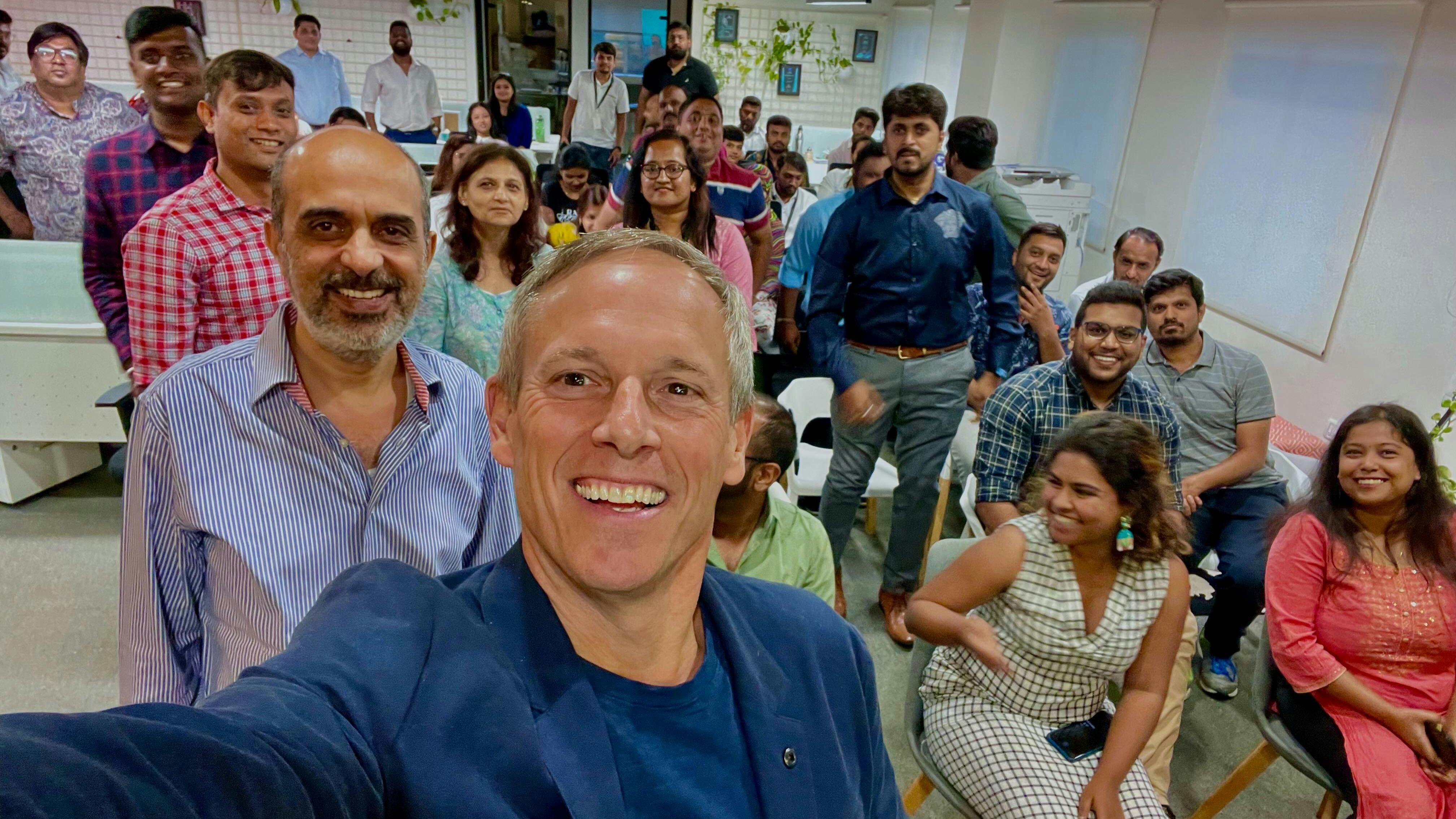
When GPJ marked 20 years in India, Meyer spoke about the team’s continuity. Its leadership had largely been there from the beginning, he said. India served local and global clients and supported work in other regions, including the Middle East and Africa. His account put the emphasis on ideas and execution that delivered business value, extending the team’s contribution beyond event production.
Asked about clients building their own capabilities, he treated in-house teams as an ordinary part of the working relationship. Strong results, in his view, came from blending internal and external agency services. It is an approach that leaves room for the client’s expertise rather than treating it as an obstacle.
The same conversation addressed an obvious tension inside an agency network: competing for work while promising to cooperate. Meyer said GPJ’s sister agencies collaborated rather than competed, and estimated that 70-75% of GPJ projects involved at least one other Project agency. That figure describes his assessment at the time of the interview, published in January 2023. It makes collaboration a feature of everyday delivery, rather than merely a line on an organizational chart.
Of GPJ projects involved at least one sister agency, according to Meyer’s January 2023 interview.
A long relationship still needs a new idea
By September 2024, GPJ’s relationship with Jeep had lasted 87 years. Its work with IBM, Salesforce and Workday also spanned substantial periods. These relationships predated any single chief executive. Meyer’s task included preserving their value while giving clients reasons to keep choosing the agency.
His explanation centered on integrity, innovation and service, with teams working closely enough that the boundary between agency and client became less obvious. Loyalty, in that account, involves continued usefulness. A long contract carries history; it still needs people who can respond to the present.
He also described events becoming studios for content that could travel through social media and other marketing channels. An audience in a venue and an audience watching elsewhere could both matter. His earlier work at an online event platform makes that observation especially relevant to his career: he had already spent time with the machinery that lets an experience leave the room.
The handover, then the larger assignment
In May 2025, GPJ announced Fiona Bruder as global CEO, with the leadership changes effective May 1. Meyer had led the agency for 12 years and was moving into the wider Project role. He would support the transition as GPJ’s strategic executive advisor. Bruder had previously led the Americas operation and worked alongside him on client partnerships and the agency’s evolving experiential capabilities.
The transition moved his attention from leading one agency to supporting a collection of them. Project’s current description spans 42 markets and 2,300 teammates. Advertising, communications, entertainment and digital work sit alongside experiential expertise. The opportunity is broad; the coordination problem is equally real.
In July 2026, Project elevated Edward Scott to president, shifted Matt Statman to global chief creative officer and added chief growth officer responsibilities to OS Studios CEO John Higgins. Meyer’s public explanation focused on giving clients access to the network’s people and capabilities while preserving its founder-led culture. Independence creates value when specialists can work together without losing the judgment that made them useful in the first place.
“Everything we do starts with where our clients need us to be.”Chris Meyer, on Project’s operating model
The room gets a beachside address
In August 2026, Project announced a Delray Beach creative hub scheduled to open that fall. The proposed space would host executive meetings, workshops and innovation sessions, connecting agency teams with clients and partners. The announcement described 45 other office locations around the world.
Meyer linked the investment to people and businesses establishing roots in South Florida. His description of a beachside boardroom gives the idea an appealing address, but the purpose is familiar: put different skills within reach of one another. The furniture has changed since his hotel years. The work still involves making a meeting worthwhile.
There is room for a life outside those meetings, too. In a 2014 Cornell alumni update, Meyer described family adventures that included ziplining among redwoods, surfing lessons in Santa Cruz and visiting a Hollywood set. He and his wife, Tracey, were also hosting a Swedish exchange student alongside their two children. For someone professionally occupied with experiences, the family calendar seems to have supplied its own fieldwork.
The connection should not be made too grand. A surfing lesson does not explain an agency strategy. It does, however, bring an executive back to the ordinary position of being a participant: arriving, trying something unfamiliar and relying on somebody else to make it work. Meyer’s career began with attention to that person. His next chapter gives him many more colleagues with whom to practice it.
Continue the conversation
- Project Worldwide
- Chris Meyer on LinkedIn
- The hospitality origin interview
- The 2013 GPJ appointment
- The future of experiential, part one
- The future of experiential, part two
- Meyer on client relationships
- The 2026 leadership conversation
- The Delray Beach announcement
- Project NEXT podcast
- Melt interview video post