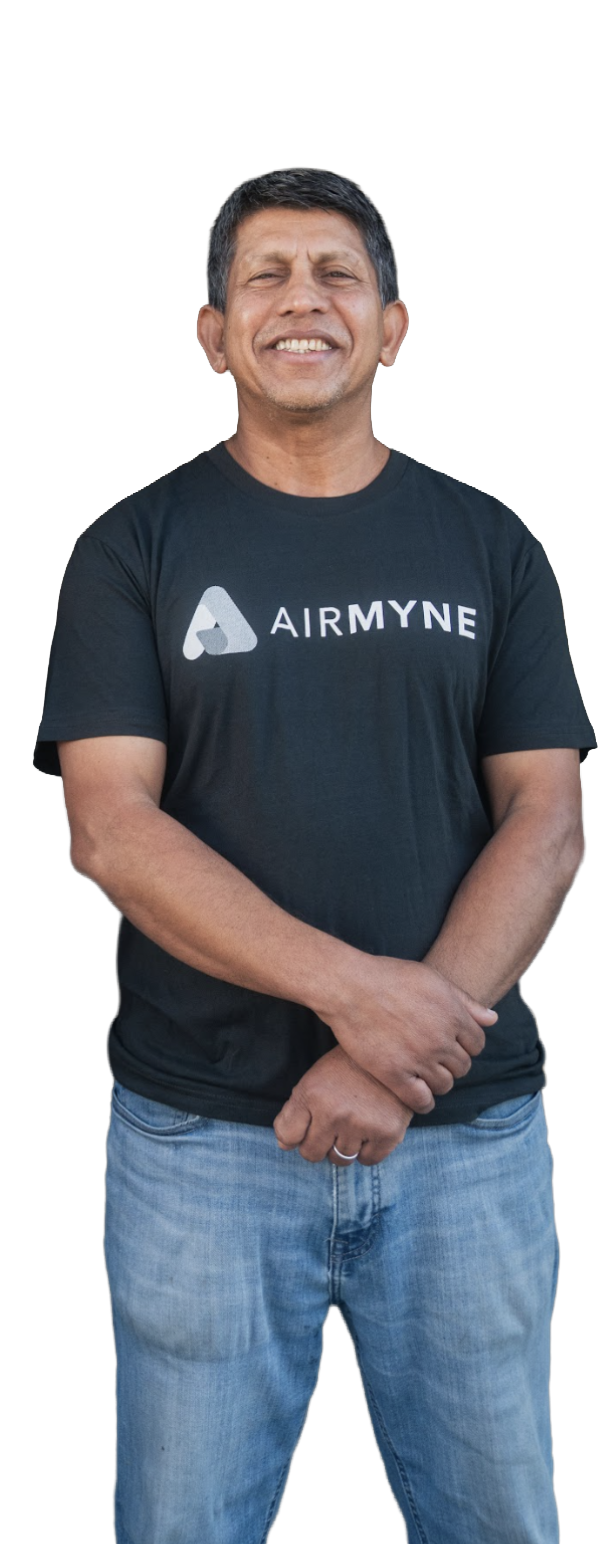
He spent a career making chemistry ship by the million. His next product is a cleaner atmosphere.
Most days, Sudip Mukhopadhyay is thinking about air. Specifically, the roughly 420 parts per million of carbon dioxide floating in every breath of it, and how to grab a few tons at a time without spending a fortune on heat. As CEO and co-founder of AirMyne, the Berkeley company he started in 2022, his job is to turn a chemistry-class reaction into industrial machinery that works in the rain, on a schedule, at a price someone will actually pay.
The approach is almost stubbornly plain. Fans draw outside air into a contactor. A proprietary liquid binds with the CO2. The CO2-rich mixture moves to a stripping column, where low-pressure steam coaxes the gas back out as a high-purity stream, ready to be stored underground or put to use. No exotic wonder-material. No moonshot physics. Just a reaction that scales, run on heat cheap enough to make the math close.
That last part is the whole game. Direct Air Capture has long been the climate world's expensive darling, technically real, financially brutal. AirMyne's wager is that if you design the chemistry around low-temperature heat, including geothermal and industrial waste steam, you change the economics instead of the laws of physics.
AirMyne builds liquid-solvent Direct Air Capture machines that remove CO2 straight from ambient air, for storage or reuse downstream. Mukhopadhyay's bet: cheap heat, not exotic materials, is what makes carbon removal scale.
Before climate, he co-invented a refrigerant now used in cars worldwide and spent 16 years at Honeywell turning lab ideas into mass-produced product. He has done the hard part - scale-up - before.
*Energy-requirement reduction reported by AirMyne for its DAC process.
Long before AirMyne, there was a molecule called 1234yf. If you have driven a car built in the last decade, its air conditioner probably runs on it. Mukhopadhyay was one of its co-inventors at Honeywell - a refrigerant engineered to keep cabins cold without the planet-warming punch of the chemicals it replaced. It was, in a sense, his first climate product. He just did not call it that yet.
He joined Honeywell in 2003 and stayed roughly 16 years, rising from engineer to corporate fellow to director of innovation. Along the way he developed and commercialized products across an unlikely spread of industries: solar, semiconductors, displays, quantum-dot TVs, natural-gas-to-liquid conversion. He was a founding member of Honeywell's drone and air-taxi efforts. The common thread was never a single field. It was the same discipline applied over and over - take a reaction that works on a bench and make it work by the millions.
His training reads like a passport. He studied engineering in India, did research in Israel - his doctoral-era work traces to the catalysis lab of Professor Yoel Sasson at the Hebrew University of Jerusalem - and landed at the University of California, Berkeley. He later advised deep-tech startups as a Deep Technology Innovation Advisor with Business Finland, working with founders trying to do exactly what he would soon do himself.
India for the foundations. Israel for the catalysis. Berkeley for the launchpad. Mukhopadhyay's engineering education spans three continents - and his wife is a Hebrew University alumna, a souvenir from the Jerusalem years.
His name sits on a long list of US patents - fluorochemicals, semiconductors, photovoltaics, and now carbon capture. AirMyne alone reports three granted patents on its DAC process.
Direct Air Capture remains the gold standard when it comes to a measurable carbon removal solution.
Fans pull ambient air into a contactor, where a proprietary liquid chemistry reaches out and binds with the CO2 molecules drifting through.
The CO2-rich liquid moves to a stripping column. Low-pressure steam - the kind you can get cheaply from geothermal or waste heat - drives the carbon back out.
Out comes a high-purity CO2 stream, ready to be locked underground or turned into something useful. The liquid cycles back to breathe again.
The expensive part of Direct Air Capture is not catching the carbon - it is letting it go. Releasing CO2 from a sorbent usually demands a lot of high-temperature energy. AirMyne's design flips the requirement toward low-temperature heat, the kind you can scavenge from geothermal wells or factory exhaust. The illustration below is a simplified read on where the leverage sits.
It is why AirMyne partnered with Fervo Energy to tap advanced geothermal in Utah, and why co-founder Mark Cyffka frames flexibility as the point: pilot plants can run on electricity, industrial waste heat, or geothermal, whatever is cheapest nearby.
Conceptual comparison of heat-source attractiveness for solvent regeneration, based on AirMyne's stated low-temperature approach. Not measured values.
We are honored to welcome ENEOS as a strategic industrial partner. AirMyne is building a world-class DAC technology, and this close collaboration strengthens our ability to accelerate cost reduction and commercial deployment.
$6.9M seed (about $7M total) from Alumni Ventures, Liquid 2 Ventures, Impact Science Ventures, Collaborative Fund and others - plus a strategic stake from ENEOS, parent of Japan's largest energy firm.
A partnership with Fervo Energy to pair DAC with advanced geothermal in Utah, turning underground warmth into the engine that releases captured carbon.
Selection in two US Department of Energy DAC Hubs, California Energy Commission funding, and collaborations with CarbonBuilt and Rubi Laboratories.
Pragmatic to a fault: he reaches for proven chemistry that scales, not the flashiest molecule in the room.
A commercializer, not just an inventor. The career theme is the same line repeated - bench to mass production.
Cross-disciplinary by habit, having jumped from refrigerants to displays to drones to carbon capture.
Mission-shaped now. The skill set that cooled cars is pointed at cooling the planet.
Remove millions of tons of CO2 from the sky - by making carbon capture cheap, modular and boring enough to deploy everywhere.