The Story
The Kid Who Made Every Programmer's Fingers Itch to Switch Editors
When Sualeh Asif's colleagues at MIT placed a bet in 2022 that AI would win a gold medal at the International Mathematical Olympiad, Asif thought they were delusional. This is the same Asif who had represented Pakistan at the IMO three times - who knew exactly how hard those problems were, what it took to crack them, how human the struggle felt. He was very wrong. By the time AI cracked the IMO, Asif was already building the tool that proved his instincts right in a different direction: that the most transformative thing you could do with AI wasn't replace programmers, it was make them unrecognizable to their past selves.
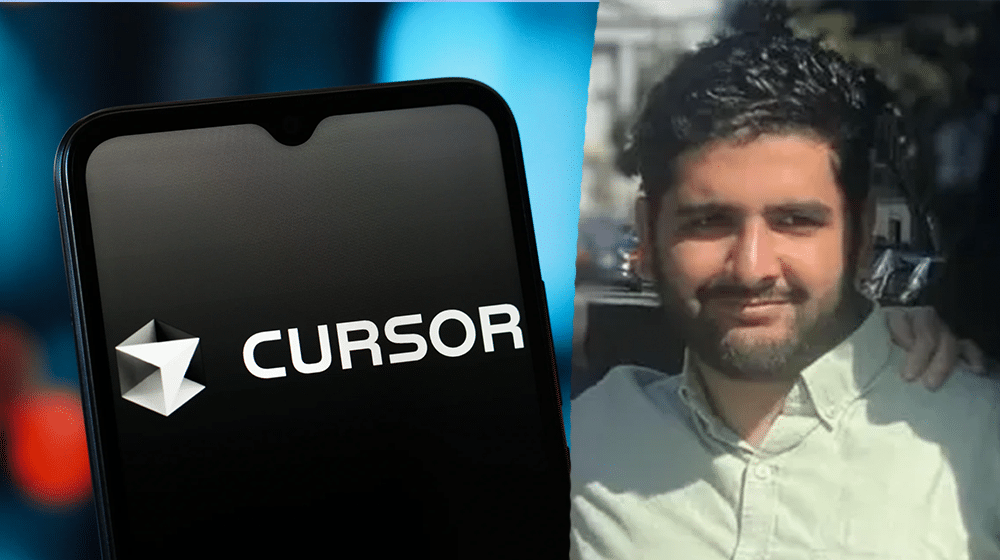
That tool is Cursor. And Cursor is now used by engineers at Nvidia, Adobe, Uber, Shopify, and 49,996 other companies who discovered what it felt like to stop tabbing between their editor and a chat window. It crossed $2 billion in annual recurring revenue in February 2026 - a number no B2B company had reached from zero in under three years. The company behind it, Anysphere, is valued at $29.3 billion after a $2.3 billion Series D. xAI has tabled a $60 billion acquisition option. And Sualeh Asif, CPO and co-founder, is 26 years old.
He is not the loudest person in the room. He barely has a public profile. His personal website lists three academic papers and a line about "hybrid human-AI engineering productivity." His GitHub bio says: "I'm currently building cursor at Anysphere." No mission statement. No thought leadership thread. Just the product.
We're making it for ourselves. You really felt this frustration that models - you could see models getting better, but the Copilot experience had not changed.
Sualeh Asif - Lex Fridman Podcast #447
This is the detail that matters: Cursor wasn't built for a market, it was built for a feeling. The feeling of watching AI get smarter and your editor staying the same. The four MIT co-founders - Asif, Michael Truell, Aman Sanger, and Arvid Lunnemark - were frustrated practitioners before they were founders. They built what they needed. The market just happened to need the same thing, at scale, immediately.
Cursor ARR Growth - Fastest B2B Ramp in History
Origins
Karachi, Math Camp, MIT - and the Slowest Possible Route to a $29B Company
Sualeh Asif was born January 24, 2000, in Karachi, Pakistan, into a middle-class family. He attended Nixor College - one of Karachi's competitive A-level institutions - where he developed the kind of mathematical instinct that gets you onto national olympiad teams. From 2016 to 2018, he represented Pakistan at the International Mathematical Olympiad, picking up honorable mentions at the Asian Pacific Mathematical Olympiad in 2017 and 2018.
But he wasn't just competing. He was teaching. During his high school years, Asif worked at Pakistani math camps, mentoring younger students in competitive mathematics. This is an easy detail to skip over, but it tells you something: the impulse to build tools for other people, to make hard things more accessible, was there before the company, before MIT, before the funding rounds. He wasn't just solving problems - he was thinking about how other people solve problems.
Anecdote
At MIT, Asif studied machine learning, number theory, performance engineering - and theater. The theater part is not incidental. Cursor's product philosophy is obsessive about feel: how a diff renders, whether a suggestion arrives at the right psychological moment, whether the interaction creates friction or dissolves it. That intuition didn't come from an ML paper.
MIT gave him the technical scaffolding and the collaborators. He published research on graph algorithms, helped prove that Tetris is NP-Hard even with O(1) columns (a 2019 paper that is exactly as niche and brilliant as it sounds), and contributed early work to Metaphor Systems - an LLM-powered search engine that was doing interesting things before anyone used "AI-native" unironically. He interned at IBM Watson, working on language translation.
By 2022, he and three classmates had a clearer diagnosis than most: AI models were improving on a predictable curve, but developer tooling wasn't keeping pace. The gap was the product. Anysphere was incorporated that year. Cursor launched in 2023. The seed round - $8 million from the OpenAI Startup Fund, with former GitHub CEO Nat Friedman among the angels - arrived with the timing of something whose category had already been decided.
A colleague bets that AI will win an IMO gold medal. Sualeh Asif, three-time IMO participant, person who has stared at those problems for years, calls it delusional. AI wins the IMO by 2024. Asif later describes being "very wrong" about the prediction. The lesson he took was not that AI is magic - it was that the gap between where AI was and where developer tools assumed AI was had become a product opportunity the size of the entire software industry.
♦ ♦ ♦
The Product
A VS Code Fork That Made VS Code Feel Like a Fax Machine
Cursor is built on Visual Studio Code - the same editor hundreds of millions of developers already use, already know the shortcuts for, already have their plugins in. The Anysphere team's bet was that starting from that foundation and adding AI natively, deeply, architecturally, would be more powerful than starting from scratch. They were right. Within months of launch, developers who tried Cursor began describing their old workflow the way people describe dial-up internet: technically functional, but hard to return to.
The product is not a chat window bolted onto an editor. It is an editor rebuilt around the premise that AI will be in every interaction - code generation, smart rewrites, codebase-wide queries, the "Tab" feature that predicts your next edit after you've already expressed your intent. That last one is the one that feels like a magic trick. Asif described it on the Lex Fridman podcast as "zero-entropy edits" - moments where, once you've expressed your intent, there's no new information needed to complete the thought. The AI finishes the sentence you were already writing.
Build the tool that builds all the world's software.
Sualeh Asif - on Cursor's mission
The product found its market through product-led growth, with zero marketing budget initially. Engineers told other engineers. GitHub stars accrued. Enterprises started paying. By August 2025, the company had roughly 150 employees. By the time the $2.3 billion Series D closed in November 2025, those engineers were serving millions of individual developers and more than 50,000 companies.
The Diff Problem
One of the underappreciated product challenges Asif has described publicly: how to show AI-generated changes in a way that feels intuitive. The team tried Google Docs-style strikethrough. They tried blue highlights. Everything felt off. "It's just not intuitive," Asif said. "I think that's the key thing." They iterated until the feel was right. This is a small detail with a large implication: the team's standard for "right" wasn't "functional" or "technically correct" - it was whether a developer, in the middle of a flow state, would find it jarring. That standard is expensive to maintain. It is also why Cursor doesn't feel like a feature.
Cursor by the Numbers (2026)
- $2B+ ARR - fastest B2B company to reach this milestone
- $29.3B company valuation (Series D, November 2025)
- $60B acquisition option from xAI/SpaceX (April 2026)
- 50,000+ enterprise customers including Nvidia, Adobe, Uber, Shopify
- Millions of individual developer users globally
- Investors: OpenAI Startup Fund, a16z, Thrive Capital, Accel, Coatue, NVIDIA, Google
- ~300 employees as of 2025
Anysphere Funding History
Jul 2024
$60M
Series A — $400M val.
Jun 2025
$900M
Series C — $9.9B val.
Nov 2025
$2.3B
Series D — $29.3B val.
The Person
Quiet, Technical, Wrong About One Thing
There is a certain type of builder who becomes famous for talking about building. Asif is not that type. His Twitter account (@sualehasif996) exists. It is sparse. His personal website, sualehasif.me, has his research papers, a photograph of someone staring at the sky, and a short note about the joy he takes from his work and his friends. There is no newsletter. No podcast of his own. No "my hot takes on AI" section.
What the public record suggests instead is someone who thinks carefully, iterates obsessively, and calibrates quickly when wrong. The IMO prediction is a useful data point not because it shows overconfidence, but because of what came after: he updated his model. He didn't dig in. He changed his mind and kept building.
From the Research Papers
In 2019, Asif co-authored "Tetris is NP-Hard Even with O(1) Columns." In 2020, he published on arithmetic expression construction. In 2021, he published in Mathematics of Computation. These are not the papers of someone building a brand - they are the papers of someone who finds problems genuinely interesting and wants to figure them out. The career arc from "proving Tetris is computationally intractable" to "building the most-used AI code editor" is the same arc: find the hard thing, characterize it exactly, build something useful around the insight.
The Pakistan thread matters to him. In a fireside chat at Stanford, he said: "Pakistan has the talent. What we lack is the infrastructure to retain it." For Umar Saif, Pakistan's former IT Minister, Asif's success is itself a data point worth citing: "Finally, the kind of role models Pakistani youth needs... a self-made kid from a middle-class family in Karachi... worth over $1 billion at age 26."
He was 22 when he co-founded the company. He is 26 when the acquisition options arrive. The math is remarkable only if you forget the decade of actual work that ran underneath it - the math camps, the olympiads, the research papers, the MIT labs, the early contributor credit at an LLM-powered search engine nobody outside the industry knows the name of. The "overnight success" is a thirteen-year project with a very short last chapter.
♟
Tetris is NP-Hard
He co-authored a paper proving Tetris is computationally intractable - even with a tiny board. Fitting hobby for someone automating boring code.
🇳🇰
Three IMO Appearances
Represented Pakistan at the International Mathematical Olympiad from 2016 to 2018. He taught the next generation at Pakistani math camps while still competing.
🏭
Studied Theater at MIT
Alongside ML and number theory. Cursor's obsessive attention to product feel - that nothing should jar a developer's flow - may owe more to this than any ML paper.
⚡
YOLO Badge on GitHub
GitHub's "YOLO" badge is awarded for merging a pull request without code review. He has earned it. The CPO of a $29B company, shipping with confidence.
What's Next
The Tool That Builds the Tool That Builds Everything
The $60 billion figure from the xAI/SpaceX deal announced in April 2026 is attention-grabbing. But the more interesting number might be the one Asif stated as a mission, not a metric: "Build the tool that builds all the world's software." That sentence is either hubris or a research agenda, depending on how charitably you read it. Given what Cursor has done in three years, the research agenda reading is harder to dismiss.
The question for Cursor is what "AI-native development" looks like when the AI gets two more generations better. Asif's answer - built into the product's architecture - is that the editor should be the place where that improvement compounds directly for developers. Not a tool you use alongside your editor. The editor itself, rebuilt from the assumption that the AI is already in the room.
What he's described wanting is not a product, exactly. It's a category. A new baseline for what a developer environment is. Given that he and three classmates built the current baseline-challenger from a dorm-adjacent office while finishing degrees, the aspiration is at least consistent with the track record.
Pakistan has the talent. What we lack is the infrastructure to retain it.
Sualeh Asif - Stanford Fireside Chat
He lives in San Francisco now. He maintains a low public profile by the standards of anyone running a product at a company with a $29 billion valuation. He is, by most accounts, exactly the kind of person he was in Karachi at 16 - someone who finds hard problems interesting, works carefully, and occasionally makes confident predictions he later revises. The difference is that now, when he revises a prediction, he's usually already shipped the thing that made it obsolete.
Career Timeline
The Chronology
2016-18
IMO & Math Camps. Represented Pakistan at the International Mathematical Olympiad three times. Taught at Pakistani math camps during high school. Honorable mentions at Asian Pacific MO (2017, 2018).
2018-22
MIT. Bachelor of Science in Mathematics and Computer Science. Studied ML, number theory, performance engineering - and theater. Interned at IBM Watson ML on language translation systems.
2019
Research. "Tetris is NP-Hard Even with O(1) Columns" published at JCDCG³ Conference. First major academic publication.
2020-21
More Research. Published "Arithmetic Expression Construction" (ISAAC 2020) and "Computing L-Polynomials of Picard Curves" in Mathematics of Computation (2021).
2022
Anysphere Founded. Co-founded with Michael Truell, Aman Sanger, and Arvid Lunnemark. Early contributor to Metaphor Systems (LLM-powered search). Bet placed that AI would win IMO - Asif's verdict: delusional.
2023
Cursor Launches. AI-powered code editor ships. $8M seed round from OpenAI Startup Fund with Nat Friedman among angels. Zero marketing budget, word-of-mouth growth begins.
2024
Series A & Lex Fridman. $60M Series A at $400M valuation (July). Appears on Lex Fridman Podcast #447: "Future of Programming with AI." AI wins IMO. Asif updates his model.
2025
Hypergrowth. $900M Series C at $9.9B (June). $2.3B Series D at $29.3B (November). ARR rockets from $100M to $1B+ in 10 months. ~300 employees.
2026
Forbes Billionaire. Cursor hits $2B ARR (February). Forbes lists Asif at $1.3B net worth, rank #2,919 (April). xAI/SpaceX announces $60B acquisition option. Age: 26.