Steve Winn wanted tax software. What came along with it was a little landlord business called Little Buddy. In 1995, while expanding Computer Language Research, he bought a tax-software operation from Simon & Schuster and had to take the sideline too. It was the corporate equivalent of buying a wardrobe and discovering that someone had left a tenant inside.
“I was forced to buy it,” Winn recalled. “I didn’t intend to keep it.” He reconsidered. Real estate lacked a dominant software supplier; here was a modest product attached to a much larger opportunity. After the family sold Computer Language Research to Thomson in 1998, he bought the property-software business back for $10 million and founded RealPage. An unwanted passenger had acquired the steering wheel.
Winn had grown up in Dallas and trained as an electrical engineer at the University of Texas at Austin. His first professional world was his father Francis Winn’s accounting-software company. He eventually became its chief executive. Stanford added a master’s degree to his education. The sequence matters: long before apartments entered the picture, he knew the business of turning complicated administrative work into something a computer could repeat.
Tax compliance and apartment management have an obvious quality in common. Their customers cannot simply decide to stop doing them. Software in these fields has to earn its place through everyday use, in books that balance and work that gets finished. Winn’s career developed around those obligations. Glamour could make its own arrangements.
A landlord’s desk, moved online
RealPage dates its founding to the 1998 acquisition of Rent Roll, a supplier of software installed at rental-property businesses. Three years later came its first on-demand property-management product. Instead of maintaining separate software installations, customers could use applications delivered over the internet. Winn was building a business around the browser while much of the work still lived on somebody’s office computer.
By 2004, the company was describing three product families: OneSite for property operations, CrossFire for marketing and YieldStar for asset optimization. The names suggested separate departments. The architecture pulled them toward a common store of information. A leasing inquiry, a resident’s account and the financial performance of a building could be understood as parts of the same operation.
Winn could sound unusually sympathetic about the person expected to keep that operation moving. In a 2009 interview, he described a property manager earning $40,000 to $50,000 while running a $20 million asset. Leasing, collecting rent, keeping books, paying bills and making marketing decisions all landed on the same desk. Software, in his telling, ought to make the workload manageable for an ordinary human being.
He also identified integration as the difficult part. Separate tools could handle separate jobs; making them work together in real time, and changing the organization around them, was harder. That distinction gives his story some texture. The founder’s challenge extended beyond finding another feature to sell. Every addition had to connect to the resident ledger and to people already busy doing their jobs.
One property. Many moving parts.
The bell rings. The work continues.
RealPage began trading on Nasdaq on August 12, 2010. An initial price of $11 a share gave the business a public market and a new audience of investors. Winn’s response to the change was almost comically unceremonious. The company had spent two years preparing, he explained, and operations teams were still supporting clients and building products. A stock-market debut apparently did not excuse anyone from answering the customer.
His interest in marketing was similarly practical. He argued that apartment advertising should be judged by completed leases rather than the number of leads delivered. Counting inquiries was easy. Discovering which spending actually filled an apartment required following the process further. The principle was familiar from the rest of his business: connect the records, then ask a question that matters to the operator.
In 2012, he received an Ernst & Young Entrepreneur Of The Year award in the Southwest Area North technology category. The recognition specifically cited RealPage’s internet-delivered rental-housing applications and its public offering. By then the company described an ecosystem of 49 integrated software solutions. The little property-software purchase had become a collection of jobs that a landlord could buy help doing.
1998RealPage founded
2010Nasdaq debut
2021Thoma Bravo acquisition
He kept buying the missing pieces
Acquisitions brought people as well as products. In 2004, Winn recruited Ashley Glover while he was buying a business that would become RealPage’s utilities division. Her background included computer science, Harvard Business School and consulting at McKinsey. She went on to become a senior operating leader at RealPage. The machinery of expansion depended on executives who could make a purchase function after the announcement had faded.
The 2017 acquisition of Axiometrics offers another view of his approach. Its founder, Ron Johnsey, said Winn approached him with the proposed combination. Former research rivals would bring their resources together. For Winn, widening the software business also meant adding market intelligence. The company increasingly wanted to help customers understand a property in relation to the market around it.
At a 2021 entrepreneurship conference, Winn explained his appetite for outside invention: “We innovate, but we don’t hold the keys to innovation.” Successful smaller businesses might have useful technology without the sales organization to distribute it widely. RealPage could supply that reach. There was room in his model for an idea to originate on someone else’s payroll.
That approach required financial partners, too. He described reaching out to private equity because he could not build everything alone. It is an instructive admission from a founder whose name became so closely attached to the company. Ownership, money, distribution and invention were different contributions. Winn’s work involved assembling them into a business that could keep expanding.
“We innovate, but we don’t hold the keys to innovation.”Steve Winn · 2021
A sale with a very large number
On April 22, 2021, Thoma Bravo completed its acquisition of RealPage in an all-cash transaction valuing the company at approximately $10.2 billion, including net debt. Shareholders were entitled to $88.75 per share. The size of the deal was a measure of the business assembled over more than two decades. It was also a transaction for the whole company, rather than a personal payday equal to the headline figure.
Winn stepped down as chief executive after the sale. Dana Jones became president and CEO in August 2021. His name remained part of RealPage’s history while operational leadership moved on. For a career that had already passed through the family software business and an industry change, the handover opened another stretch of road.
RealPage’s subsequent history includes a serious dispute over its revenue-management software. In November 2025, the Justice Department announced a proposed settlement addressing allegations that landlords shared competitively sensitive information and aligned pricing through the company’s tools. The proposed restrictions covered data use and pricing features, with independent monitoring. RealPage said the agreement contained no findings or admissions of wrongdoing. State litigation continued in 2026.
The controversy belongs in the account of what Winn built. Rental software affects the households paying the rent as well as the businesses collecting it. A founder’s legacy travels with those consequences, even after a change of ownership. The convenience of connected information brings questions about who benefits from the connections and where their limits should lie.
Approximate company valuation, including net debt
From resident ledgers to rooms full of fans
Winn’s next business interests are easier to photograph. Through Dallas-based Mirasol Capital, where he is founder and CEO, he pursues investments in real estate, technology and entertainment. At Cosm he serves as board chairman; Jeb Terry is president and CEO. The division of roles is useful to keep in view. Winn backs and chairs the business while Terry leads its operating team.
Cosm was formed in 2020 around the acquisition of Evans & Sutherland and its subsidiary Spitz, followed by LiveLikeVR and C360. These brought together experience in planetariums, immersive media and video capture. There is a recognizable Winn pattern here: acquire capabilities with an existing history, combine them and find a wider commercial setting for the result.
The resulting venues put spectators inside large LED domes to watch live sports and other entertainment together. The Texas project at Grandscape was planned around an 87-foot-diameter dome in a 65,000-square-foot building. Food, drinks and a crowd are part of the proposition. The technology has a decidedly social ambition: give people a reason to leave their own screens and gather around a much larger one.
Perhaps this change was less abrupt than it looks. At RealWorld in 2018, Winn had emerged from a presentation involving multiple holograms. An apartment-software conference had found room for stagecraft. Years before Cosm’s venues opened, he was already participating in a demonstration that business information could arrive with a theatrical entrance.
A shovel, then the next screen
Cosm announced more than $250 million in funding in July 2024, with Winn and Mirasol among the existing investors participating alongside new backers. The first Los Angeles venue had opened, and the business was preparing to extend its model. Winn described the launch as the result of five years of research, development and investment. Even a room designed to make distance disappear took time to build.
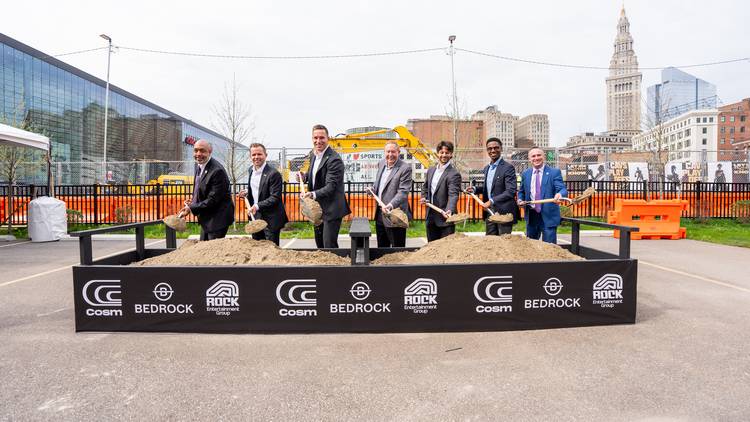
In April 2026, he joined the groundbreaking for Cosm’s Cleveland venue. The photograph is pleasingly literal: a chairman, civic leaders and partners holding shovels above a trough of soil. Whatever happens inside the dome, construction still begins with dirt. Winn stood alongside Terry and Cleveland’s public and business leadership, a new company becoming part of another city’s physical landscape.
Another significant partner arrived that June, when Sony Pictures Entertainment announced a $100 million investment in Cosm and a minority ownership stake. Sony’s Ravi Ahuja would join the board. By the announcement, Cosm had opened venues in Los Angeles, North Dallas and Atlanta. Entertainment rights, technology and buildings were being brought into the same expanding enterprise.
At the Cleveland ceremony, Winn offered a succinct version of the promise: “You won’t just be looking at the game, you’ll be in the game.” It is quite a distance from tax returns. Yet the route is traceable: buy a capability, connect it to others, and work out what people will pay to do with the combination. Little Buddy needed a second look. Steve Winn has made a long career out of taking one.